Matte Paint Breaks Every Rule of Car Paint (On Purpose)
Every rule of automotive paint says a car should shine. For a century, the deep mirror gloss of a well-painted body has meant quality, newness and care — a waxed car is a loved car, and the entire chemistry of a paint shop is built to make light bounce off the surface as cleanly as possible. Matte paint throws all of that away on purpose. It is harder to make, impossible to polish, punishing to repair, and can cost thousands more — and it has become one of the most desirable finishes in the industry. Understanding why is a lesson in what a finish is actually for.
Start with how badly matte breaks the practical rules. A matte finish is more fragile and more demanding than gloss in almost every way. You cannot simply buff out a scratch — polishing is precisely what creates shine, so the usual repair for a scuff would leave a glossy smear in a matte panel. Touch-up is near-impossible; a marked panel often has to be refinished entirely. It needs special products and careful washing to avoid burnishing the surface to an accidental sheen. And it is expensive: a matte repaint can run up to $7,000 against roughly $1,000 for gloss, a factory matte option adds thousands to the sticker, and bespoke hypercar matte can cost tens of thousands. By every conventional metric — durability, repairability, cost — matte is the worse choice.
And yet demand for it is climbing fast. Analysts describe a roughly 25% surge in matte and satin finishes, framed explicitly as "quiet luxury": understated, sophisticated, the opposite of flashy. Matte is now a factory option across luxury and performance brands rather than an aftermarket rebellion, and it is winning the industry's own prizes — PPG and BYD took a top award at the International CMF Design Awards for an effect finish on an electric super-coupe. Something is clearly worth all that hassle. The question is what.
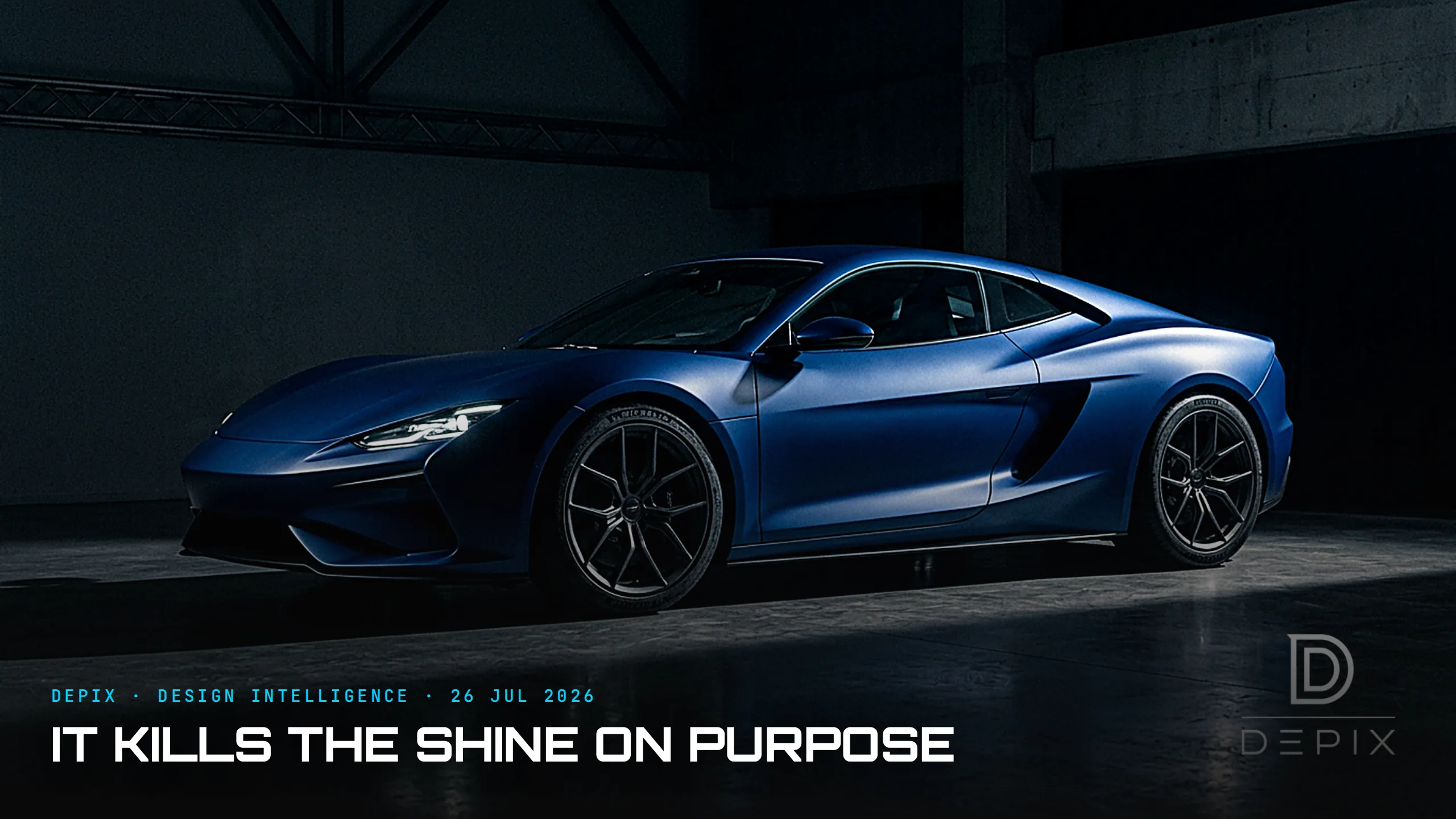
The answer is that a finish is not a neutral wrapper on a colour; it decides what your eye is allowed to see. Gloss works by reflecting the world — highlights, sky, the smear of passing lights — and those reflections are what read as "shiny and expensive," but they also sit on top of the shape, competing with it. Matte removes the reflections almost entirely, and with the highlights gone the eye has nothing to look at but the car's own surface and lines. The sculpture stops being interrupted by light and starts being read directly: the haunch over a wheel, the tension of a shoulder line, the way a roof flows into a tail. Matte does not hide the form; it is the only finish that fully shows it.
That reframes the whole trade-off. Everything that makes matte "worse" — no reflections to flatter the paint, no gloss to buff back, no forgiving shine to disguise a dent — is the same property that makes it read as confident. A matte car quietly announces that it does not need the world's reflections to look good; the form can carry it alone. It is conspicuous restraint, the CMF equivalent of an unbranded but perfectly cut coat. The fragility is part of the message: matte signals that someone chose beauty over convenience, on purpose.
For anyone designing a physical object, that is the transferable idea. Finish is not decoration applied at the end of a project; it is a decision about perception, and it belongs at the concept stage next to form and proportion. Gloss, satin and matte are not three levels of "shininess" — they are three different instructions to the viewer's eye about whether to look at the light or at the shape. Choose wrong and you waste the form you spent months resolving; choose right and an ordinary surface looks considered and a considered surface looks inevitable. The next wave of automotive CMF — self-healing matte clearcoats, satin-over-colour-shift, matte protective wraps — is really a race to keep matte's perceptual magic while softening its practical penalties. But the underlying lesson was true the moment the first designer killed the shine on purpose: decide what you want the eye to see, and choose the finish that points it there. The paint was never really about the paint.
Sources:
- ●Matte paint is a growing trend — is it worth it? — The Globe and Mail
- ●Trend of auto paint 2025: matte, eco & smart finishes — Accio
- ●Non-metallic car paint trends + CMF Design Awards — Accio
- ●The Truth About Matte Paint (2025) — Dr. Beasley's
- ●The Biggest Problems With Matte Paint — Jalopnik
- ●How to Maintain Matte Car Paint — HowStuffWorks
- ●Keeping Your Matte Car Paint in Good Condition — CarParts.com
- ●How to Care for Matte Car Paint — AAA
- ●Matte Car Paint: Is It Really Worth It? — Cloud10
- ●Matte Black Car Paint Pros and Cons — Dr. Beasley's
- ●Automotive paint — Wikipedia