The Cabin's Fifth Material Is Light
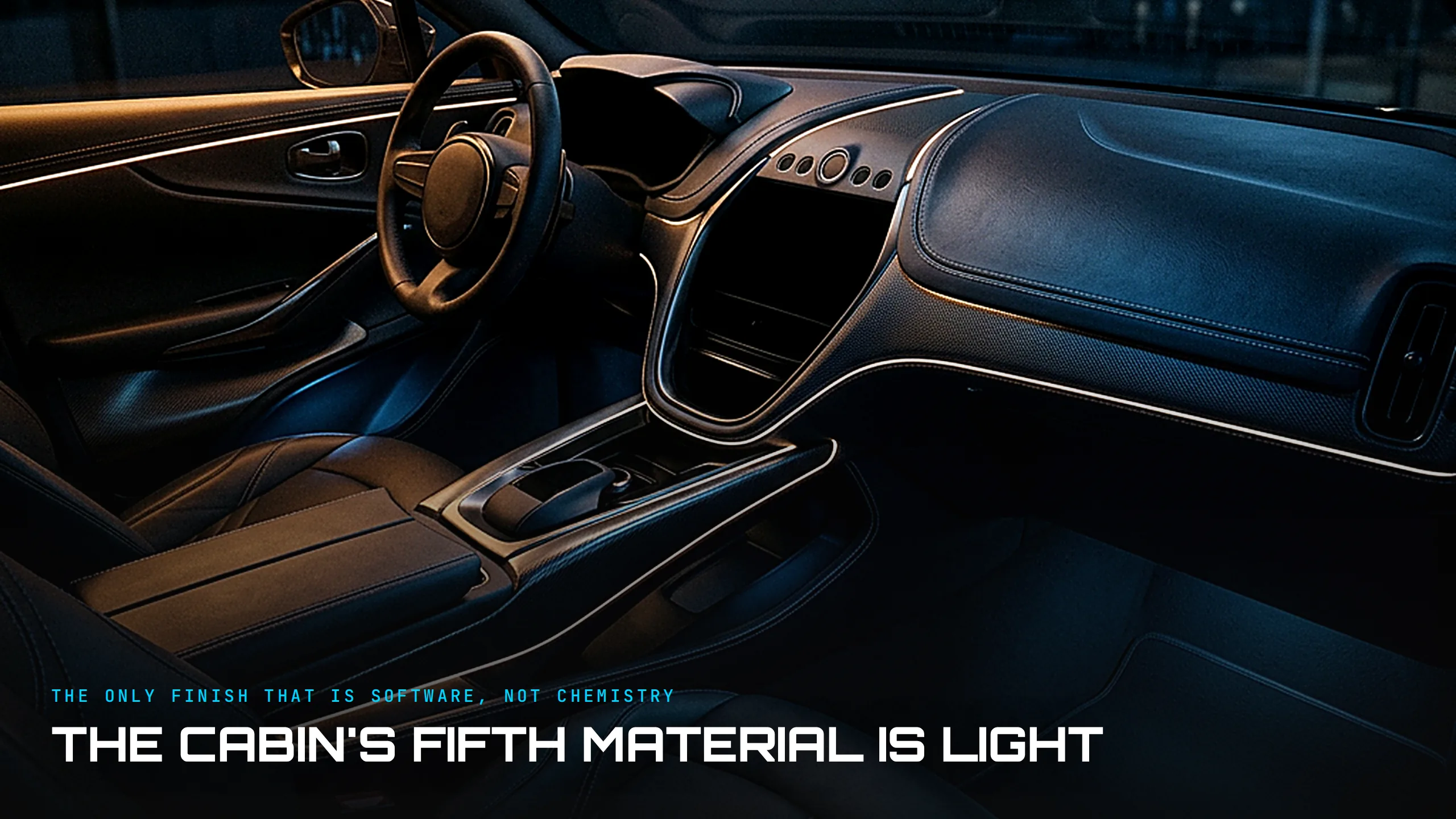
CMF — colour, material, finish — is how the industry describes what an interior is made of. But climb into a modern cabin at night and the thing setting the entire mood is none of the three. It is light: a thin line of it tracing the dashboard, a wash spilling down the door, a glow breathing under the seats. Over the last decade the number of interior light sources has climbed relentlessly, from a single footwell bulb to strips strewn across the dash, console, doors and even the seatbelt buckles. Mercedes' flagship cabins now run three zones and hundreds of individually addressable LEDs across 64 colours, tunable right down to the mood you want to sit in. Light has quietly become the cabin's fifth material.
Here is what makes it different from the other three: colour, material and finish are fixed the moment the car is built, but light is the only element of the interior you can reprogram at will — warm amber to unwind, cool blue to focus, a red pulse in sport mode — and increasingly update over the air after you have bought the car. It is a finish made of code, not chemistry — the only layer of the interior that can change its mind after it leaves the factory. That is why 2026 coverage now talks about the cabin's "mood engine" and calls intelligent lighting the car's new language. One material in the cabin is now dynamic — and it is the one that touches how the space feels most directly.
It is easy to dismiss all this as disco for the driveway. The research says otherwise, and unusually clearly. A landmark study by BMW and Ilmenau University found ambient lighting measurably improves perceived safety, spaciousness, interior attractiveness and — crucially — the perceived quality of the materials and design themselves. Warm, low colour temperatures increase the feeling of comfort while cooler ones sharpen alertness. In other words, light makes the very same leather and plastic read as more expensive. It is, in the most literal sense, a finish applied on top of the other finishes — one that changes how they are judged without physically touching them. The affective response to cabin colour is now studied in its own right.
And here is the counterintuitive part that separates good lighting design from bad: more is not better. The same research found a restrained sprinkle of light is as effective as a flood, and cranking the brightness does nothing for perceived quality — it merely produces glare and complaints of distraction. The luminance has to stay under a strict threshold to keep light from becoming a hazard. Ambient light is a material you can overuse into cheapness — the RGB-strip-in-the-footwell look — or wield with restraint into genuine calm. The line between "premium" and "boy racer" is a design decision about how much, not how bright.
This is the concept-phase lesson. A convincing light signature is not stuck on at the end; it is built into the structure. The glow has to emerge from somewhere hidden — light guides and pipes routed inside the trim, diffusers engineered into the door card, a channel tucked behind the dash topper. Where the light emerges, how evenly it washes a surface, whether you see the diode or only its effect — all of that is decided when the interior architecture is laid out, not when the car is optioned. Get it wrong early and you get hotspots and visible LEDs; get it right and light appears to seep from the material itself. BMW's faceted Crystalline Interaction Bar — simultaneously trim, control and light — only works because it was conceived as one integrated object from the first sketch.
So the acronym needs a fifth letter, or at least an asterisk. Colour, material, finish — and light, the finish that moves. It is the cheapest way to transform a cabin's entire mood, the only one that keeps updating after purchase, and the element modern buyers increasingly judge an interior by. The brands winning the cabin are not the ones with the most LEDs; they are the ones who decided, at the concept phase, exactly where light should live and how little of it to use. Everyone else is just leaving the disco on.
Sources:
- ●EVKX — Ambient Lighting (technology overview)
- ●CarBuzz — Cars With Ambient Lighting: A Quick Guide
- ●Mercedes-Benz of Scottsdale — How Do I Customize Ambient Lighting in My Mercedes-Benz?
- ●Joybuy — Car Interior Ambient Lighting: The Ultimate 2026 Guide
- ●YourLite — 2026 Smart Ambient Light Trends: The Rise of the 'Mood Engine'
- ●ADT.media — Automotive interior lighting: when light creates emotion
- ●ScienceDaily — Car lighting makeover impacts feel of safety and style (BMW / Ilmenau study)
- ●CarExpert — Ambient lighting: Beyond just looks
- ●arXiv — Affective responses to chromatic ambient light in a vehicle
- ●Preh — Ambient lighting for car interior: design and safety
- ●The Drive — Which Car Has the Best Ambient Lighting? (BMW Crystalline Interaction Bar)