The Return of the Button
For a decade, the physical control was quietly executed. A touchscreen is cheaper to build than a panel of switches, faster to change in software, and — crucially — it photographs as "modern." So interior teams stripped the switchgear out year by year, part of a long design trend away from physical controls, until whole dashboards became a single sheet of glass. The button did not lose on merit. It lost on cost and on fashion, which are not the same thing as quality.
Then the data caught up. Burying a simple task in menus pulls a driver's eyes off the road for as long as forty seconds, and from January 2026 Euro NCAP has made physical controls a condition of a five-star rating: a car that hides its indicators, hazards, wipers, horn or SOS behind a screen can no longer score top marks. Europe is, in effect, legislating the button back into the car, and because around ninety percent of European buyers check the safety rating before they buy, compliance is not optional. What taste took away, physics and regulation are handing back.
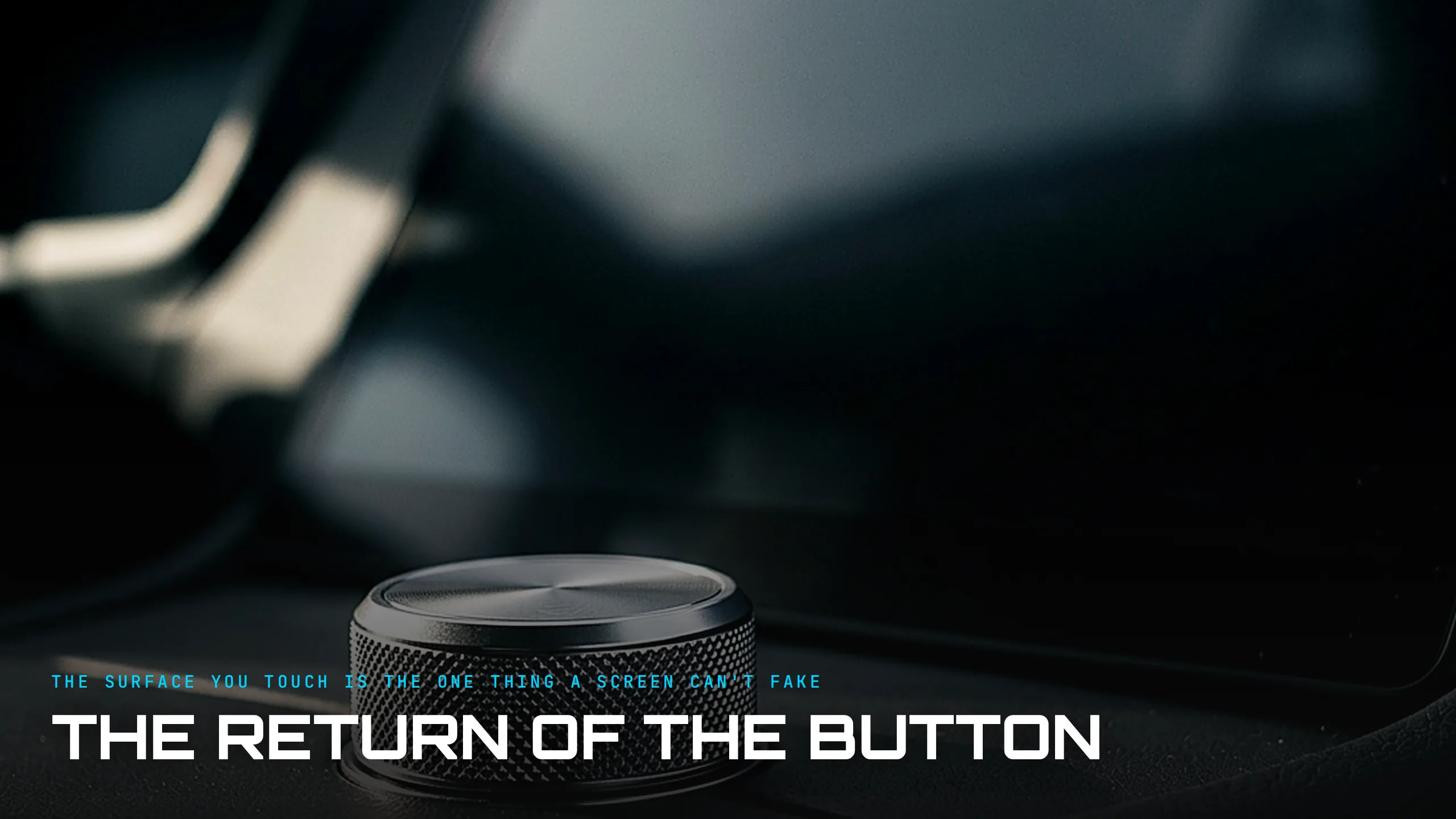
The makers who screened everything are now reversing hardest. Volkswagen's design boss put it bluntly — "it's a car, not a phone" — and the new ID. Polo brings back a knurled volume dial and a proper physical window-switch layout where frustrating touch-sliders used to be. Volkswagen has formally shifted back to physical buttons on its dashboards; Hyundai is deliberately keeping tactile controls for everyday essentials while reserving the big display for maps. Almost overnight, physical switchgear has become a genuine brand differentiator — the thing a driver notices in the first ten seconds inside.
Here is why this matters to anyone who designs surfaces. The control you touch is the hardest CMF problem in the whole car, and the one you cannot fake. A screen has no material truth: every button on it is the same flat, cold glass, and its "feel" is a marketing claim. A physical control has weight, temperature, a knurl your fingertip reads in the dark, and a detent that clicks with a specific, tuned resistance — so choosing to push or to touch is a materials-and-feel decision, not merely a question of layout. Audi keeps a team whose entire job is making every knob damp and click with the same consistency; Bentley sells diamond-knurled dials as jewellery. The resistance curve of a single rotary detent is tuned across dozens of prototypes until the click lands at exactly the right torque — an investment in feel that never appears in a press photograph but is the first thing a hand learns to trust. As one designer put it, the feedback of a knurled object or a well-made click "gets you to a place where you realise it's been beautifully assembled." That is the whole argument: felt quality is quality you cannot photograph, and cannot cheapen without the hand noticing.
The return, though, is neither nostalgia nor total, and pretending otherwise misreads it. The intelligent direction is a "premium haptic" hybrid: fewer, better physical controls for the things you operate blind — volume, temperature, hazards — beside screens that fight back with real haptic feedback, touch surfaces engineered to mimic a detent so a tap feels like a press. The button is not simply beating the screen; the two are being sorted by which one your hand needs when your eyes belong on the road. Designing that split well is far harder than deleting every switch, because it demands you know exactly which functions are muscle-memory and which are occasional.
And that sorting is a concept-phase decision, not a late one. Switchgear is the most-touched, most-remembered surface in the interior and the one most often value-engineered last, after the screen has already eaten the budget — which is exactly backwards. The feel of a car's primary controls is its tactile signature, and it has to be specified early, protected through every cost-down round, and treated as the brand's handshake with the driver. A knob decided in the final weeks to save a few euros will feel like it forever, in the one place the customer's hand returns to every single day. The button was never obsolete. We simply stopped valuing the one thing a screen can't do — and the moment safety forced us to look again, the craft was still there, waiting under our fingertips.
Sources:
- ●Carwow — Physical buttons beat touchscreens in Euro NCAP's new 2026 safety rules
- ●ETSC — Cars will need buttons, not just touchscreens, for a 5-star Euro NCAP rating
- ●The Autopian — Europe Is Requiring Physical Buttons For Cars To Get Top Safety Marks
- ●Motorbeam — Euro NCAP 2026: Cars Without Physical Buttons Lose Points
- ●Euro Weekly News — Europe's war on touchscreens: 2026 rules force carmakers to bring back buttons
- ●InsideEVs — VW Design Boss: 'It's A Car, Not A Phone' — buttons coming back
- ●Carscoops — VW ID. Polo interior brings back physical buttons and a volume dial
- ●Semafor — Volkswagen shifts back to physical buttons on dashboards
- ●S&P AutoTechInsight — Hyundai plans to retain physical buttons in next-gen interiors (2026)
- ●Autocar — Why physical buttons are poised to become a key brand differentiator
- ●CarExpert — Interior controls: to push or to touch?
- ●TechRadar — Future cars could ditch touchscreens and bring back buttons, for safety
- ●FormTrends — Interior Trends: Reduction in Switchgear