Your New Design Team Is a Network of Agents
For most of the last two years, the conversation around AI in design has been stuck on a single question: what's the best model? The answer kept changing, but the framing didn't. One model. One prompt. One output. Iterate until it's close enough, then move on.
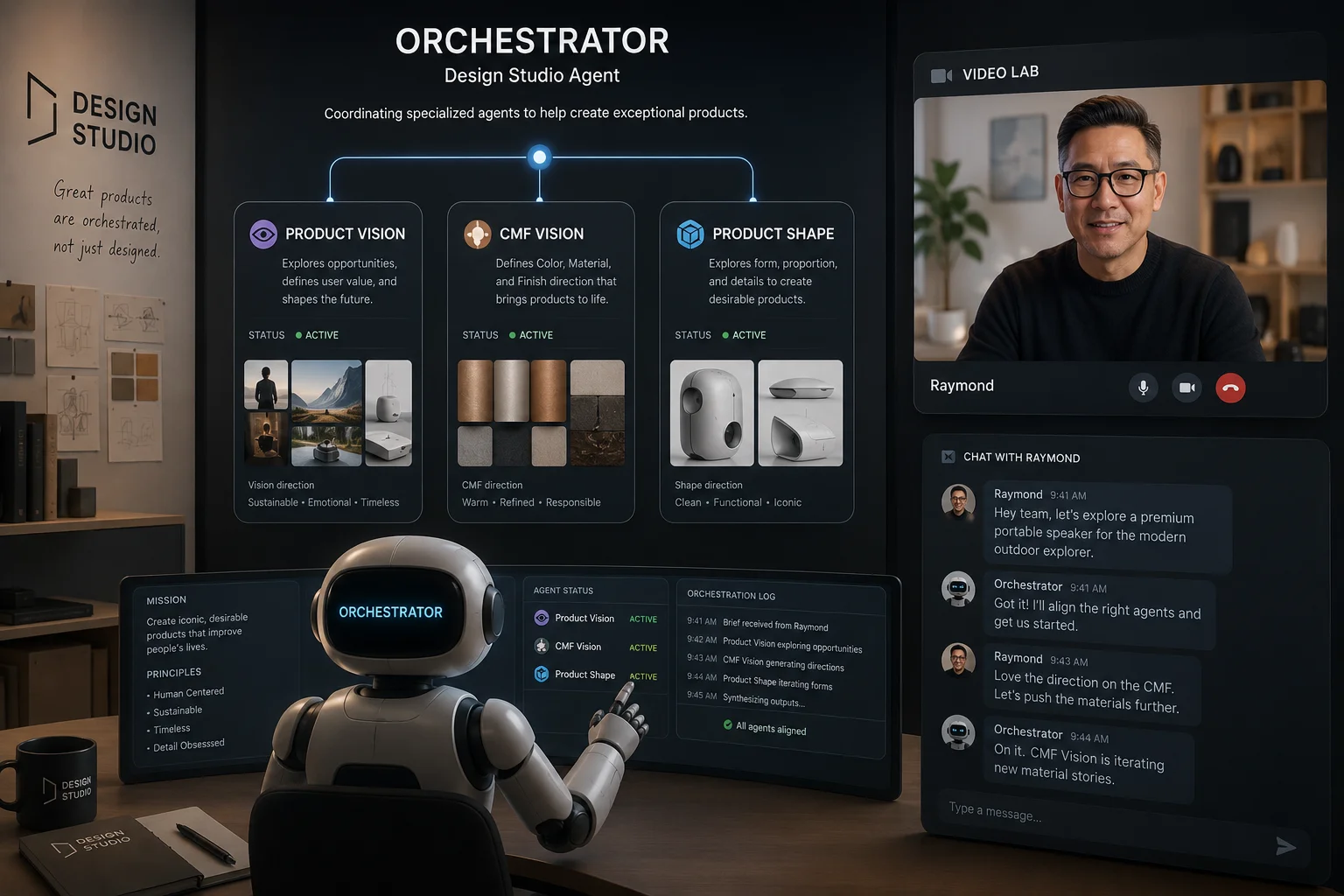
That framing is already obsolete. The teams shipping the most interesting work right now aren't asking which model is best — they're asking which team of agents is best. And like any good team, the magic isn't in any individual member. It's in the orchestrator that knows when to call on whom.
The orchestrator: a creative director, not a chatbot
Think of the orchestrator as the lead on a project. It doesn't draw, it doesn't render, it doesn't write copy. What it does is hold the brief in its head, break the work into the right kind of tasks, and route each piece to the specialist that will handle it best. It keeps the project coherent across every output, remembers decisions you made three steps ago, and pushes the work forward without losing the thread.
The shift here matters. When you talk to a single general-purpose model, you are the orchestrator — you're the one stitching outputs together, remembering context, deciding what comes next. When you work with a proper orchestrator, that cognitive load lifts. You brief once. The orchestrator delegates.
And here's the part that changes how studios actually plan their work: these agents aren't a replacement for your team. They're additional resources sitting alongside your designers, available the moment you need them and quiet when you don't. Need a CMF specialist for a project but don't have one on staff? Plug one in for the duration. Pipeline suddenly stacked with three deliverables and a team built for two? Hand the overflow to the agents and keep your designers on the work only they can do. You're not hiring. You're not training. You're not carrying the headcount between projects. You're extending the capabilities your studio offers, on demand, without changing the shape of your team.
Below are five of the specialist agents that, in our experience, change what's possible when an orchestrator can call on them.
The concept image agent
The first agent in the lineup is a generative image model tuned specifically for design concepts — not stock photos, not anime portraits, not marketing renders. Design concepts. It understands form language, silhouette, proportion, the difference between a sketch that reads "early exploration" and one that reads "near-final direction."
A generic image model will give you a beautiful object. A concept-tuned agent will give you twelve variants of the same object that all feel like they came from the same studio, in the same week, exploring the same hypothesis. That difference — coherence across a set rather than quality of a single hero shot — is what designers actually need when they're trying to find a direction.
The orchestrator knows when to reach for this agent: early in a project, when divergence matters more than polish.
The CMF agent
CMF — colors, materials, and finishes — is the layer of design where products win or lose in the real world. It's also the layer where general-purpose models fall apart fastest. Ask a generic model for "brushed aluminum with a soft-touch coating in warm grey" and you'll get something that looks like brushed aluminum the way a stock photo of food looks like dinner. Technically correct. Spiritually wrong.
A CMF-tuned agent has been trained on the actual vocabulary and visual reality of materials: how anodized finishes catch light differently from PVD coatings, why a 70 Shore A elastomer reads differently than an 80, what "warm cool grey" actually means when you're standing in a meeting room arguing about Pantone chips.
When the orchestrator hands work to the CMF agent, it's not asking for a pretty picture. It's asking for a credible material story that a manufacturing partner could actually source.
The highlight-line agent
If CMF is where designs win in the real world, surface quality is where they win in the studio. Highlight lines — the reflections that trace across a 3D model and reveal exactly how light flows over a form — are the unforgiving truth-teller of industrial design. A surface can look right in a render and fall apart the moment you turn on zebra stripes.
A highlight-line agent is tuned to read and modify these reflections directly. Pull a highlight tighter across a shoulder. Soften it where it kinks. Move the catch line on a fender so the eye lands a centimeter higher. These are the moves a senior surface designer makes by instinct, and they're exactly the moves a general-purpose model has no language for.
The orchestrator calls this agent when a form is almost right — when the silhouette is locked, the proportions are committed, and what's left is the millimeter-level surfacing work that separates a competent product from one that feels resolved. It's the agent that protects the design from looking close-but-not-quite when it ships.
The video agent
Stills are necessary but increasingly insufficient. Stakeholders want to see things move, products in context, interfaces under the thumb. A video-generation agent tuned for design — controlled camera moves, consistent subjects across cuts, the kind of restraint that makes a product film feel like a product film and not a fever dream — fills a gap that almost no design workflow currently has a good answer for.
The orchestrator uses this agent at moments where motion adds information: showing how a hinge actually opens, how a UI flows between states, how a product sits in the rhythm of someone's morning. It's not about replacing your film team. It's about getting a watchable, sharable thirty seconds of motion onto a slide deck in the time it used to take to write the brief.
The sparring partner
This is the agent that makes the rest of it work, and the one most teams overlook.
Every good designer has a sparring partner — a senior who pushes them, a peer who calls out the easy choice, a critic who refuses to let "fine" pass for "good." That role is hard to staff, hard to schedule, and emotionally expensive even when you have it. A design-focused agent with a real point of view changes that equation.
This isn't a yes-machine. It's an agent tuned to argue, to ask the hard question, to notice when you've defaulted to a trope, to push you toward the version of the work you almost made. You bring it the concept, the CMF story, the video — and it tells you where the work is hiding. Sometimes you fight it and win. Sometimes you fight it and realize you were defending the wrong hill. Both are useful.
Working with a sparring agent feels different from working with a tool. It feels like collaborating with someone who cares about the work being good.
Why the orchestrator changes everything
Any one of these agents on its own is a productivity boost. The five of them together, routed by an orchestrator that understands the shape of a design project, is something else entirely. It's the difference between owning a power drill and running a workshop — except the workshop scales up when a project demands it and goes quiet when it doesn't.
The orchestrator decides when to diverge and when to converge. It hands the concept agent's best output to the CMF agent for a material study. It hands the CMF-defined object to the video agent for motion. It hands the whole package to the sparring agent and asks, honestly, where this is weak. Then it brings the critique back to you with options.
You stop being a prompt engineer. You go back to being a designer with a team — your team, now with extra hands on the bench for the capabilities you don't staff for and the projects you couldn't otherwise take on.
Where this is going
The single-model era was useful — it taught us what was possible. The orchestrated-agent era is what makes it shippable. Specialists working together, coordinated by something that holds the whole project in its head, freeing you to do the part of design that was always going to be yours: deciding what the work should mean.
That's the part no agent will ever take from you. The orchestrator just makes sure nothing gets in the way of you doing it well.

Stop upskilling. Start unlearning.

KeyShot vs Vizcom vs Depix: Which AI Visualization Tool Is Best for Product Design Teams?