Why Metal Feels Expensive
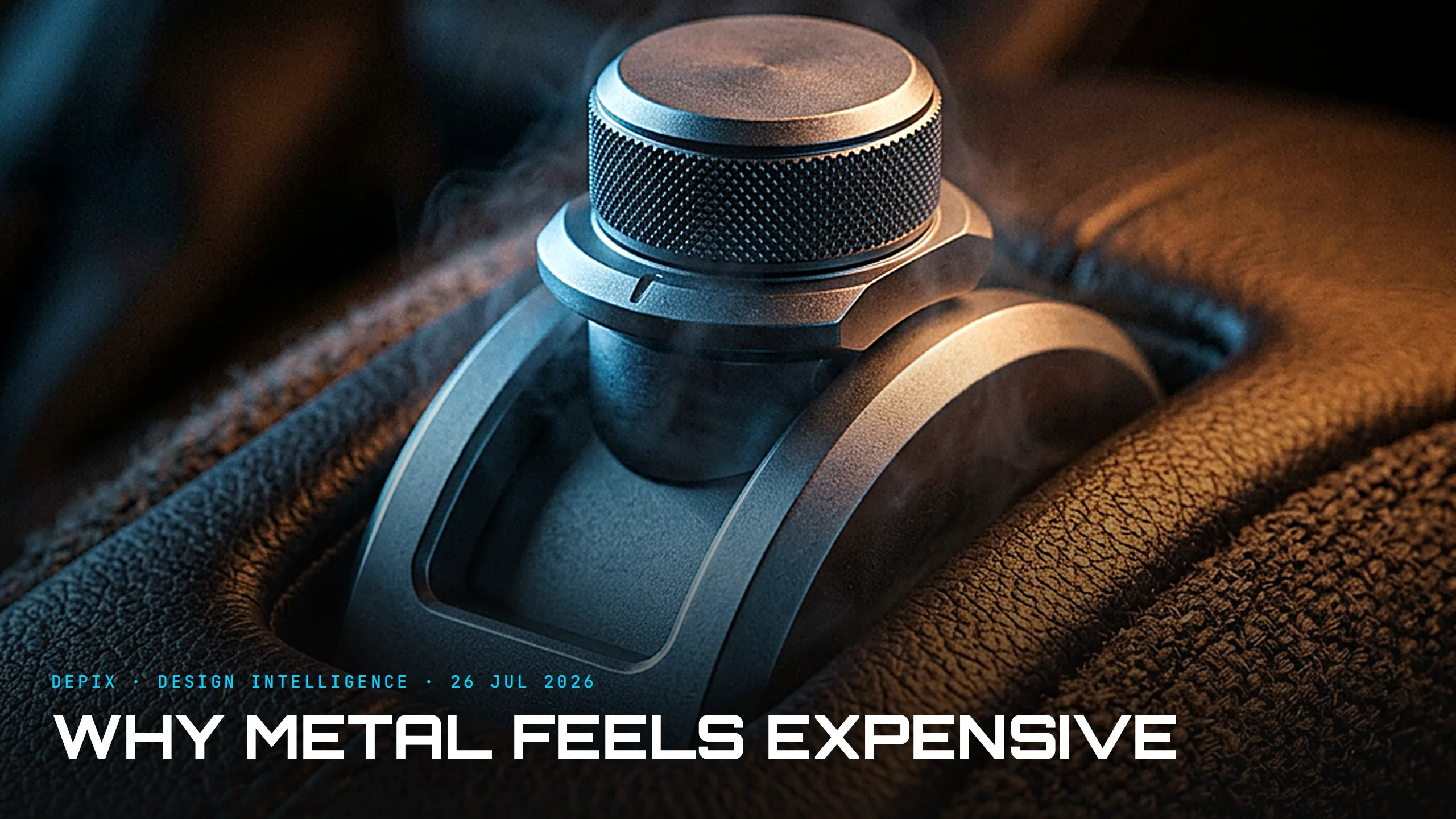
Pick up a metal gearshift, then a plastic one. The metal feels cold, dense, precise — expensive. The plastic feels warm, hollow — cheap. Here is the strange part: leave them both in the same room overnight and they are the exact same temperature. What your hand feels is not temperature at all. It is how fast the material pulls heat out of your skin — a property called thermal effusivity, and it is a CMF decision you have judged a thousand times and never once named.
The physics is simple and ruthless. Thermal effusivity measures how readily a material exchanges heat on contact — roughly, a combination of thermal conductivity and heat capacity. Metals like aluminium and steel have high effusivity: they yank warmth from your fingertip fast, so the nerves report "cold," even at room temperature. Wood, foam, textile and soft-touch plastics have low effusivity: they barely draw heat, so they read "warm." Your skin never measures temperature — it measures heat flow, and the brain translates that flow into a material identity before you have consciously registered anything. It is one of the most reliable cues we have for telling one substance from another in the dark.
Here is what designers exploit without naming it: thermal feel is a status signal. Cold, high-effusivity metal reads engineered, dense, precise, real — which is why the gearshift, the volume knob, the door pull, the paddle shifter are metal or are desperately engineered to feel like it. Warm, low-effusivity materials read cosy, safe, considered — which is why the armrest, the seat, the surfaces you rest against are soft. And the flash of disappointment when a "brushed-metal" trim turns out to be warm plastic is a thermal mismatch: your eye said metal, your hand said cheap, and the hand won. Thermal feel is the lie-detector for materials — the sense a spec sheet can fake to the eye but not to the fingertip.
The electric car is turning this hidden property into a live battleground. In a combustion car, cabin warmth was free — waste heat from the engine. In an EV, every degree of heating costs range, so the whole approach is inverting: instead of heating the air, heat the surfaces you touch. Gentherm turns door panels and armrests into sources of warmth with conductive and radiant elements; surface heating is being called the key to efficient EV interior comfort; suppliers like Antolin are building intelligent thermal-comfort systems tuned for energy efficiency. Thermal feel has just gone from a passive property of what a material is to an active, designed, on-demand experience — and an energy decision at the same time. A surface can now choose the temperature it reports to your hand.
This is the concept-phase lesson, and it is a hard one because it is invisible. Thermal feel is decided by material choice — the effusivity is baked into what you pick, in the earliest material selection, and you cannot bolt "premium cold" or "reassuring warmth" onto the wrong substrate later. It is the sense nobody sets out to design and everybody judges by. Get it right and a cabin feels expensive in a way the owner can never quite articulate; get it wrong and something feels "off" that no amount of colour or stitching can fix.
What comes next makes the axis explicit. Actively thermally-tuned surfaces will let a car warm the wheel and the shifter before you reach them and cool the console on a hot day; phase-change materials will buffer the shock of a sun-baked seat; and "thermal branding" — a marque's signature warmth, as deliberately tuned as its signature colour — is a logical next step once heat becomes a controllable surface property rather than a fixed one.
Colour is seen. Texture is touched. But temperature is felt — and it is the one channel in CMF that runs below conscious notice while quietly delivering the verdict of expensive or cheap. Your hand runs a thermal test on every surface it meets and reports back before your eye has finished looking. Design intelligence is knowing that test is always running, and deciding what its answer will be — at the concept phase, in the material, long before anyone can feel the mistake.
Sources:
- ●Wikipedia — Thermal effusivity
- ●Infinita Lab — Thermal Effusivity Measurement & Testing
- ●tec-science — Why does metal feel colder than wood (human thermal response)
- ●Make It From Metal — Why Metal Feels Cold to the Touch and How to Change That
- ●PMC — Material recognition based on thermal cues: mechanisms and applications
- ●Cantor's Paradise — Why Metals Feel Colder Than Wood
- ●Alibaba Insights — Why Does Metal Feel Cold: The Science Behind Temperature Perception
- ●C-Therm — Thermal Conductivity of Automotive & Electric Vehicles
- ●Gentherm — Climate & Comfort (surface heating)
- ●Automotive Interiors World — Surface heating holds key to efficient EV interior comfort
- ●Antolin — Intelligent thermal comfort system for electric vehicles