Why Every Car Is Grey
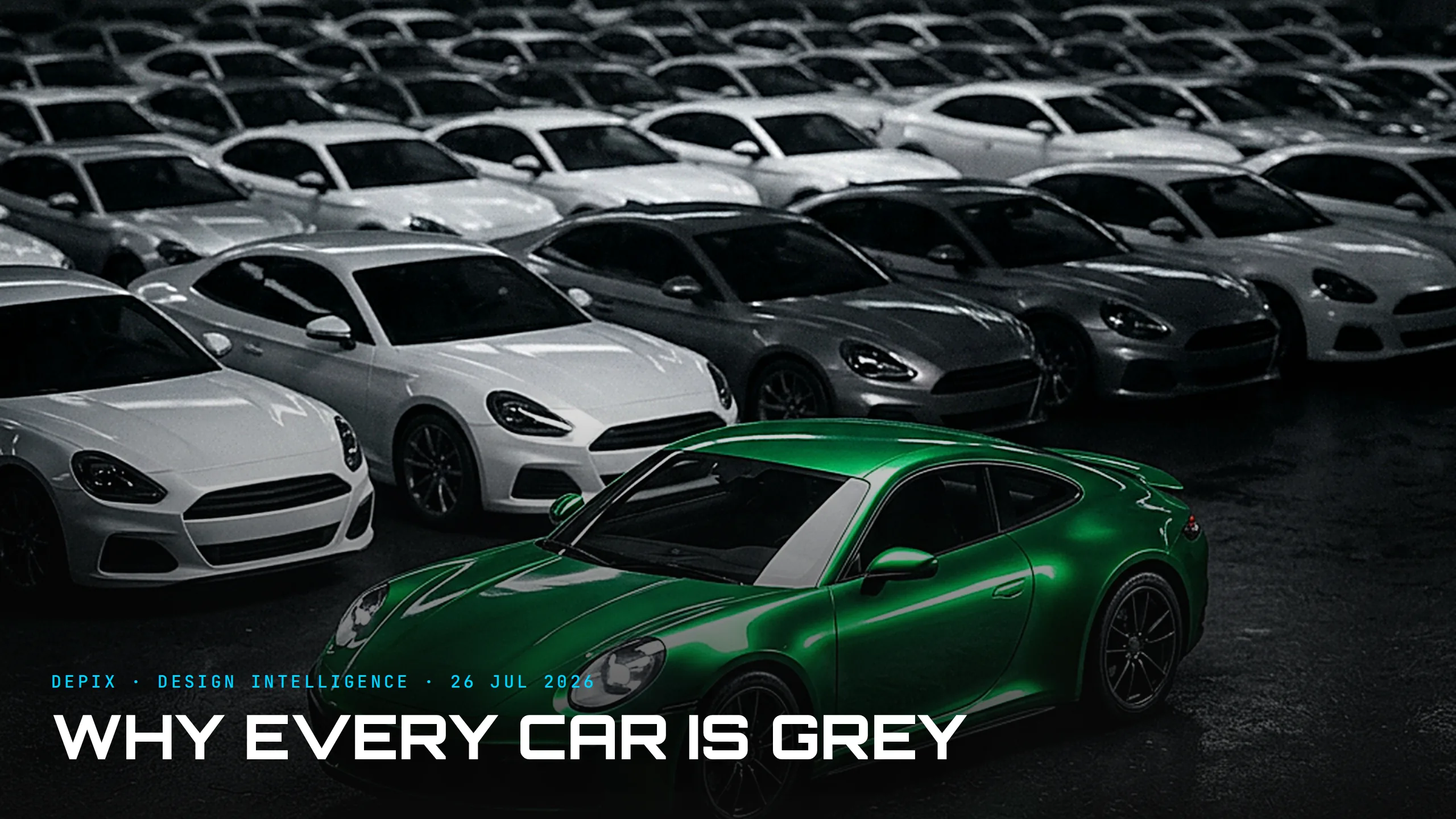
A century ago the car was the most colourful object in the driveway. Today it is the least. According to Axalta's 2025 Global Automotive Colour Popularity Report, neutrals — white, black and grey — account for roughly 74% of the world's cars: white leads at 29%, black 23%, grey 22%, silver another 7%. The single strongest chromatic colour, blue, musters just 6%. The car has quietly gone greyscale, and it is worth asking who actually chose that.
Because you probably didn't. Colour died for three reasons, and taste was the smallest of them. The first is resale. Bold colours are widely believed to hurt resale value while neutrals hold their money and sell faster — a car in white, black or grey is easier to move because it is harder to date across a crowded lot. Resale studies and dealer wisdom both reinforce it. As the car became a financial instrument — leased, cycled every three years, valued as a depreciating asset — colour stopped being expression and became risk. Fleets, lessors and dealers order the safe neutrals, and the private buyer inherits a lot that is already 74% greyscale.
The second reason is the screen. A decade of minimalist phones, matte-black gadgets and greyscale interfaces taught a whole culture that "premium" and "modern" look like the absence of colour. The third is the loop the first two create: grey sells because grey is what is on the lot, and grey is on the lot because grey sells. It is a self-fulfilling palette. As PCI Magazine and the bodyshop trade press note year after year, the movement is glacial precisely because everyone is de-risking against everyone else. The visible result is a public realm drained of colour: a car park in 2005 was a scatter of reds, greens and golds; a car park today is a gradient of grey. Every buyer optimised their own resale, and collectively they made the whole street duller — a textbook case of individually rational choices producing a colourless commons.
Here is the contrarian turn. The industry did not simply delete colour — it deleted it from the standard palette and then sold it back as a luxury good. Porsche's Paint to Sample charges roughly $11,000–$14,000 for a pre-approved colour outside the standard range, and Paint to Sample Plus — a genuinely bespoke shade — runs past $30,000, with feasibility testing that can take up to eleven months. Porsche has expanded the programme to over 190 historic and custom colours, and rivals run their own bespoke ateliers; it has become a statement of exclusivity. Read that sequence carefully: colour was standard, the industry de-risked it out of the catalogue, and now charges five figures to give it back. Scarcity was manufactured, then monetised.
This is a concept-phase story about emotional equity. A brand's palette is decided years before launch, and when a maker defaults to neutral to protect inventory, it does not just paint fewer cars in colour — it trains its whole market to read colour as a gamble. That timidity compounds. Ceding the palette to greyscale is ceding emotional territory a brand can't easily reclaim later, because colour is not a trim option bolted on at the end; it is part of what the car means from the first sketch.
The encouraging news is that the tide is turning. Axalta's own data notes rising interest in finishes with greater depth, movement and individuality, and the chromatic share has ticked up around two points, with North America leading — blue at 10%, red at 7%. BASF has named green and warm, emotionally resonant tones as the direction of travel, forecasting warm neutrals, mauves and browns that expand the definition of neutral rather than surrendering to it. And the structural fix is coming: digital, on-demand, paint-to-sample-style production decouples colour from inventory risk — configure it, build it to order, and nothing colourful ever sits unsold on a lot. When colour stops carrying inventory risk, the entire economic argument for greyscale evaporates.
Colour, in other words, did not die of natural causes. It was de-risked out of the standard palette and sold back as a luxury. The concept-phase lesson is that a palette is a bet on how brave your buyer is allowed to be — and the makers who win the next decade will be the ones who make colour feel like confidence again, not a $30,000 gamble. Design intelligence is recognising that a market's timidity is manufactured, and therefore reversible.
Sources:
- ●Axalta — 2025 Global Automotive Color Popularity Report
- ●European Coatings — Axalta report: white remains top choice
- ●FAPCO — How Auto Paint Affects Resale Value
- ●iSeeCars — Most Popular Car Colors Study
- ●TopSpeed — The Unusual Car Color That Increases Resale Value
- ●PCI Magazine — Axalta Releases 2025 Global Automotive Color Popularity Report
- ●BodyShop Magazine — Most popular car colour revealed in Axalta report
- ●CarBuzz — Here's Why Porsche's Paint To Sample Costs So Much
- ●Porsche Newsroom — Paint to Sample program expands
- ●Motor Illustrated — Porsche's Paint To Sample: Colourful Exclusivity
- ●Axalta IR — 2025 Global Automotive Color Popularity Report (detail)
- ●BASF — Green and gray redefine the 2025 automotive color landscape
- ●PCI Magazine — BASF Coatings Releases 2025-2026 Automotive Color Trends
Design Intelligence Daily — 26 July 2026
Sustainable Car Interiors Have a Desire Problem