The Wassily Chair Was Stolen From a Bicycle
Design history loves an origin myth, and Marcel Breuer's is one of the best: a twenty-three-year-old at the Bauhaus stares at his bicycle, notices the handlebars, and invents the tubular-steel chair. The story is true in its facts and wrong in its emphasis. Breuer did not invent anything. He committed a much smarter act — he recognised that the hard problem had already been solved in another industry, and he carried the solution across the border.
The object is the B3 club chair, designed in 1925 and later nicknamed the "Wassily" after the painter Wassily Kandinsky, a Bauhaus colleague who admired it. Breuer, newly put in charge of the school's cabinet-making workshop, was chasing a modern chair: light, hygienic, mass-producible, stripped of upholstered bulk. The breakthrough came not from the furniture world but from the one he pedalled to work. He rode an Adler bicycle and became fascinated by its frame — bent steel tube that was strong, springy, cheap and already made by the thousand. He later described the handlebars as "steel tubes like macaroni".
The crucial move is what he did next. Instead of trying to develop a new furniture material, Breuer went straight to the people who already made the old one: the steelworks Mannesmann. The Mannesmann brothers had patented a process for seamless rolled steel tube back in 1885 and industrialised cold-drawn tubing in the 1890s — decades of refinement, paid for by the bicycle and plumbing trades. By the time Breuer arrived, the material was mature, consistent and cheap. He was not inventing a technology; he was importing one.
That distinction shaped every detail of the design. Because the tube could be bent without weld points, the frame could be chromed in pieces and bolted together, giving the chair its floating quality — leather or fabric straps slung across a continuous metal line, as if someone had sketched a club chair in the air. The heavy, stuffed bourgeois armchair was reduced to its diagram. Critics found it shocking precisely because it looked like plumbing or a machine part, not furniture. But the "radical new material" was radical only in its context; in its home industry it was ordinary.
Breuer then did the unglamorous work that turns a prototype into a product. He founded a company, Standard Möbel, in 1926–27 to manufacture the designs, and by 1928 had signed a tubular-steel furniture agreement with Thonet, the bentwood giant, which absorbed Standard Möbel a year later. Thonet already understood industrial furniture at scale — another mature capability borrowed rather than built — and its distribution turned a Bauhaus experiment into a catalogue programme. Within a year of the first chair, designers across Europe were bending tube; the whole modernist romance with "industrial materials in the home" was, underneath, a romance with processes lifted from other industries. Bentwood had been Thonet's own borrowed trick a lifetime earlier — steam-bending, taken from shipbuilding and craft joinery and pushed into industrial mass production — so the chair sat at the meeting point of two separate acts of technological transfer, one century apart.
None of this diminishes Breuer; it sharpens what he was actually good at. His genius was not material science but recognition — the ability to look at a bicycle and see a chair, to look at a plumbing supplier and see a furniture factory. He is remembered, rightly, as one of the century's defining designers, and the thing he defined was a method as much as a form: raid the industrial world for something already de-risked, and apply it where no one else thought to look.
That is the concept-phase lesson worth stealing in turn. Teams under pressure to innovate often assume they must invent — a new material, a new mechanism, a new process — and invention is slow, expensive and risky. The faster, more reliable move is lateral: scan adjacent industries for a mature technology someone else has already spent decades perfecting and cheapening, then be the first to carry it across. Bent steel tube did not need to be discovered in 1925; it needed to be noticed. The most valuable question at the start of a project is rarely "what can we invent?" It is "what has already been solved next door, and what would happen if we brought it here?" Breuer answered it on a bicycle, and we have been sitting in the answer for a hundred years.
Sources:
- ●Club Chair (B3) — Harvard Art Museums
- ●Marcel Breuer, biography — The Art Story
- ●Breuer's armchair inspired by his bicycle's handlebars — Domus
- ●How the Classic Wassily Chair Was Inspired by a Bicycle — CNBC
- ●Focus on the "Wassily" club chair of Marcel Breuer — Centre Pompidou
- ●Marcel Breuer and Thonet — Thonet
- ●Thonet and tubular steel — Thonet
- ●The Time Marcel Breuer Broke the Rules — Robb Report
- ●Wassily Chair — Wikipedia
- ●Mannesmann (seamless steel tube, 1885) — Wikipedia
- ●Marcel Breuer — Wikipedia

The Trinitron Was a Forty-Year Bet on One Idea
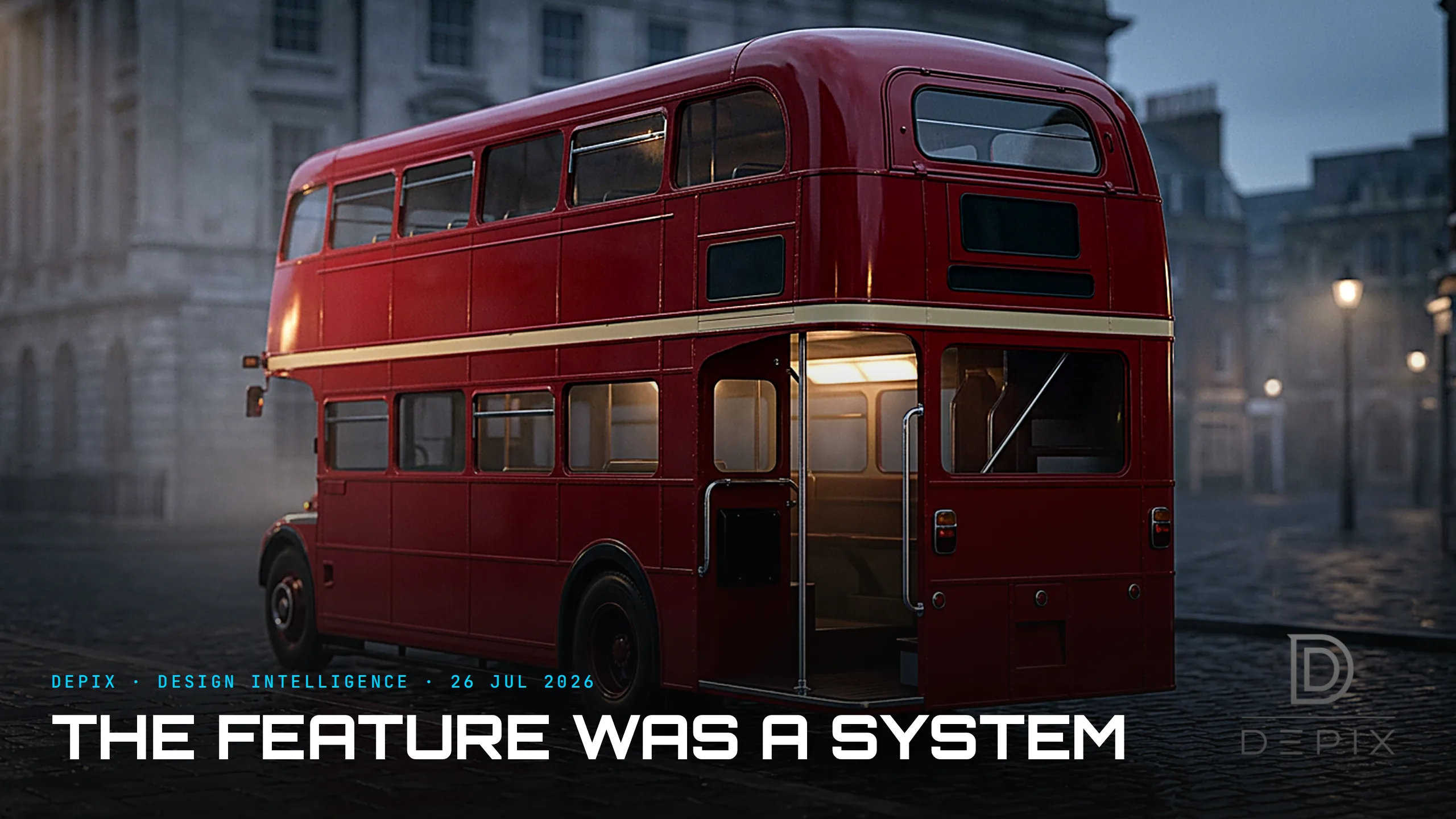
The Routemaster: London Loved a System, Not a Shape