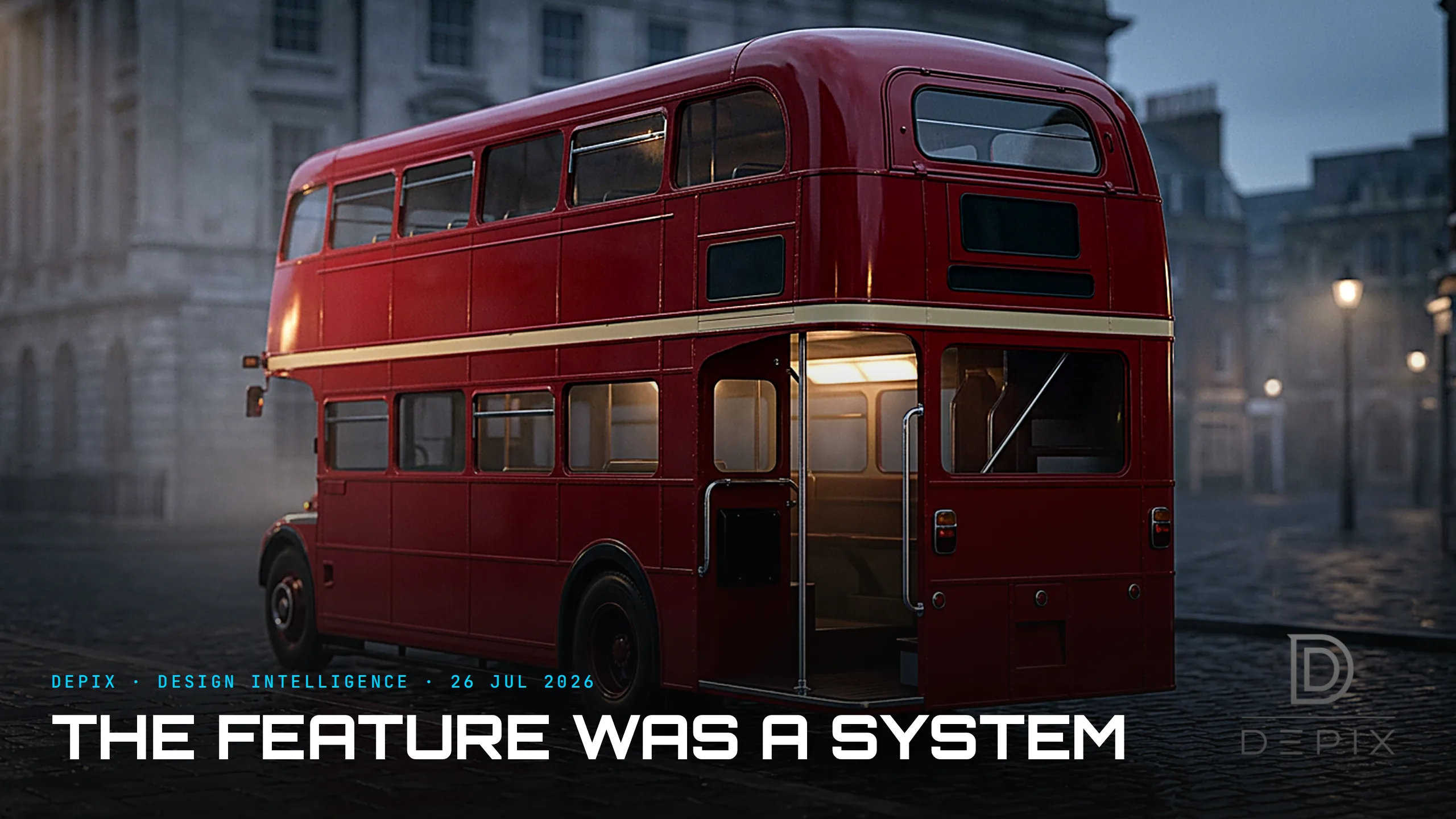
The Routemaster: London Loved a System, Not a Shape
There is a specific feeling people mean when they say they miss the old Routemaster: stepping onto an open rear platform at a red light, nodding to a conductor, hopping off between stops. London mourned that feeling so loudly that a mayor was later elected partly on a promise to bring it back. But the feeling was never a shape anyone could redraw. It was a system — a bus, a conductor and a fare model designed as one thing — and separating those two ideas is the entire design lesson.
The original AEC Routemaster, in regular London service from 1959, is remembered for its silhouette. Underneath it was quietly radical integrated engineering: a chassisless, aircraft-inspired aluminium structure with bolt-on front and rear sub-frames, independent front suspension, power steering and an automatic gearbox — lighter than the bus it replaced while carrying more people. Its interior and livery were resolved by the industrial designer Douglas Scott), whose reds, moulded seats and warm interior became the template for what a London bus should feel like.
But the beloved part — the hop-on, hop-off platform — only worked because of a person. A conductor moving through the bus took fares while it was in motion, so the rear platform could stay open and passengers could board and alight almost anywhere. The thing that felt like freedom, the quality writers still use to explain what a London bus route means, was actually a staffing decision. It bought speed and human contact at the price of a second wage on every vehicle.
Its longevity was a system too. London Transport designed the bus to be routinely overhauled at Aldenham Works, where vehicles were stripped to components every few years and rebuilt effectively as new, their interchangeable body units and sub-frames swapped across the fleet. The Routemaster did not last half a century because the metal was magic; it lasted because an entire industrial process existed to keep resurrecting it. When that process became uneconomic, the durability quietly went with it.
Both systems eventually lost to arithmetic. The conductor was the first casualty — a whole-fleet wage the network could no longer justify — and the last originals were withdrawn in December 2005 on route 159, replaced by accessible, one-person-operated buses. Even admirers conceded the open platform excluded wheelchair users and cost too much to staff. Ken Livingstone, who presided over the withdrawal, had earlier joked that only "some sort of ghastly dehumanised moron" would want to get rid of Routemasters — then did exactly that, because the economics no longer closed.
Which is what makes the sequel so instructive. In 2012 the New Routemaster, designed by Heatherwick Studio with manufacturer Wrightbus, deliberately reinstated the open rear platform as heritage — a form quotation, complete with a conductor to guard the open door. When it was unveiled it looked the part. Then reality reasserted itself: staffing that platform cost roughly what it always had, and by 2016 Transport for London had removed the conductors and permanently sealed the rear doors. Around 300 conductor jobs went; the hop-on bus became a bus you could not hop onto. The studio that designed it had recreated the gesture beautifully — but a gesture was all it could be, because only the shape had come back.
That is the trap worth naming at the concept phase. Users fall in love with experiences, and experiences are usually properties of a whole operating model — staffing, servicing, unit economics, the unglamorous machinery that never appears in a rendering. The Routemaster's open platform and its fifty-year lifespan were both system outputs. You can photograph a system output and reproduce the photograph in sheet metal, but you cannot reproduce the feeling without rebuilding the model beneath it — and if the model was killed for cost, the remake will be killed for the same cost.
For anyone designing at the concept stage, the discipline is to separate the two early: what will people actually love here, and is that a form I control on the drawing board or a system property I do not? If it is a system property, styling it back later is theatre — an open door that has to stay shut. The most honest thing the New Routemaster taught London is that nostalgia can commission a shape, but only economics can operate one. Design the system that produces the feeling, or stop promising the feeling.
Sources:
- ●AEC Routemaster — Wikipedia
- ●AEC Routemaster: aluminium integral construction — Kiddle
- ●Douglas Scott, industrial designer — Wikipedia)
- ●How the Routemaster Became a British Icon — Anglotopia
- ●What the Route 38 Bus Tells You About London — Ben Yeoh
- ●Aldenham Works (routine overhaul) — Wikipedia
- ●The Routemaster Double Decker Bus — Ambassatours
- ●New Routemaster project — Heatherwick Studio
- ●New Routemaster — Wikipedia
- ●Thomas Heatherwick — Wikipedia
- ●Wrightbus — Wikipedia
- ●New Routemaster bus unveiled in London — BBC News

The Wassily Chair Was Stolen From a Bicycle

The World's Safest Plug Assumes You're Careless