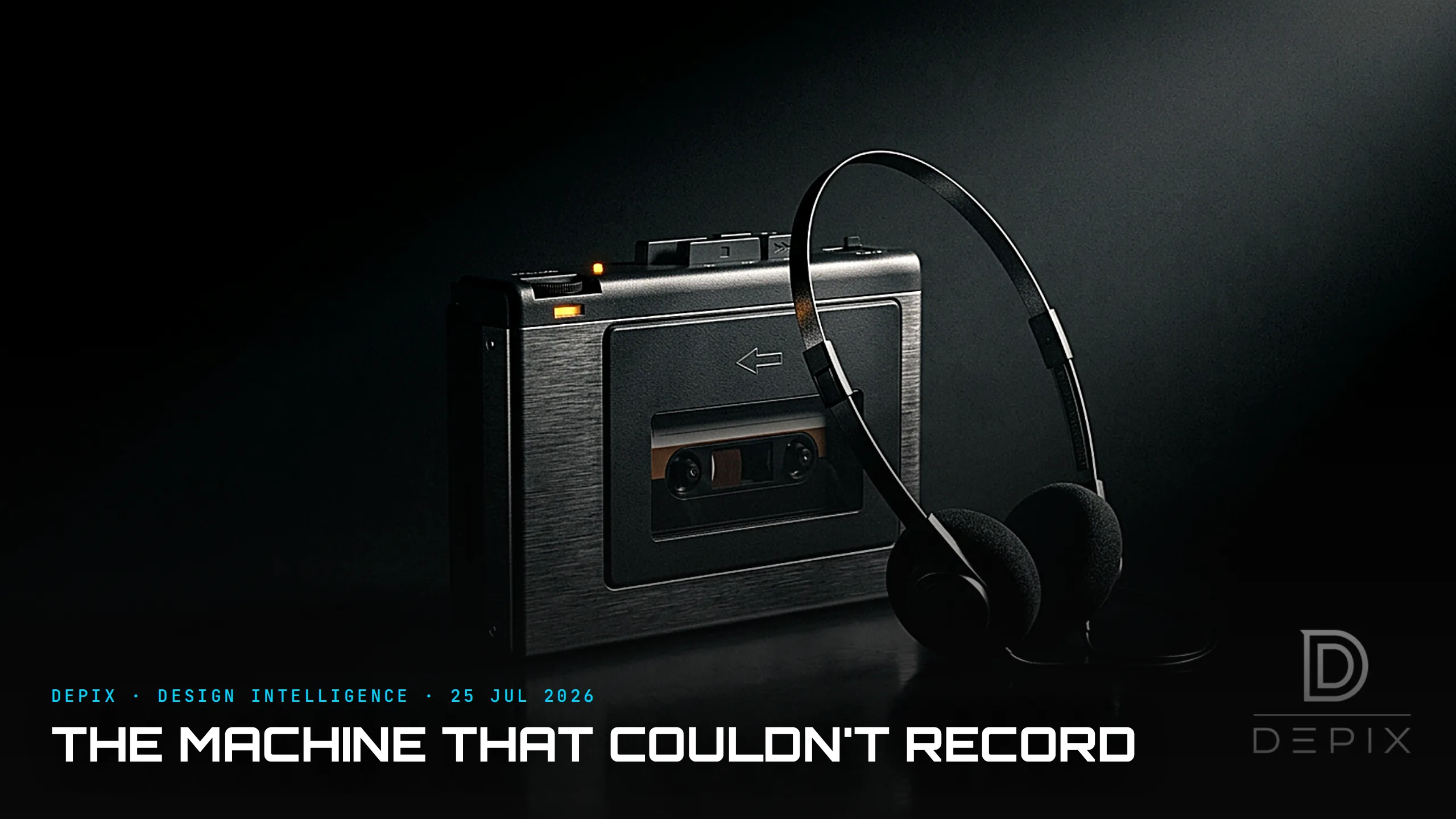
The Sony Walkman: The Machine That Couldn't Record
In 1979 Sony shipped a portable cassette machine that could not record. To the people who sold tape machines for a living, this bordered on nonsensical — recording was the whole point of a cassette recorder. Yet the Walkman went on to sell hundreds of millions and to change, quite literally, how the world listens. It won by removing the one feature everyone assumed a tape machine must have.
The idea did not come from a marketing brief. Sony's co-founder Masaru Ibuka travelled constantly and wanted to listen to opera on long flights without lugging a stereo. His partner, Akio Morita, saw something larger in the request: not a smaller recorder, but a device for private, personal listening while you moved through the world. Engineers took an existing product — the Pressman, a compact cassette recorder — and, in a matter of days, stripped it. Out came the record button, the erase head, the tape counter. In went stereo playback and a light pair of headphones. What remained was defined by what was missing.
This is the move worth dwelling on. Every other portable tape device of the era was designed by addition — more functions, more buttons, dictation and recording and playback all in one. Sony's designers did the opposite. They asked what the object was really for — one thing, listening — and then deleted everything that did not serve it, including the function that gave the whole category its name. The subtraction was not a cost-cut or a limitation; it was the entire concept. A recorder is a tool you point at the world to capture it. A Walkman is a membrane you place between yourself and the world to score it. Removing "record" is what turned one into the other.
Predictably, the people closest to the old category hated it. Sony's own sales staff were sceptical of a tape player that could not tape; the received wisdom was that no one would buy a crippled recorder. They were measuring the new object against the old definition. Morita overruled them and bet on a behaviour that did not yet exist. Sony expected to sell around five thousand a month; it sold more than thirty thousand in the first two months, and became one of the defining objects of its century — its silhouette starting the portable-media-player lineage that runs straight through the iPod to the phone in your pocket.
Here is the lesson we keep returning to at Depix, because it is the hardest kind of concept-phase decision to make. The instinct, always, is to define a product by what it DOES — the list of functions, the feature grid, the things you can print on the box. The Walkman was defined by what it deliberately would not do. That is a call you can only make at the very start, when you are choosing what the object is FOR, because by the time features are being built the category's assumptions have already hardened around you. Subtraction of a defining feature is almost impossible to reach by iteration; nobody refines their way to removing the main function. You have to decide it upfront, against the room, as an act of conviction about a use nobody has named yet.
And it created a behaviour, not just a product. Before the Walkman, listening to music was mostly shared and stationary — a room, a hi-fi, other people. After it, music became private, portable and personal; the sight of someone sealed off in headphones in public, so ordinary now, was genuinely strange in 1979. The decision to remove recording did not just make a smaller machine; it authored a new way of being in the world. Its place in industrial design history — the V&A keeps an original in its collection — rests on that: it is remembered not as a better recorder but as the birth of personal audio.
The Walkman is proof that the boldest thing you can do at the concept phase is sometimes to take away the feature everyone insists is essential. What looked like a machine with something missing was, in fact, a machine with nothing unnecessary — aimed at a use the rest of the industry had not yet learned to see. As one retro history of the device puts it, it was the sound of freedom — and it started with a deletion.
Sources:
- ●Sony — the company behind the Walkman
- ●Walkman — the playback-only personal stereo
- ●Masaru Ibuka — Sony co-founder, portable-opera idea
- ●Akio Morita — Sony co-founder who bet on the Walkman
- ●Compact Cassette
- ●Headphones
- ●Portable media player (the lineage the Walkman began)
- ●Music
- ●Industrial design
- ●Sony 'Stowaway' TPS-L2 personal stereo (V&A collection)
- ●1979: the Sony TPS-L2 Walkman changed music forever

The Vespa: Designed by Someone Who Hated Motorcycles

The Game Boy: The Worse Machine That Won