The Game Boy: The Worse Machine That Won
In 1989 Nintendo shipped a handheld that was, by every number on the box, worse than its rivals. The Game Boy had a tiny monochrome LCD — four shades of murky green — and a processor that was already old. Within two years it faced the Atari Lynx and the Sega Game Gear: both had backlit colour screens and far more powerful chips. On paper it was no contest. In the market it was no contest either — the other way. The Game Boy sold roughly 119 million units and stayed Nintendo's best-selling system for nearly two decades. The "better" machines became footnotes.
This was not luck; it was a philosophy, and it has a name. Its architect, Gunpei Yokoi, called it "lateral thinking with withered technology": take cheap, mature, thoroughly-understood components — technology that is "withered," well past the bleeding edge — and combine them with creative thinking about what the product is really for. Yokoi's conviction was that fun and utility do not require the newest silicon; they require the right decision about what matters. And for a thing you carry in your pocket and play on a train, what mattered was not colour. It was battery life, price, durability, and a great library of games.
Follow that logic and the whole product falls out of a single decision. A colour backlit screen in 1989 was a battery furnace: the Game Gear ran about three to five hours on six AA cells. The Game Boy, monochrome and unlit, ran around thirty on four. For a handheld — a device defined by being away from a wall socket — that is not a minor spec gap; it is the entire experience. A console that dies before your journey ends has failed at the one job its category exists to do. Yokoi looked at the trade-off everyone else resolved in favour of the spec sheet, and resolved it the other way, in favour of the use.
Here is the part worth taking to any design table, and the reason we keep coming back to it at Depix. The industry around Yokoi was locked in a specifications arms race — more colour, more power, more of the numbers you can print on a box. He refused to play, because he had done the harder, earlier work of identifying which single constraint actually governed his product. Once you know the real constraint, "worse" on every other axis becomes irrelevant, even advantageous: the withered 8-bit chip was cheaper, more reliable, easier to develop for, and sipped power. The decision that looked like a compromise was in fact the sharpest possible optimisation — of the right variable.
That is a concept-phase act, not an engineering one. By the time you are choosing components you have usually already lost this argument; the constraint hierarchy has to be set at the start, when you ask what the object is truly for and what it must never fail at. Most teams never do this explicitly. They inherit the industry's definition of "good" — the reigning spec race — and optimise inside it, shipping something slightly better than last year on the axes everyone already agreed to care about. Yokoi's move was to step outside that frame and pick a different variable to win on. As Nintendo's later history shows — the Wii and the Switch are the same philosophy — that is a repeatable strategy, not a fluke.
There is a humility in it, too. "Withered technology" is an unglamorous phrase on purpose. It asks you to give up the ego of the cutting edge and the comfort of the spec sheet, and bet instead on judgement — on having correctly named the thing that matters. Yokoi's own philosophy has aged into a design classic precisely because that judgement is the scarce skill; anyone can add power. The academic studies of the Game Boy keep returning to the same point — that its genius was subtractive and deliberate. This seasoned-technology approach wins whenever the loudest metric is not the deciding one, which is more often than the industry admits.
The Game Boy is the proof, still warm in a drawer somewhere. It was the worse machine on every line of the spec sheet, and it won for thirty years, because someone decided at the very beginning which line was the only one that counted.
Sources:
- ●Game Boy — Nintendo's 1989 handheld
- ●Liquid-crystal display (the monochrome screen)
- ●Atari Lynx — colour handheld rival
- ●Sega Game Gear — colour handheld rival
- ●Gunpei Yokoi — Game Boy's designer
- ●Lateral thinking with withered technology (Matthias Ott)
- ●Handheld game console
- ●Trade-off
- ●Nintendo — the same philosophy in the Wii and Switch
- ●The philosophy of Nintendo's Game Boy inventor (Forbes)
- ●The Vitruvian Thumb: lateral thinking and the Game Boy (Game Studies)
- ●Lateral thinking with withered ideas (David Perell)
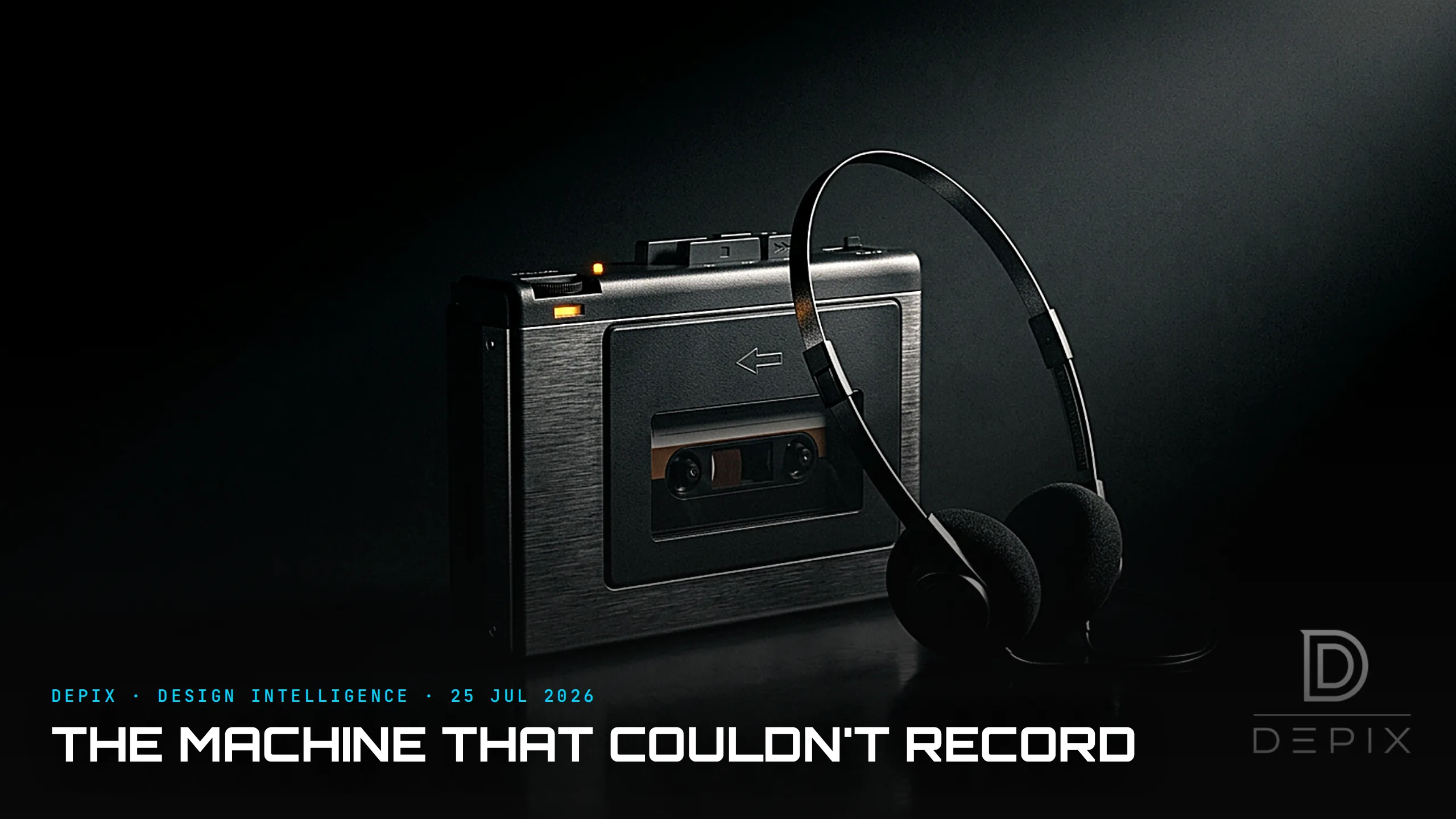
The Sony Walkman: The Machine That Couldn't Record

Tupperware: The Invention You Couldn't See