The Pringle's Shape Was Solved, Not Styled
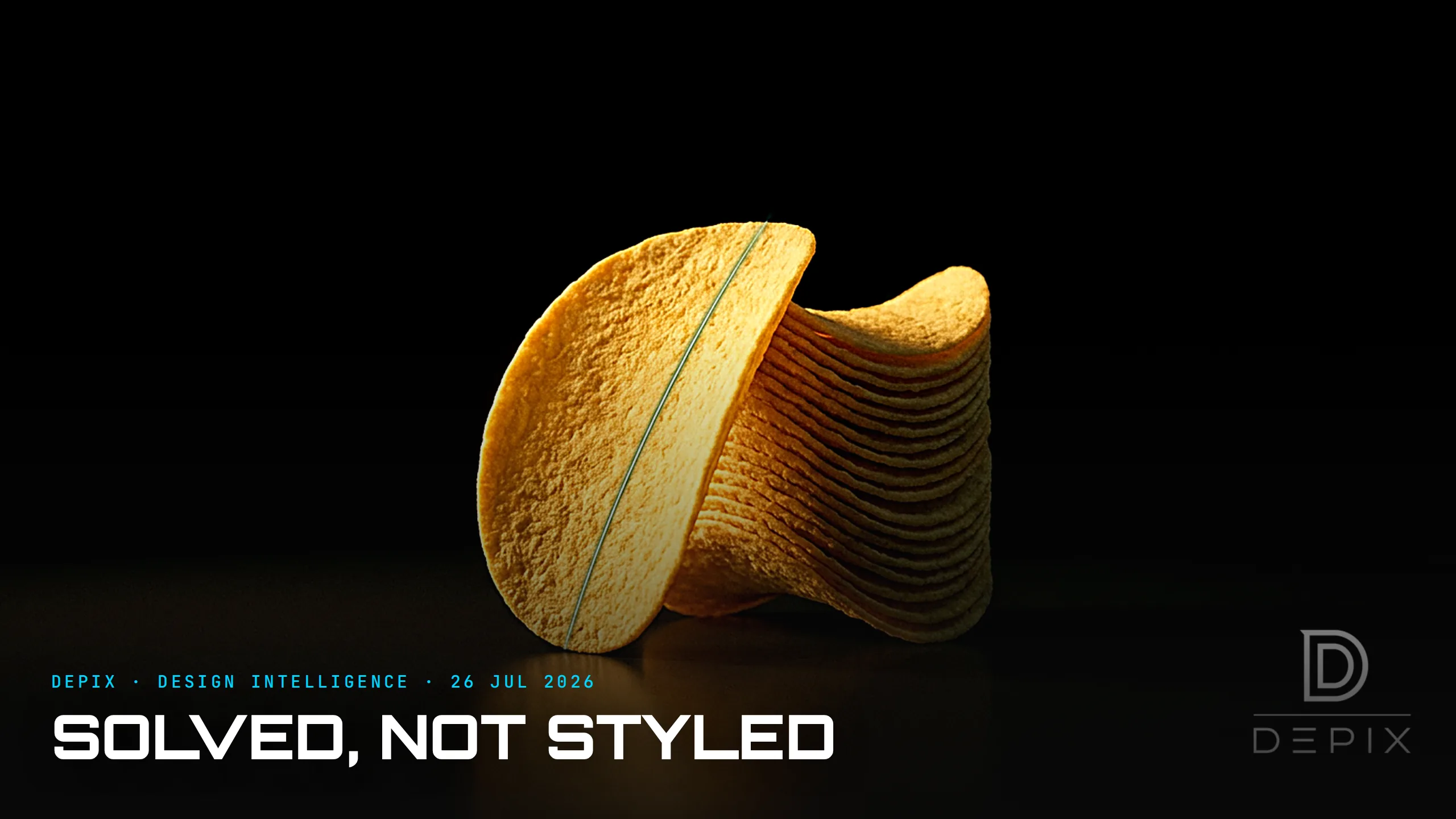
Pick up a Pringle and you are holding a solved equation. Its distinctive shape — the double-curved crisp that arcs up along one axis and down along the other — is not a stylistic flourish or a bit of fun. It is, precisely and by name, a hyperbolic paraboloid: a mathematical surface that curves in two opposite directions at once. The shape was not drawn. It was derived — chosen because a single geometry could solve several unrelated problems at the same time.
Start with the one that launched the product. In the 1960s, Procter & Gamble was fielding complaints about ordinary potato chips: bags full of crumbs and air, chips broken before the pack was even opened. An organic chemist named Fredric Baur was asked to fix the packaging, and he realised the packaging problem was really a shape problem. Irregular fried potato slices cannot be stacked; they trap air and shatter. But if every chip were made from a dough, pressed to an identical curve, and fried on a matching mould, the chips could nest — stack tightly, like spoons, into a rigid column that fills a tube with almost no wasted air. Baur spent two years on the saddle and filed his patent for the can and the stacking method in 1966. His pride in it became famous: when he died in 2008, part of his ashes was buried, at his request, in a Pringles can.
But the saddle earns its keep four times over, and this is the part that makes it real engineering. First, nesting: identical hyperbolic paraboloids stack perfectly. Second, strength: a surface curved in two opposing directions is far stiffer than a flat one — the same anticlastic double-curvature that helps a thin chip resist snapping is why it is genuinely hard to break a Pringle cleanly. Third, stability in manufacture: a flat, thin, wet chip flutters and flies off a fast conveyor, whereas the curved form is aerodynamically settled and can be produced at speed. Fourth, uniformity: because each is stamped and fried between forms rather than sliced from a potato, every chip is dimensionally identical — which is what makes the nesting possible in the first place. One surface; four requirements; no compromise between them.
The most beautiful part is that the shape is not unique to snacks. The hyperbolic paraboloid is a favourite of structural engineers precisely because double curvature buys enormous stiffness for almost no material. It is how Félix Candela roofed vast spaces in thin shells of concrete only centimetres thick, and why the same saddle recurs in stadium canopies and cooling towers. The market and chapel halls Candela poured in mid-century Mexico still stand as some of the thinnest large roofs ever built, holding themselves up on shape alone rather than on mass. A Pringle and a Candela roof are, geometrically, the same object at different scales — both exploiting the fact that a surface bending two ways at once is strong out of all proportion to its thinness. (A nice footnote: the machine that cooks Pringles was co-developed by Gene Wolfe, the celebrated science-fiction novelist, then a P&G engineer.)
The concept-phase lesson is one of the most useful in design, and the Pringle states it with unusual clarity. When a brief hands you several requirements that seem to conflict — pack densely and resist breakage and run fast on a line and stay uniform — the weak move is to style a compromise, trading a little of each against the others. The strong move is to hunt for the single underlying principle, often a geometry or a physical behaviour, that satisfies all of them at once. Those solutions feel inevitable in hindsight because they are not balancing the constraints; they are dissolving them into one idea. And when you find such an idea, the distinctive appearance comes for free — you do not design the look, the look falls out of the math.
That is why the Pringle is worth taking seriously as design, not merely as snack. Its shape is instantly recognisable, but it was never about recognition; recognisability is a byproduct of a surface doing four jobs at once. The next time a set of requirements looks like it demands a compromise, it is worth asking Baur's question instead: is there one shape — one equation — that makes the compromise disappear?
Sources:
- ●Pringles — the saddle-shaped stacked crisp
- ●Hyperbolic paraboloid — the Pringle's actual geometry
- ●Ruled surface — the doubly-ruled saddle
- ●Procter & Gamble — the maker
- ●Potato chip — the problem being solved
- ●Fredric Baur — the chemist who designed the can + saddle
- ●Curvature — anticlastic double curvature
- ●Industrial design
- ●Structural engineering — why engineers love the hypar
- ●Felix Candela — thin-shell hypar roofs
- ●Thin-shell structure — strength from double curvature
- ●Gene Wolfe — sci-fi novelist who built the Pringles machine
- ●Paraboloid

Zippo Designed the Promise First, the Lighter Second

Kenji Ekuan Spent Three Years Designing the Pour, Not the Bottle