The New Chrome Is Light
For a century, automotive status was borrowed light. Chrome — a mirror finish that reflected the sky, the street, the envious glance — was how a car said premium without saying anything. It never made its own light; it just caught everyone else's. That century is ending. The badge has started to glow.
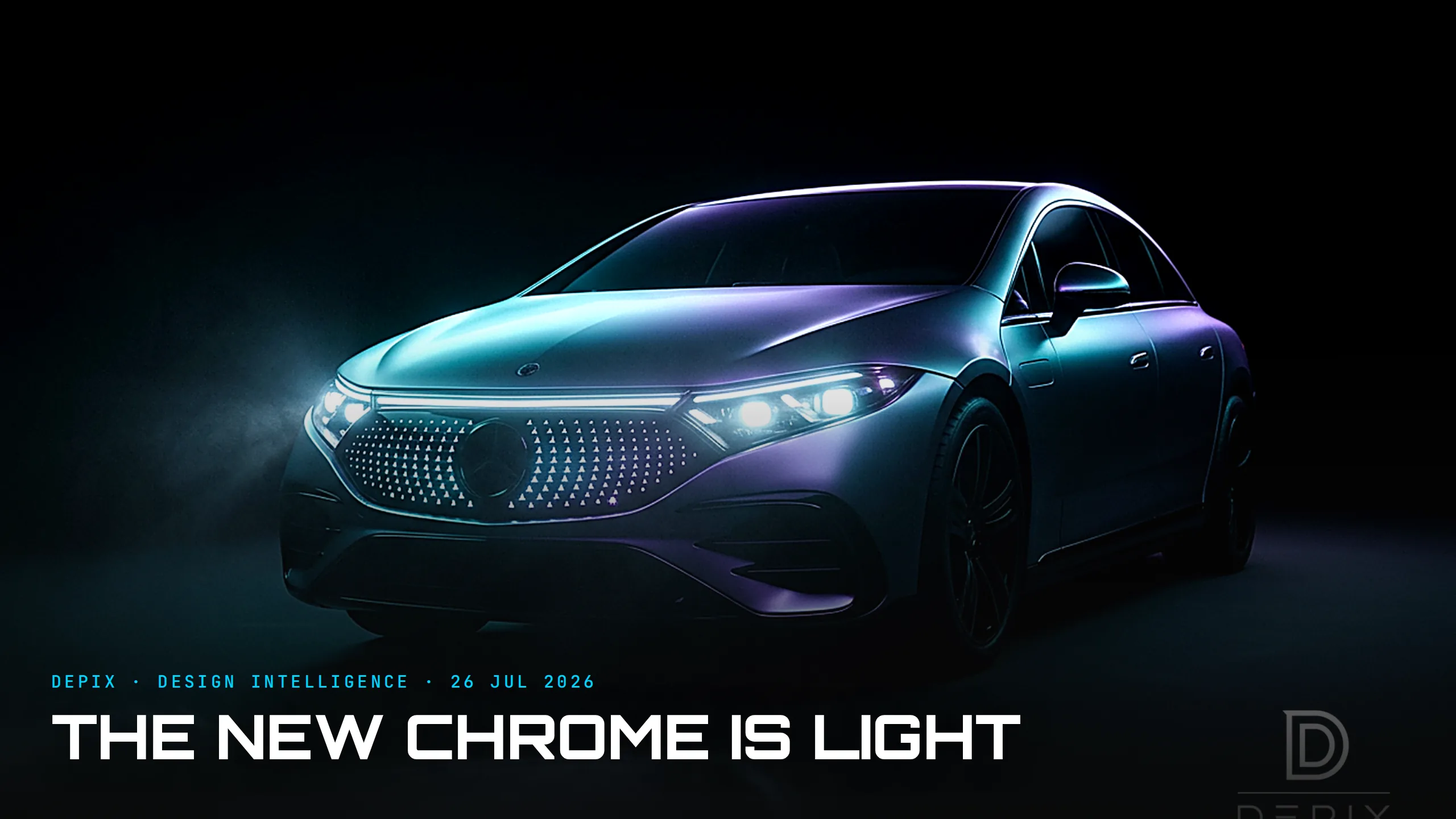
BMW's kidney grille now has an optional halo, Mercedes just put an illuminated star on the S-Class hood, aftermarket LED emblems have gone from show-car novelty to a mainstream car-culture fixture that lights up with the headlights, and BMW made the glowing grille an official production statement with its "Iconic Glow." At the extreme, digital grilles pack tens of thousands of RGB LEDs that display battery status, welcome animations and messages. This is the biggest shift in automotive finish in a hundred years, and almost nobody is naming it as one.
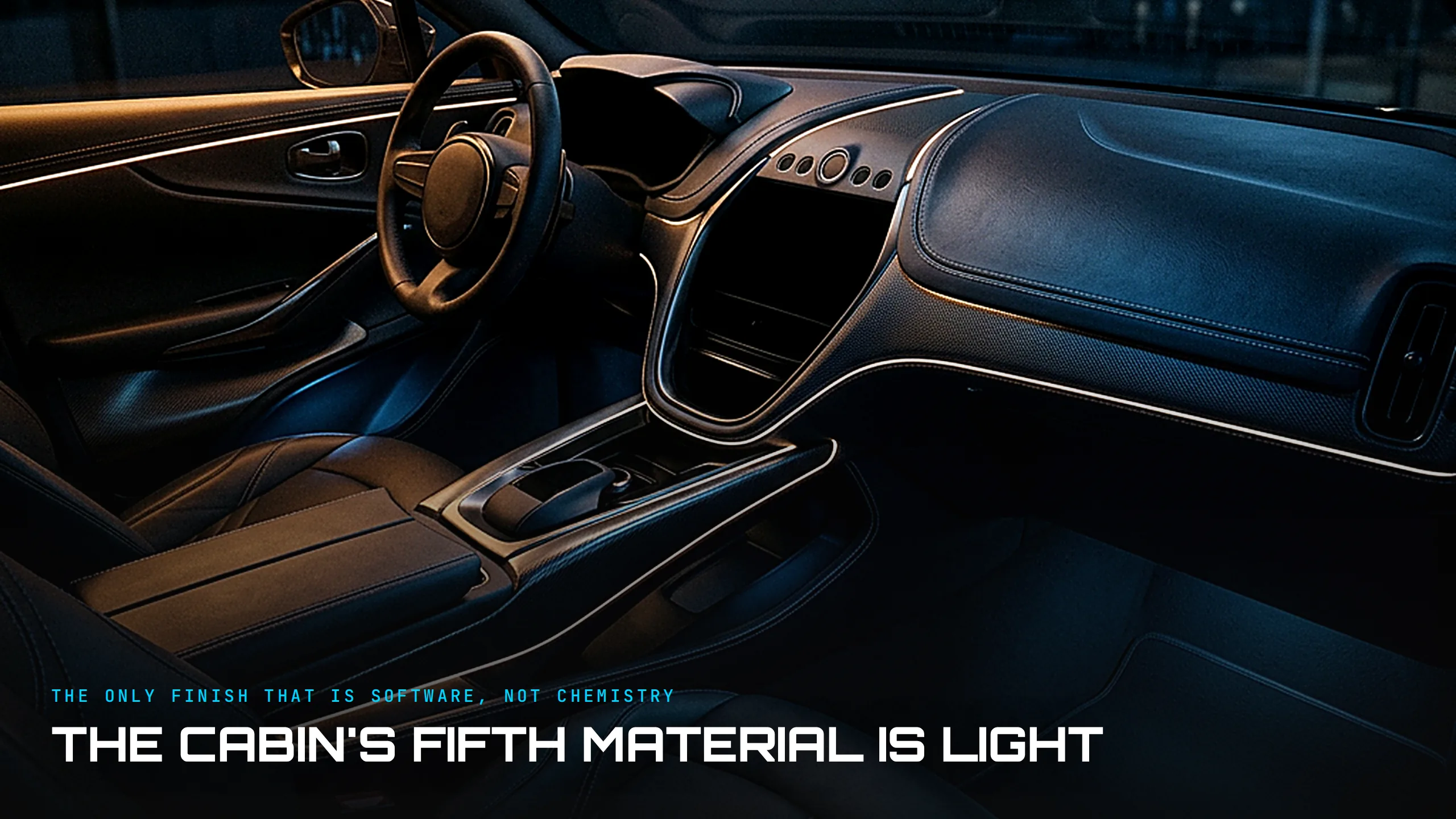
Here is the shift, stated plainly. Chrome sold status through reflection — a passive surface borrowing the sun. The lit badge sells it through emission — an active surface making its own. Passive becomes active; fixed becomes programmable; a finish you choose once at the configurator becomes a behaviour you can update over the air. CMF has spent a century deciding how a surface looks. The moment the surface can emit, the question changes to how it behaves.
It helps to see the whole arc. Chrome peaked, and then a decade of "chrome delete" stripped it off in the name of clean, blacked-out minimalism, until cars had almost no brightwork left at all. What is happening now is the status signal finding a new home: not the shine that bounces light, but the glow that generates it. Presence used to be a function of how much sky your trim could catch; now it is a function of what your car chooses to emit — day or night, dimmed or animated, on demand. That is a fundamentally different design brief, and it rewards a fundamentally different skill: not the metallurgy of a reflective coating, but the direction of a light that moves.
And that is where it gets hard, because emission is regulated in a way reflection never was. The EU effectively killed Rolls-Royce's £3,500 Illuminated Spirit of Ecstasy as "light pollution": under the UNECE R48 lighting rules, illuminated bonnet ornaments simply aren't permitted, and Europe treats an actively lit logo as an advertisement and a distraction. US DOT rules restrict front lighting to white or amber with no flashing, and an SAE study on illuminated vehicle logos exists precisely to test whether they distract other drivers. A lit grille is broadly legal; a lit hood ornament is banned. The line between the two is millimetres of intent — and that line is now part of the finish.
This is the concept-phase lesson hiding in a glowing badge. When a surface can emit and animate, the design decision stops being "what colour, what sheen" and becomes "what does the car say, and when, and is it allowed to say it here?" Identity stops being a paint chip and becomes a language and a choreography — one authored in the earliest sketches and one that has to clear type-approval in every market the car ships to. You are no longer picking a finish. You are writing behaviour, and behaviour has a legal footprint.
What comes next makes the stakes clearer. Cars are already being designed to talk to pedestrians directly — an illuminated front that warns when it has seen you and signals when it is safe to cross; Audi's light digitization maps a future of pixel-precise, programmable exterior light; OEMs are already leveraging front light signatures as core brand identity; and the industry is heading toward OTA "light choreography" you download like a ringtone. In an autonomous future, a car with no driver to make eye contact will need a face that talks — a communicative front surface is not decoration, it is the new turn signal.
Chrome was the finish that borrowed light. The next finish makes its own, animates it, updates it, and has to keep it legal. The marques that win the next decade will be the ones that treat light as a language decided at the concept phase — not a garnish bolted on at the end. Design intelligence is recognising that when the surface starts to speak, you have stopped choosing a colour and started writing what the car says.
Sources:
- ●The Truth About Cars — EU Bans Rolls-Royce's Illuminated Spirit of Ecstasy for 'Light Pollution'
- ●Automotive Blog — Illuminated Car Emblems: The Aftermarket Upgrade That's Taken Over Car Culture
- ●CarsFellow — The Complete Guide to Illuminated Car Emblems for Every Marque
- ●The Autopian — I Think BMW's Massive Glowing Grilles Are Great, Actually
- ●Made-in-China Insights — Why Are Car Grilles Becoming the Unseen Stars of Automotive Design?
- ●BMW Blog — Rolls-Royce Can't Illuminate Spirit of Ecstasy in the EU Anymore (UNECE R48)
- ●CarBuzz — The Illuminated Grille Is The Ultimate Option For Anyone Who Wants To Be Noticed
- ●Lighting Trendz — Automotive LED Lighting Laws: State Regulations & Compliance Guide
- ●SAE — Illuminated Vehicle Logos: Investigation on Potential Distraction and Road Safety
- ●Audi MediaCenter — How Audi's Light Digitization Is Pointing the Way Toward the Future
- ●CWIEME Berlin — OEMs Leverage New Front Lighting Technologies to Boost Brand Identity
- ●ADLED — Beyond Illumination: The Future of LED Modules in Automotive Lighting