The Clock That Pauses on Purpose
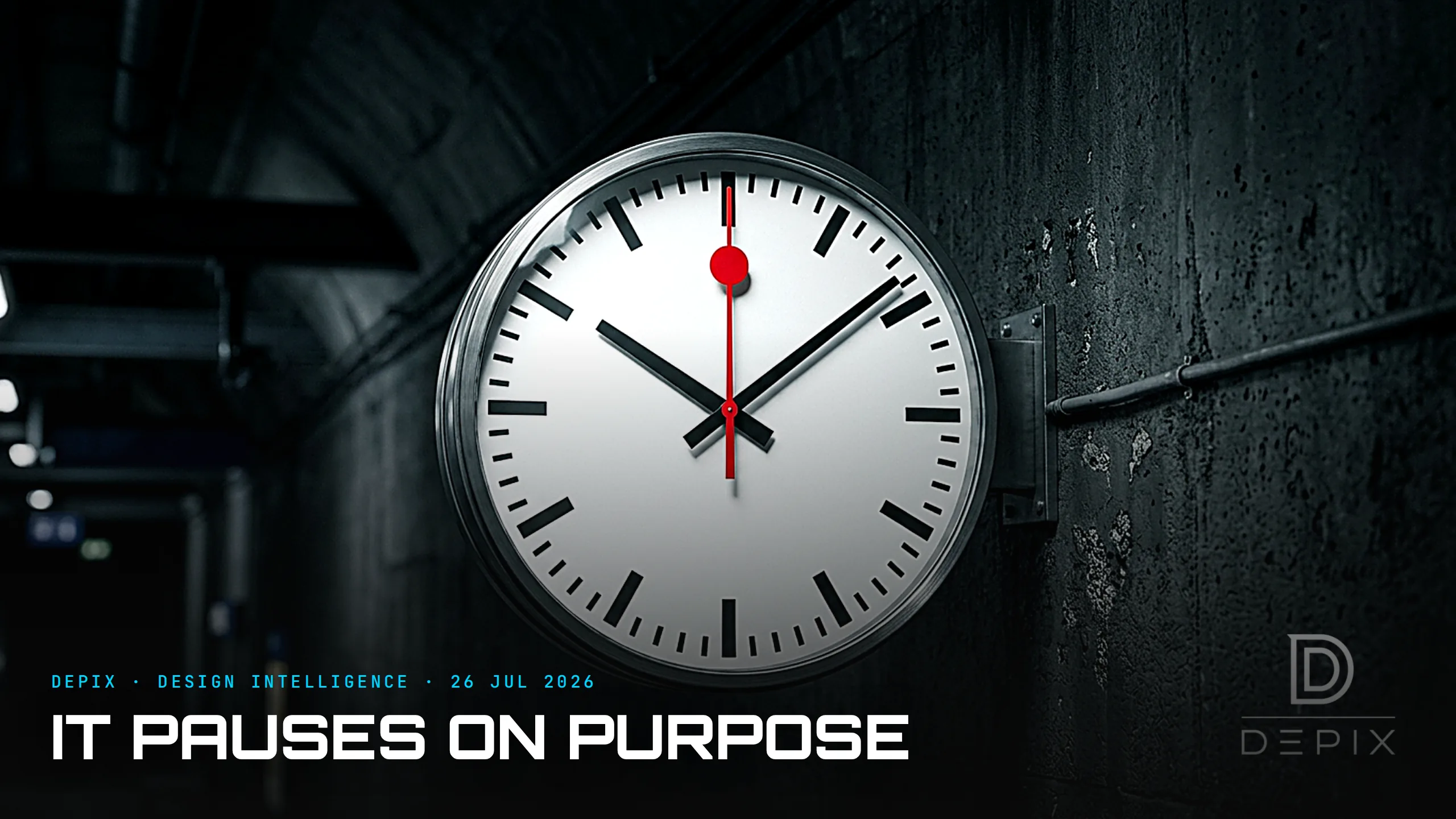
Watch the red second hand of a Swiss railway clock for a full minute and you will see it do something that, on any other clock, would look broken. It sweeps smoothly around the face, then stops dead at the top — pausing for a second or so at twelve — before the minute hand jumps and it sets off again. That pause is the most famous thing about the clock. It is also the whole design argument: the clock is briefly, deliberately wrong so that an entire country can be right.
The clock was designed in 1944 by Hans Hilfiker, an engineer at the Swiss Federal Railways (SBB), working with the clockmaker Moser-Baer. The problem he was solving was not "how do I make a beautiful clock." It was a systems problem: how do you make every clock in hundreds of stations show exactly the same time, so a timetable printed to the minute actually means something on every platform at once. His answer was to stop trusting the individual clock. Each station clock has little intelligence of its own; once a minute it receives an electrical impulse from a central master clock, sent over the telephone network, that releases its hand to begin the next minute.
The stop-to-go second hand is what that synchronisation looks like from the outside. The hand is geared to complete its circuit in about 58.5 seconds, not sixty — running slightly fast on purpose — so it always arrives early at the top and then waits. The pause absorbs the slack, holding until the master pulse arrives, and every clock in the network steps into the new minute together. A component that ran "correctly" — smoothly, continuously, keeping its own perfect time — would drift out of step with its neighbours. The clock is accurate precisely because each unit gives up its independence. It is a strikingly humble idea for such a proud object: the clock's authority comes not from its own precision but from its obedience to something larger. Left to itself, a "perfect" clock drifts and lies; connected and deferential, an ordinary one tells a whole nation the truth.
What makes it a design object rather than an engineering footnote is that Hilfiker treated the constraint as an opportunity. He did not hide the pause; he made it graceful. Later, in 1953, he added the red second hand shaped like the signalling baton a train dispatcher holds, so the face itself references the ritual of a departure. He described the pause as a way to "bring calm in the last moment" before a train leaves — a system requirement re-read as a human one. The numberless face, the bold minute strokes, the single red disc: all of it is legibility at a glance for a hurrying traveller, not decoration.
The proof of how completely Hilfiker nailed it came almost seventy years later. When Apple shipped a clock app in iOS 6 in 2012, its design was unmistakably the Swiss station clock — and SBB, which licenses the design to Mondaine for watches and Mobatime for the stations, threatened to sue. Apple, one of the most design-confident companies on earth, agreed to license it rather than argue, reportedly for a substantial fee. You do not pay to borrow a shape unless the shape is doing something no other version does.
The concept-phase lesson is about where a component's loyalty lies. Designers instinctively optimise the thing in front of them: make this clock as smooth, as accurate, as elegant as it can be on its own terms. But most objects are not solitary; they are one node in a system — one screen in a fleet, one part in an assembly, one service in a platform. For those, local perfection can be the enemy of the whole. The right question is not "is this component excellent by itself?" but "does it make the system it lives in more coherent?" Sometimes that means designing in what looks like a flaw — a pause, a compromise, a deliberate giving-up of autonomy — because that flaw is the component doing its real job. The Swiss clock has kept a country punctual for eighty years by being willing, once a minute, to stand still. Design the system's truth, not the part's vanity.
Sources:
- ●Swiss railway clock — Wikipedia
- ●Hans Hilfiker — Wikipedia
- ●Mondaine — Wikipedia
- ●Clock, SBB Bahnhofsuhr, 1944 — eGuide.ch
- ●Design Moment: Swiss railway clock, 1944 — The Irish Times
- ●Seven facts about Switzerland's famous station clocks — The Local
- ●Swiss Railway Clock at 75 — Newly Swissed
- ●Apple Agrees To License Swiss Railway Clock Design (iOS 6) — TechCrunch
- ●Apple licenses Swiss railway clock for iOS 6 — Engadget
- ●Apple To Pay SBB For Using Swiss Railway Clock In iOS 6 — Silicon
- ●Swiss Federal Railways (SBB) — Wikipedia
- ●Apple Licenses Swiss Railway Clock Design for iOS — iClarified

The Machine That Refused to Be Furniture

The Penguin Look Was a Rulebook, Not a Cover