You Press the Button, We Do the Rest
In 1900, taking a photograph was a serious undertaking. It meant expensive equipment, glass plates, chemicals, a darkroom, and the patience of a chemist. Then Kodak sold a cardboard box for a dollar), aimed it at children, and within a year had put a camera in 150,000 hands. The Brownie did not democratise photography by being a better camera. It did it by moving all the hard parts somewhere the user would never have to see them.
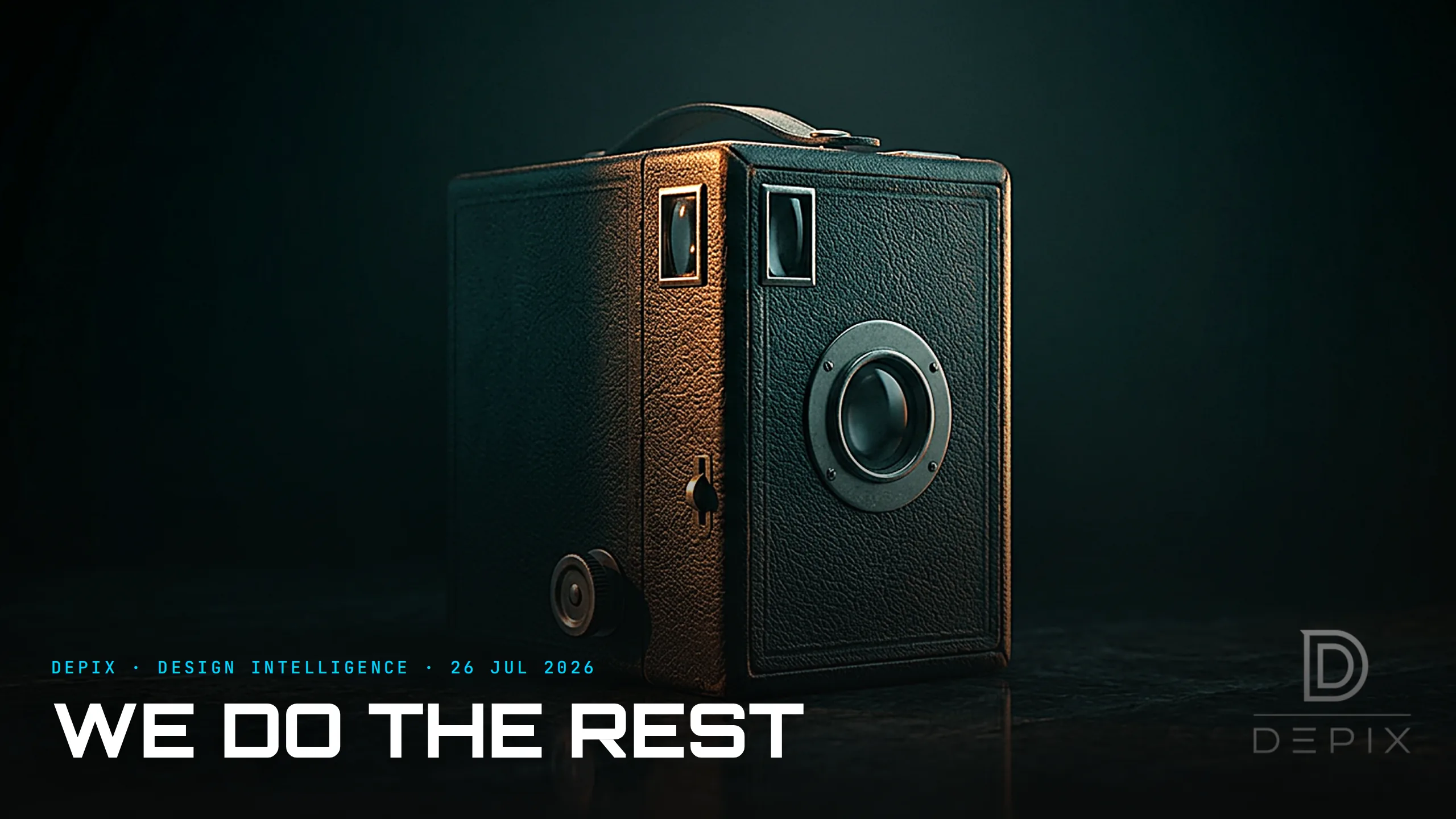
The camera itself was almost aggressively trivial: a simple carton box with a meniscus lens and a single shutter, designed by Frank Brownell to be so cheap and so simple that a child could operate it. There was nothing to focus, nothing to set. You pointed it and pressed a lever. Named after Palmer Cox's popular cartoon "Brownies" and marketed to children, it was deliberately the opposite of a serious instrument.
The genius wasn't in the box. It was in the sentence Kodak had built its whole company around: "You press the button, we do the rest." When your roll of film was finished, you didn't develop it. You mailed the roll film back to Kodak, who developed it, printed your pictures, reloaded fresh film, and sent the lot back to you. Every difficult, technical, chemical step that had previously defined photography still happened. It just happened in Rochester, invisibly, on the user's behalf. The customer's entire experience of "photography" had been reduced to two actions: aim, and press.
That is a different kind of design decision than making a nicer object. George Eastman wanted the camera to be "as convenient as the pencil," and he understood that convenience is not the same as capability. You do not make something simple by stripping out what it can do; you make it simple by deciding where the difficulty is allowed to live. Eastman took all the complexity a rival might have tried to shrink or automate inside the camera, and relocated it entirely - out of the product, out of the user's hands, into a service.
And that relocation was the business, too. The dollar camera was close to a giveaway; the film cost about fifteen cents a roll, and every roll came back to Kodak for paid developing and printing, again and again. It is one of the purest early examples of the razor-and-blades model: sell the object cheap, own the recurring loop it creates. The camera wasn't really the product. The loop was the product, and the camera was just the thing that started it.
The result reshaped how the twentieth century saw itself. Before the Brownie, photographs were formal, posed and rare - made by professionals, of important occasions. After it, ordinary people photographed ordinary life: picnics, babies, holidays, the candid and the trivial. The snapshot was born not from a new lens but from a decision about who had to do the hard part. Within a generation the family photo album existed as a fixture of ordinary life - not because lenses had improved, but because a company had quietly decided that the developing, the printing and the chemistry would be its job, and never again the customer's.
For anyone deciding what to build, the Brownie reframes what "simplifying" a product actually means. The instinct is to look at the object and ask how to make it easier to use - fewer buttons, smarter defaults, better onboarding. Eastman's move was bigger and made much earlier: he asked which of the hard steps the user should have to do at all, and moved the rest out of sight. The design boundary - what lives inside the product versus what lives in the service, the system, the loop around it - is drawn at the concept phase, and it decides more about how something feels than any amount of polish on the object.
It is the same instinct behind almost every product that has ever felt magically effortless. Someone, early, decided that a whole category of difficulty was simply not going to be the user's problem - and then did the unglamorous work of carrying it themselves, somewhere the customer never looks. You press the button. The design is everything you quietly arranged so that "we do the rest" could be true.
Sources:
- ●Brownie (camera) - Wikipedia)
- ●George Eastman - Wikipedia
- ●Kodak - Wikipedia
- ●Roll film - Wikipedia
- ●History of the camera - Wikipedia
- ●Razor and blades model - Wikipedia
- ●Kodak Brownie Camera - The Franklin Institute
- ●The Wizard of Photography (George Eastman) - PBS American Experience
- ●Kodak Introduces Brownie Cameras - EBSCO Research Starters
- ●How the Affordable Kodak Brownie Made Photography Accessible - My Modern Met
- ●The Kodak Brownie: The Camera That Brought Photography To The Masses - Artisan Obscura

The World's Safest Plug Assumes You're Careless

The Red Phone Box Was Meant to Be Silver