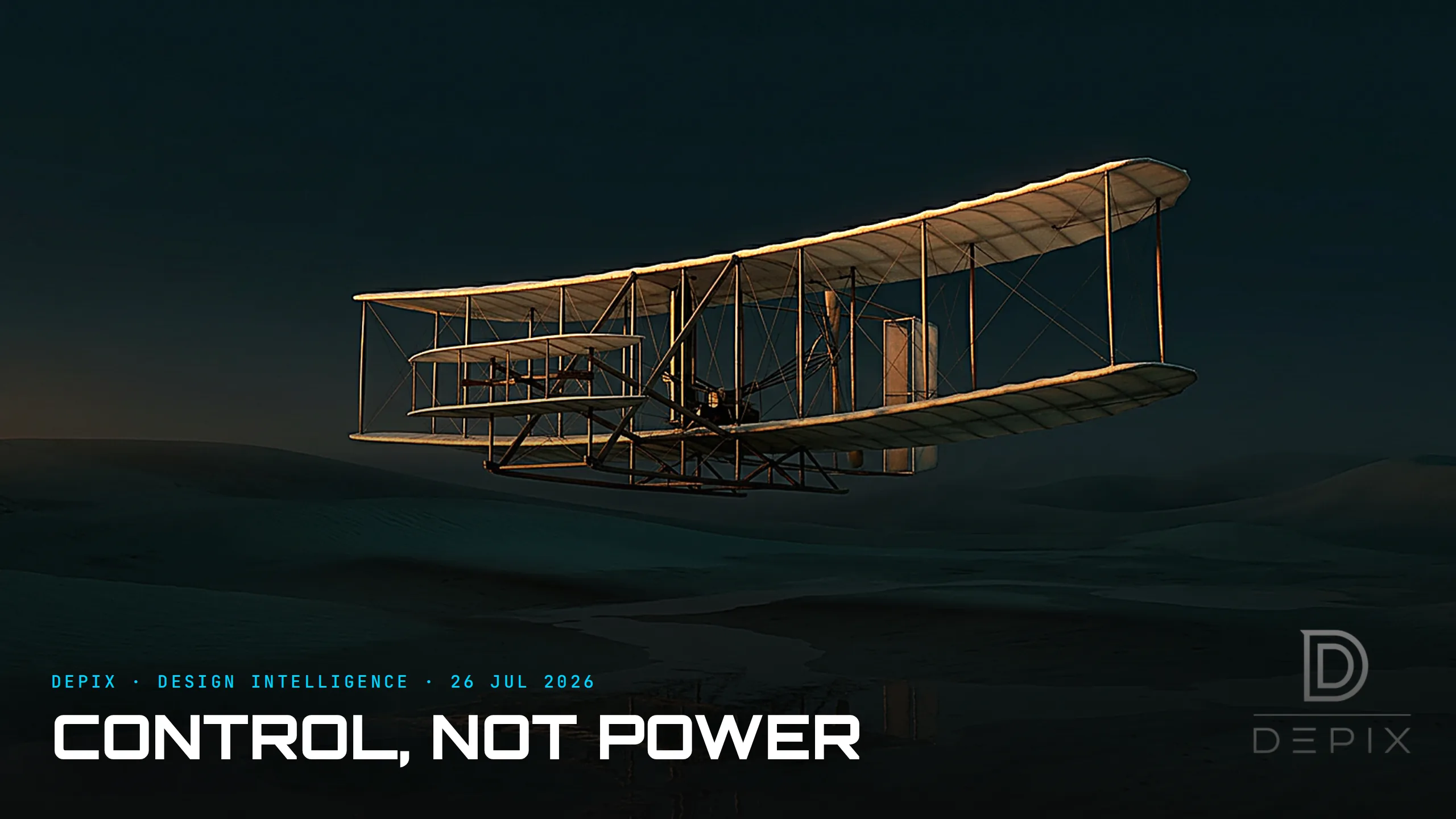
The Wright Brothers Didn't Win With Power. They Won With Control.
In the first years of the twentieth century, the race to build a flying machine was, in the popular telling, a race for power. The best-funded competitor, Samuel Langley, had more than fifty thousand dollars of US government money and a large, powerful engine bolted into his "Great Aerodrome." Others chased ever-bigger motors and wings. In December 1903 Langley's machine was catapulted off a houseboat and plunged straight into the Potomac — twice — "like a handful of mortar." Nine days later, two bicycle makers from Ohio flew.
The Wright brothers won because they had, years earlier, disagreed with everyone about what the problem even was. Wilbur and Orville broke "the flying problem" into three parts — wings, engines, and control — and concluded that the first two were "already sufficiently promising." The genuinely unsolved part, the one their rivals treated as an afterthought, was control: how to keep an inherently unstable machine balanced and steerable in the air. That reframing is the whole story. Everyone else was optimising the obvious variable; the Wrights identified the real bottleneck and pointed all their effort at it.
Their bicycle shop had taught them not to fear instability. A bicycle is an unstable machine that stays upright only through constant rider correction — and nobody thinks that is a flaw. As the record puts it, "their work with bicycles... influenced their belief that an unstable vehicle such as a flying machine could be controlled and balanced with practice." Where competitors wanted a machine so stable it would fly itself, the Wrights wanted one a trained pilot could steer, and they set out to invent the steering.
What they invented was three-axis control, still the basis of every aeroplane flying today. For roll, wing-warping — twisting the wingtips in opposite directions, an idea Wilbur hit on while idly flexing a long cardboard inner-tube box in the shop. For pitch, a forward elevator. For yaw, a movable rudder, which they realised, during the 1902 glider trials, was not for turning the way a boat's rudder does but for keeping the aircraft aligned through a bank. They perfected all of it with no engine at all — over a thousand controlled glides before power ever entered the picture. When they finally needed a motor and no manufacturer would build one light enough, they made their own: a modest twelve-horsepower engine. Power was the easy part, and they solved it last.
One fact captures the whole philosophy. The Wrights' foundational US patent, 821,393, was filed in March 1903 — before they had ever made a powered flight — and it "did not claim invention of a flying machine, but rather a system of aerodynamic control." They patented the steering, not the aircraft. They knew exactly where the invention lived, and it was not in the engine or the wing. It was in the answer to the question no one else was seriously asking.
The concept-phase lesson is the most important and least glamorous one in design: before you solve anything, make sure you are solving the right thing. When an entire field is racing to optimise the same obvious variable — more power, more speed, more resolution, more features — the breakthrough almost always belongs to whoever correctly identifies the different, harder, less obvious problem that is the true bottleneck, and attacks that instead. This is not about cleverness of execution; Langley had brilliant engineers. It is about problem selection, which happens at the very start, when you decide what the project is even about. Get that decision right and modest resources beat lavish ones. Get it wrong and no amount of horsepower saves you — you crash into the Potomac with the best engine in the country.
It is worth remembering, too, that the Wrights did not guess. They built a wind tunnel in 1901 because the published lift data everyone relied on was simply wrong, and they trusted their own measurements over the authorities. Choosing the right problem and then refusing to inherit bad assumptions about it: that is engineering intelligence, and it is indistinguishable from design intelligence. The aeroplane that lifted off the sand at Kill Devil Hills on 17 December 1903 flew 120 feet in twelve seconds. It was barely controllable — and that is exactly the point. The Wrights had spent years making "barely controllable" possible at all, while everyone else built machines that could not be controlled no matter how much power they poured in.
Sources:
- ●Samuel Langley - the well-funded, powerful, uncontrollable rival
- ●Bicycle - the unstable machine that taught them control
- ●Wright brothers
- ●Aircraft principal axes - roll, pitch, yaw (three-axis control)
- ●Wing warping - their roll-control invention
- ●Flight control surfaces - rudder, elevator
- ●Wright Glider - control perfected before power
- ●Wright brothers patent war - the patent was on control
- ●Wind tunnel - built to reject bad published data (1901)
- ●Engineering
- ●Wright Flyer - the 1903 aircraft
- ●Kitty Hawk, North Carolina - Kill Devil Hills, 17 Dec 1903
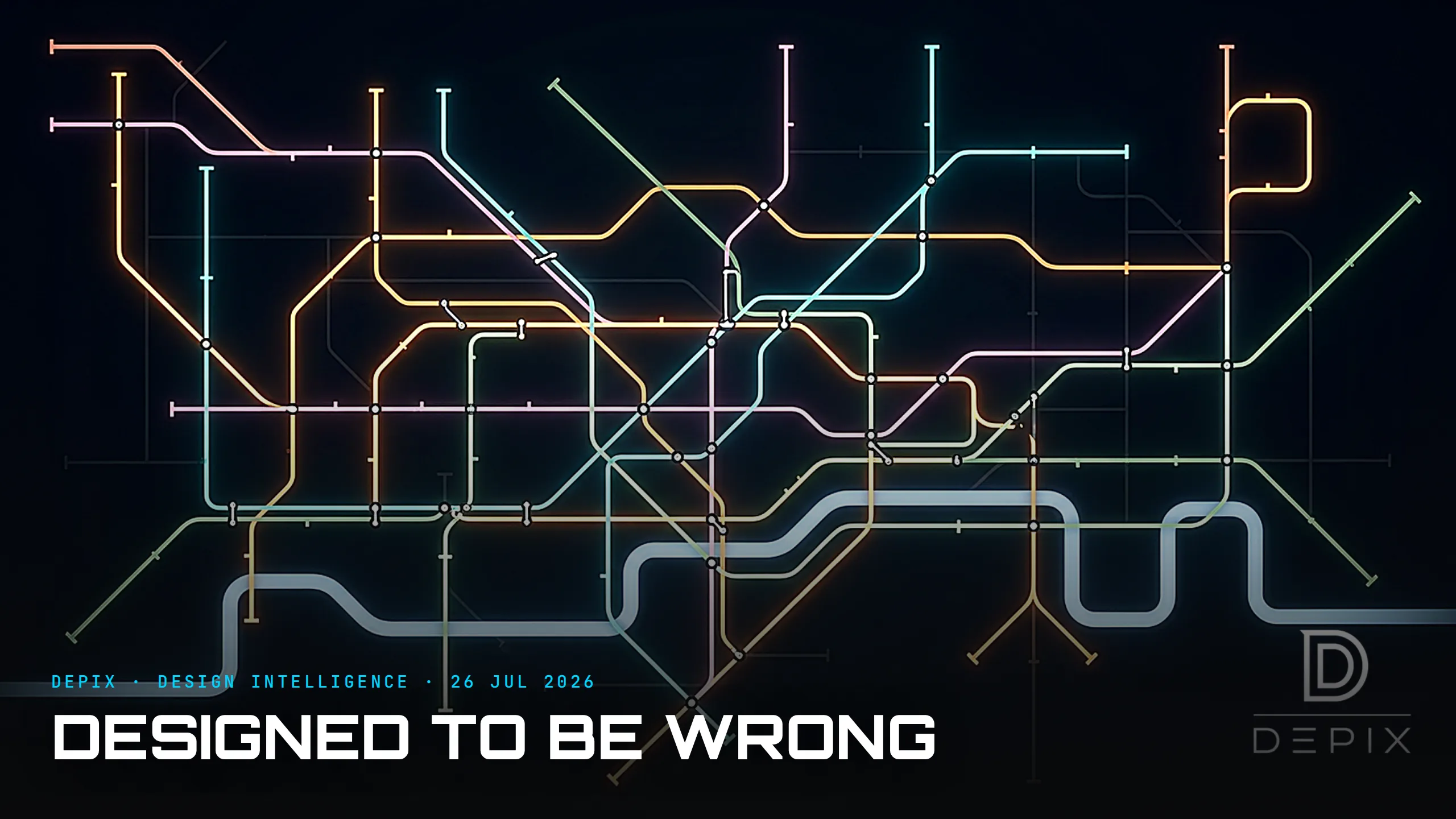
The Most Useful Map in Britain Is Deliberately Wrong

The Juicy Salif Barely Works. That Was Always the Point.