There's a Difference Between a Cheap Car and a Considered One
Renault has revealed the new Twingo E-Tech, an electric city car aimed at under €20,000, and it has been received not as a compromise but as the happiest little car of the year. That reaction is worth pausing on, because "a cheap car people actually love" is one of the hardest things to pull off in all of design — and the Twingo is a small clinic in how it's done.
Start with what "cheap" usually means. A cheap car is a decontented one: engineers take a more expensive car and remove things — softer plastics, extra sound deadening, a nicer switch — hoping you won't notice the absence. It feels like a subtraction, because it is one. A considered affordable car does something completely different. It doesn't remove; it allocates. It decides, up front, where a scarce budget gets spent and where it can be quietly saved, and it pours the savings into character and cleverness instead of hiding them under grey plastic.
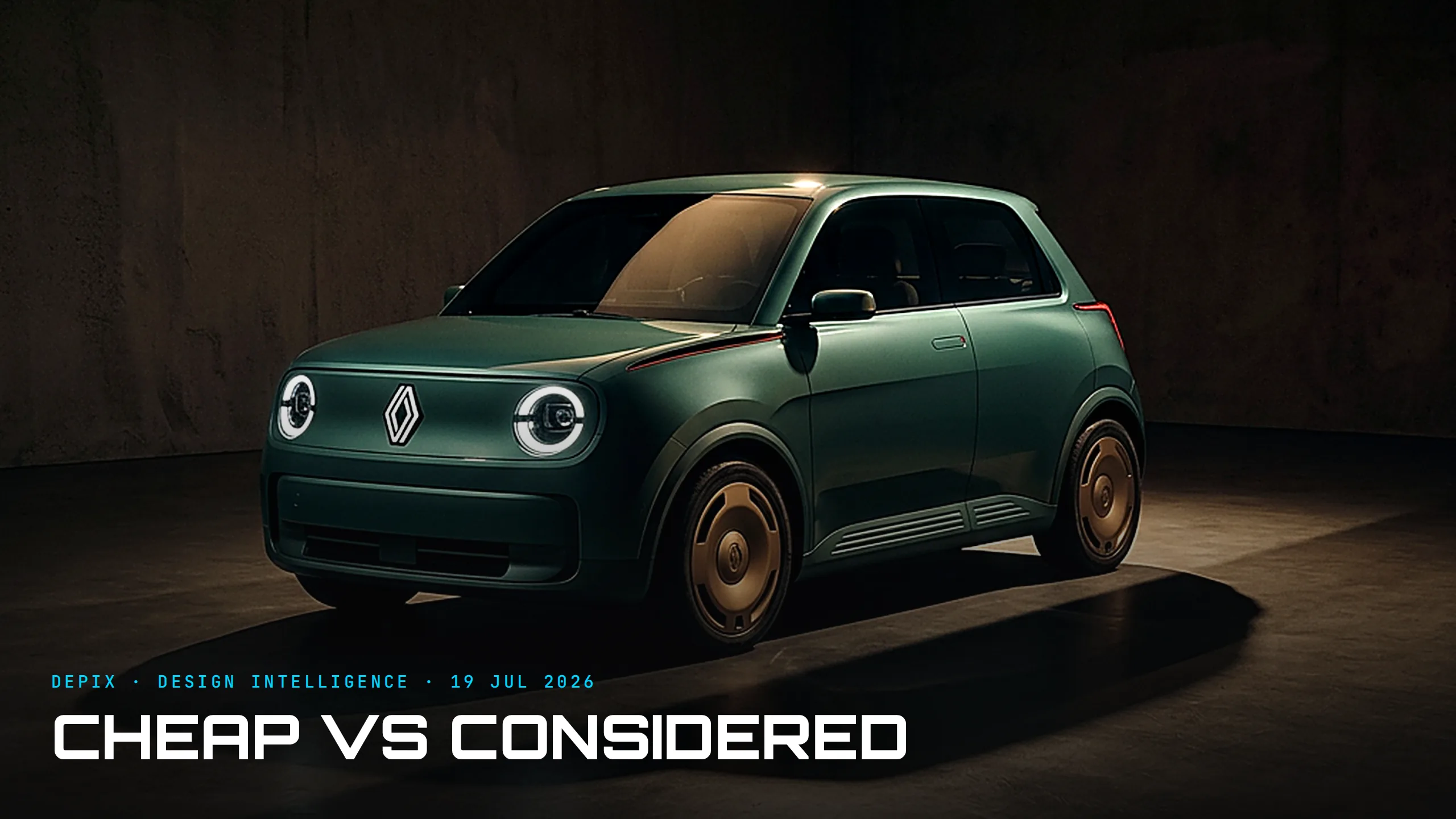
Watch where the Twingo spends. It spends on identity: round, prominent LED headlights that reinterpret the original 1992 car, giving the whole car a face you recognise and warm to instantly. Heritage, used well, is character you barely have to pay for. Renault's design chief calls the result a different animal, "more modern and almost futuristic", and the market read it as a retro-chic EV for the masses, a $23,000 car with genuine style and charm rather than a penalty box.
Then watch where it spends its ingenuity, which is the part that separates considered from cheap. The clever touches cost almost nothing to build and feel like gifts: a magnetic pad on the front headrest so a rear passenger can stick a phone to it, an elastic strap that doubles as a map pocket and a bottle holder, a zip-open armrest bin, individually sliding rear seats. None is expensive. All of them read as "someone thought about my day." That is ingenuity substituting for money — the defining skill of designing to a price.
This is why affordable design is a genuinely harder discipline than luxury design, not an easier one. When the budget is unlimited, the answer to almost every problem is "add cost": nicer material, bigger screen, more insulation. When the budget is fixed and low, every one of those doors is closed, and the only lever left is intelligence — knowing precisely which few things a buyer will actually feel and touch, and pouring the whole effort there while ruthlessly economising everywhere they won't. Get that map of priorities wrong and you get a car that is expensive and joyless. Get it right and you get a €20,000 car with the design confidence to undercut a wave of cheap rivals on charm rather than raw price.
Crucially, that map of priorities is a concept-phase decision, made before a single surface is finalised. You cannot value-engineer character back into a car late in the programme; by then the money is committed and the proportions are locked. The decision about what this car will be good at — and honest about being cheap at — has to be taken at the very start, which is presumably why Renault could develop it in about two years through its Ampere EV unit, startup-fast, built on the compact AmpR Small platform with the priorities fixed early and defended hard. Speed like that only works when the concept phase has already answered "where does the money go?"
At Depix, that question — where does the money go, and where do we spend cleverness instead — is one of the most consequential a studio ever asks, and it is almost invisible in a beauty render. A hero shot shows you the cheerful face and the colour; it doesn't show you the fifty small decisions to save here so you could spend there. The Twingo is a reminder that the difference between a cheap car and a considered one isn't the size of the budget. It's how early, and how well, you decided what to do with it.
Sources:
- ●Motor Illustrated — Renault to Launch Twingo E-Tech Electric in 2026 Under €20,000
- ●Top Gear — Is Renault's new Twingo the happiest little car of 2026?
- ●EV.com — Renault Reveals Twingo E-Tech Interior: Retro Charm With Electric Innovation
- ●Auto&Design — Renault Twingo E-Tech Electric, a Futuristic Icon
- ●Motor1 — The New Renault Twingo Is a Retro-Chic EV for the Masses
- ●InsideEVs — Renault Twingo E-Tech: A $23,000 EV Packed With Style and Charm
- ●InsideEVs — Retro Renault Twingo EV Aims To Undercut China
- ●Conceptcarz — 2026 Renault Twingo E-Tech Specifications & Dimensions
- ●Bike-EV — Renault Twingo E-Tech 2026: Price, Specs, Range and Release Date
- ●Go-Electra — Renault Twingo E-Tech Electric 2026: price, range and charging
- ●Carsfera — New Renault Twingo 2026: retro design, 100% electric and under €20,000

The Super Shoe Proves Performance Is a Design Decision

The Air Taxi Is the First New Vehicle Typology in 80 Years — and There's Nothing to Copy