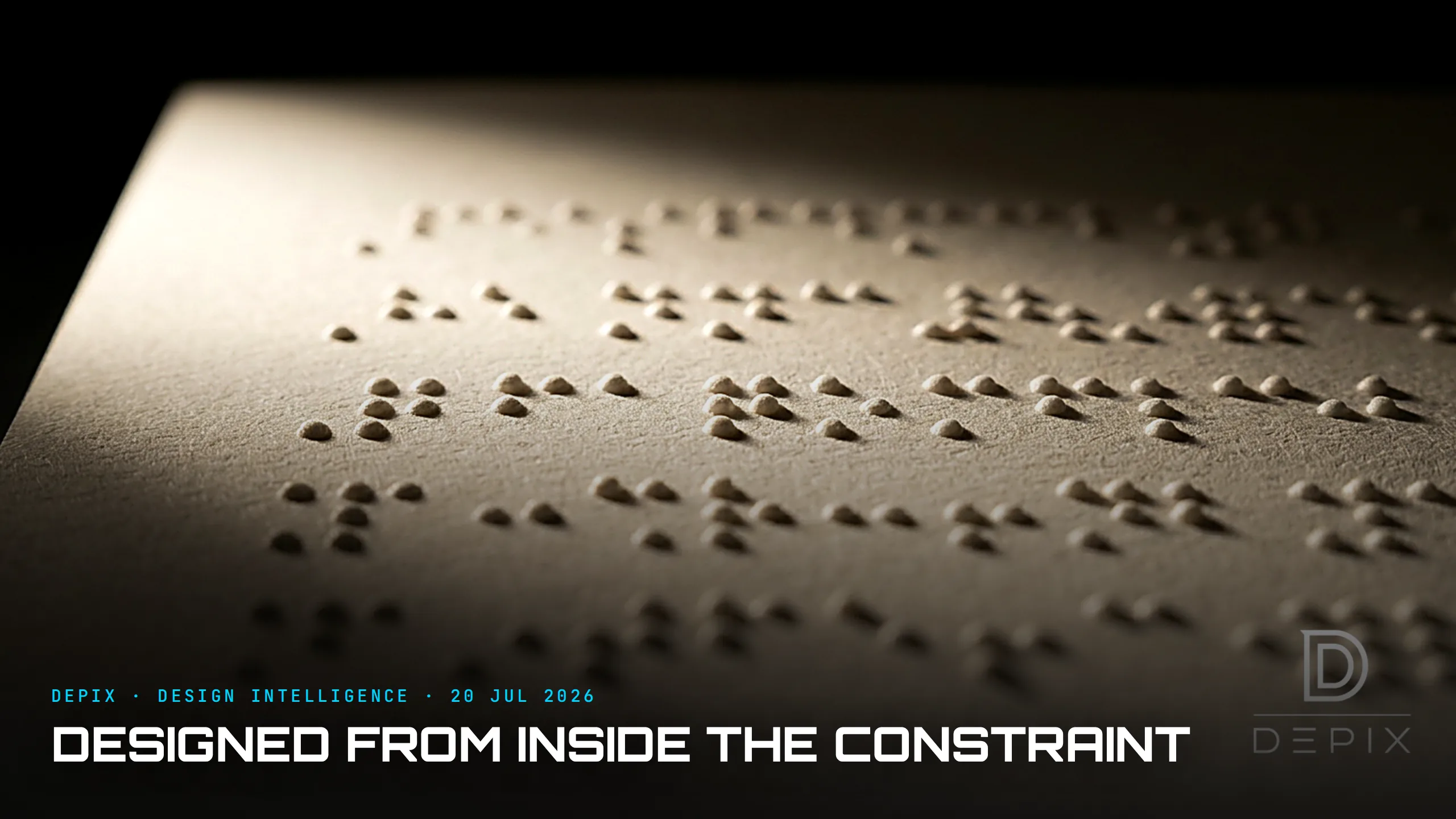
Braille: Designed From Inside the Constraint
In 1824, a fifteen-year-old blind student at a Paris school took a clumsy military code and, by cutting it in half, solved a problem that sighted experts would keep getting wrong for the next hundred years. Louis Braille had been blinded in an accident as a small child. At school he met "night writing," a raised-dot system Charles Barbier had devised — a twelve-dot cell, two wide and six tall, encoding sounds phonetically. Braille saw both its promise and its fatal flaw: the cell was too tall for a fingertip to read in a single touch. So he halved it to six dots, dropped the phonetics for ordinary spelling, and produced a cell one fingertip could take in at one impression, then move on instantly. He published it in 1829. It is, essentially, still what blind readers use today.
You would think a solution that good, from someone who actually read with his fingers, would win at once. It did the opposite. For most of the nineteenth century the dominant system in America was something else entirely — and the reason it lost is the real design lesson.
The rival was Boston Line Type, created in 1835 by Samuel Gridley Howe, the first director of what became the Perkins School. Howe's system was embossed Roman letters — the same alphabet sighted people use, simplified and rendered in raised type. His reasoning was principled and generous: he did not want blind people reading a separate script that would cut them off from the sighted world. Keep the letters the same, and no one is isolated. It is exactly the kind of humane, inclusive instinct a good designer is trained to have.
And it was wrong — for a reason that only shows up if you judge the design from the reader's fingertip rather than the designer's eye. A fingertip cannot trace the continuous curves of a Roman "S" quickly; it registers a small cluster of discrete points almost instantly. Howe's letters looked legible to the sighted teachers who chose them, and were slow and difficult for the blind students who actually had to use them. The design had been optimised for the wrong perceptual system — the one belonging to the people making the decision, not the people using the product. It is the oldest trap in the discipline: a solution that is comfortable for the person choosing it will always feel like the safe choice, whatever it quietly costs the person holding it.
Worse, the two systems failed differently on a second axis. Boston Line Type had to be embossed by a press; a blind person could read it but not write it. Braille, read and written with a cheap slate and stylus, let the user produce as well as consume — it gave blind people their own literacy, not a read-only version of someone else's. A tool that only lets you receive is a weaker tool than one that lets you make.
None of this settled the matter quickly. What followed was decades of the "War of the Dots" — Braille against Boston Line Type against New York Point against American Braille — dragging from 1829 into the 1930s. For much of it, American educators resisted braille precisely because it required sighted teachers to learn an arbitrary set of symbols. The convenience of the people administering the system kept outvoting the fluency of the people living inside it. Braille only became the U.S. standard in the early twentieth century — after Howe had died and, crucially, after blind-led organisations formed and made it a priority. The right design won when the actual users finally held the pen.
For the concept phase, the lesson is uncomfortable and durable. The most dangerous solution is rarely the lazy one; it is the intuitive, well-meaning one that quietly encodes the designer's own frame of reference. "Make it the same letters so no one is left out" felt inclusive and was exclusionary in practice. The only way to catch that class of error is to judge the design against the real user's constraint — here, literally the resolution of a fingertip — and to get that user into the decision, not merely into the user test. Braille had the answer in 1824 because he lived inside the constraint every day. Everyone else needed a century to stop trusting their own eyes.
Sources:
- ●Wikipedia — Braille
- ●Duxbury Systems — Louis Braille and the Braille System (Barbier's night writing)
- ●American Foundation for the Blind — Braille Invents His Code
- ●History Hit — How Louis Braille's tactile writing system revolutionised blind lives
- ●Wikipedia — Boston line letter
- ●NPS — Samuel Gridley Howe
- ●Slate — Samuel Gridley Howe's Boston Line atlas (why he resisted braille)
- ●PRINT Magazine — Braille vs. Boston Line Type: How Design Can Truly Be Inclusive
- ●TSBVI — A Brief History of Tactile Writing Systems (PDF)
- ●American Printing House — Blindness History Basics: The War of the Dots
- ●Imperial County Office of Education — The Story of Louis Braille
- ●Sight Scotland — Who was Louis Braille?
The Tin Can: Solved Everything Except Opening It

The Paper Clip: There Is No Perfect Design


