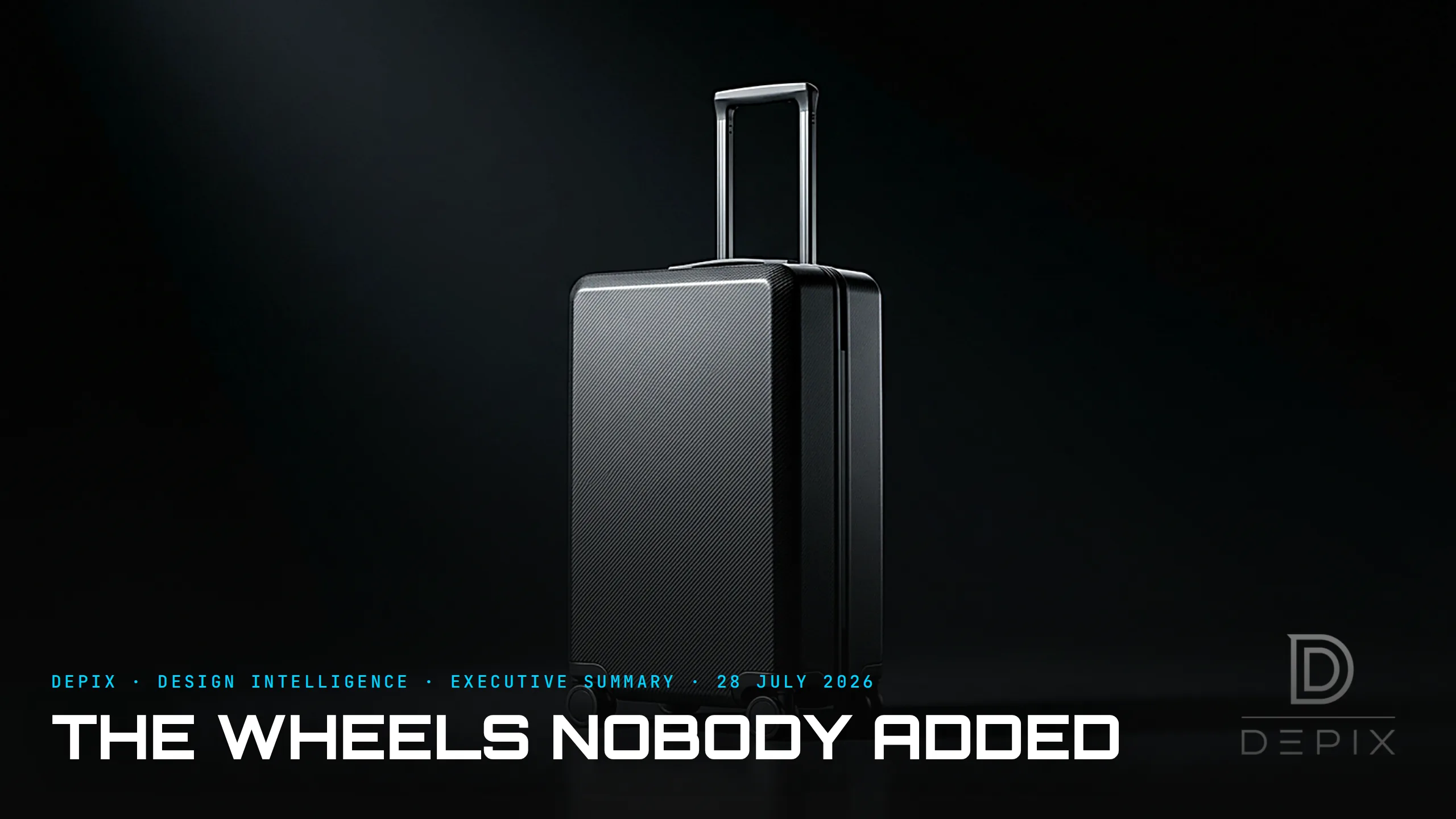
The Wheels Nobody Added
For roughly five thousand years, humanity possessed two things: the wheel, and the need to move heavy objects. For at least a century, we also had the modern suitcase. And for almost all of that overlap, nobody put the two together. The wheeled suitcase - now so obvious that a bag without wheels feels broken - did not arrive until 1970, when a luggage executive named Bernard Sadow, dragging two heavy cases through an airport after a family holiday, watched a worker roll a heavy machine on a wheeled skid and had the thought that should have occurred to someone millennia earlier.
Even then it barely worked. Sadow's patented "Rolling Luggage" was a case laid flat on four casters and towed on a strap, a bit like walking an uncooperative dog. Stores were skeptical; the big retailers initially turned it down. The design we actually use was not his. In 1987 a Northwest Airlines pilot named Robert Plath stood the bag upright, gave it two wheels and a telescoping handle, and called it the Rollaboard. He sold them first to fellow flight crews out of his garage; passengers watched cabin crews glide through terminals and demanded their own, and Plath left flying to build Travelpro. The object had existed in crude form for seventeen years and in the right form for none, and then it conquered the world almost overnight.
The obvious question is the interesting one: why did it take so long? Not the technology - casters and telescoping tubes were centuries old. The barriers were entirely in people's heads. Wheeled luggage was long dismissed by the trade as a niche product "for women"; in the culture of the time, a man who could not carry his own bags was making a statement. Porters and bellhops were everywhere, so the problem felt already solved. And crucially, the world the wheeled bag needed had not been built yet: the era of vast airport terminals, self-service travel and long walks to the gate is what turned a nice idea into a necessity. There were even earlier attempts that went nowhere - a traveller named Anita Willets-Burnham rolled a wheeled case decades before Sadow and could not get anyone to care. The idea was not missing. The permission was.
That is the whole design-intelligence lesson, and it is a humbling one. The most transformative move in a designer's toolkit is often not invention at all - it is recombination: taking two things everyone already has and noticing that they belong together. The wheel plus the suitcase. The phone plus the camera. The map plus the location dot. Each looks, afterwards, so inevitable that we assume it must have been hard to build. It was not. It was hard to see. The engineering was trivial; the reframing was everything - the shift from "how do I carry this better" to "why am I carrying this at all."
And reframing is a concept-phase act, the earliest and cheapest one there is. It costs nothing but attention, and it is worth more than any amount of later refinement, because it changes which problem you are solving. Sadow's version was a worse execution of the right idea; a thousand luggage engineers before him had been executing the wrong idea beautifully - better latches, lighter frames, stronger handles - all optimising the experience of carrying a weight that never needed to be carried. You cannot refine your way from the wrong problem to the right one. No amount of better handle is a wheel. Even now people still argue about two wheels versus four, which only proves how alive the design space became the moment the frame finally moved.
This is why the wheeled suitcase belongs in every design conversation. It is proof that "obvious in hindsight" is not an insult but a description of the most valuable ideas - the ones that reorganise an assumption everyone was standing on without noticing. The barrier is almost never capability. It is the invisible frame: the belief about who a product is for, about what is dignified, about which parts of an experience are simply fixed facts of life rather than problems waiting to be dissolved.
The lesson for anyone designing anything is to treat the assumptions as the real work. Before optimising the object, interrogate the frame around it - the "that is just how it is" that everyone has stopped questioning. Somewhere in almost every mature product is a wheel waiting to be added to a suitcase: a burden so normalised that no one has thought to remove it. The teams that find those are not smarter engineers. They are the ones who refused to accept that the way a thing has always been carried is the way it has to be.
Sources:
- ●https://interestingengineering.com/innovation/who-actually-invented-the-wheeled-suitcase
- ●https://travelpro.com/blogs/the-travelpro-blog/the-history-of-rolling-luggage
- ●https://patents.justia.com/inventor/bernard-d-sadow
- ●https://en.wikipedia.org/wiki/Suitcase
- ●https://invention.si.edu/invention-stories/roll-aboard
- ●https://ordun002.wordpress.com/2015/05/09/the-rollaboard/
- ●https://thisbugslife.com/2021/11/08/wheels-on-suitcases/
- ●https://www.winnetkahistory.org/gazette/before-her-time-anita-willets-burnhams-rolling-suitcase/
- ●https://jeffreyrubel.substack.com/p/the-rolling-suitcase
- ●https://dynomight.substack.com/p/luaggage