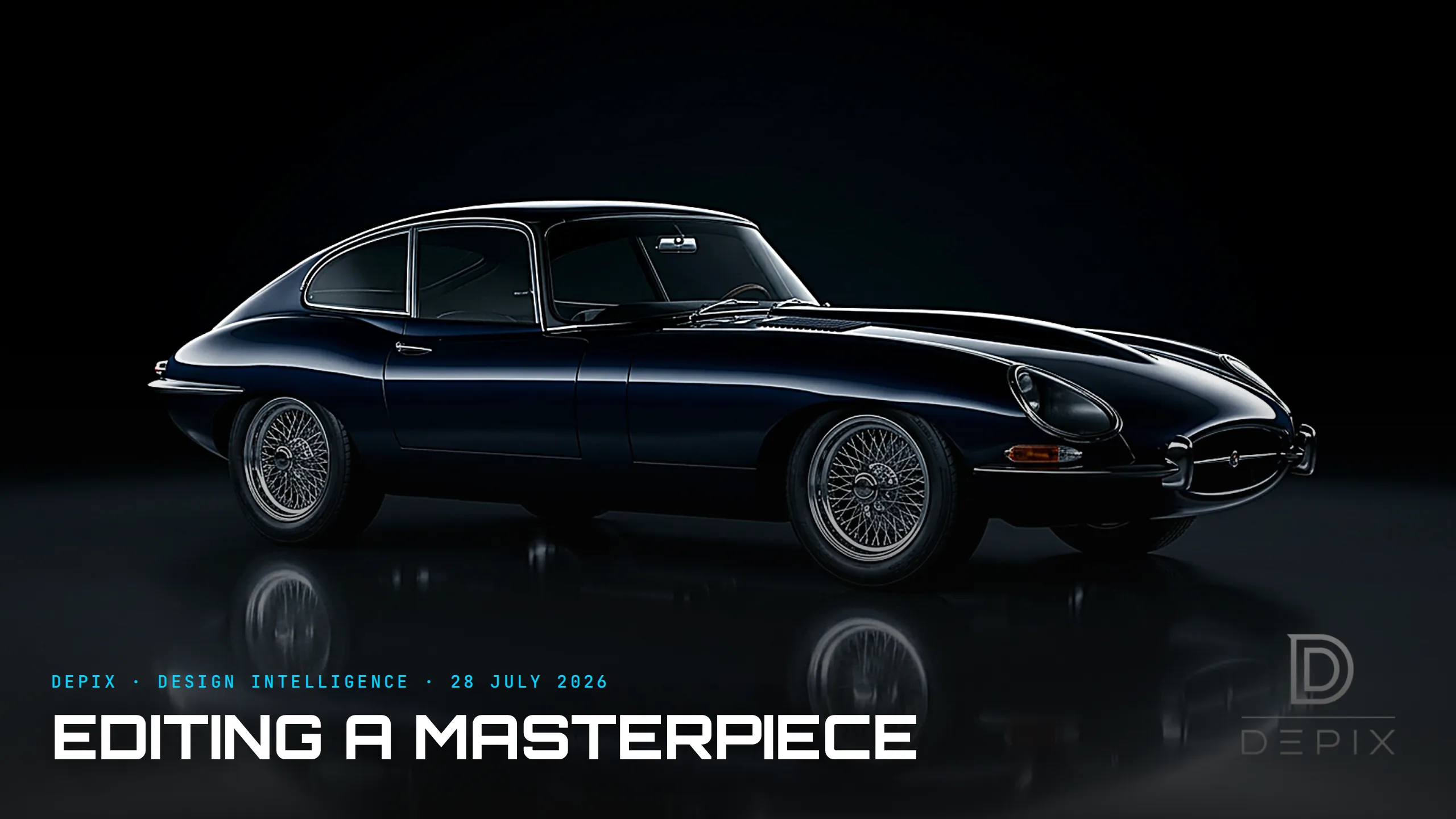
Editing a Masterpiece
The most expensive cars at Monterey Car Week this August will not all be the fastest, the rarest, or the newest. Some of the most coveted will be old cars, rebuilt — reimagined classics that keep a beloved silhouette and rework everything underneath. At The Quail on 14 August, a Porsche 911 reimagined by Singer will sit near an Eagle E-Type so re-engineered it weighs around 975kg — and buyers happily wait years and pay a fortune for the privilege. This is the restomod, and it is quietly the most instructive object in car design.
Here is why. Designing a new car is hard, but you own the blank page — nobody knows what it "should" look like, so any coherent vision can feel right. A restomod is the opposite. Singer does not restore a 911; it re-decides one — and is not even permitted to call it a Porsche, only a "911 reimagined by Singer." Every choice it makes is laid directly over a shape millions already hold sacred. Move a line and the whole world notices. There is nowhere to hide.
That makes it the purest test of design taste there is. The entire discipline reduces to a single, brutal question asked before any work begins: which lines are sacred, and which are free? Get that judgement right and the result feels more like the original than the original did — the platonic 911, the E-Type as you remember it rather than as it actually was. Get it wrong and you have vandalised a masterpiece. No amount of craftsmanship rescues a bad edit; Singer's watchmaking-grade hand-built gauges and burnished leather only matter because the fundamental proportions were left alone.
Look across the field and the best all share this restraint. Gunther Werks rebuilds the air-cooled 993 in full carbon with a 4.0-litre flat-six, roughly 25 cars a year, north of a million dollars — yet the silhouette stays unmistakably 993. Kimera reimagines the Lancia 037; Alfaholics reworks the little Alfa 105 coupe so thoroughly the waitlist runs to 2029, and still it reads as that exact Alfa. Theon Design and its peers take commissions from several hundred thousand pounds upward. What all that money buys is not addition. It is editing — the confidence to know what to leave untouched. The engineering is often radically new; the surprise is how little the eye is allowed to change. That is the discipline the price tag is really paying for.
This is the concept-phase discipline made visible, and that is exactly why it matters beyond cars. Every mature product, brand or interface is somebody's masterpiece that a team will one day be asked to revise. The redesign of an iconic logo, the next generation of a beloved phone, the update to a building everyone already loves — each is a restomod problem. The temptation is always to prove you were in the room: add a flourish, move the badge, restyle the thing to justify the budget. The restomod masters teach the opposite lesson. The value is in the decisions you do not make — the reverence to identify the sacred lines and the discipline to leave them alone.
And crucially, this judgement is entirely a concept-phase act. You decide which lines are sacred before you cut a single panel; you cannot discover it in the workshop. A restomod that starts modifying and hopes to find the balance later ends up a pastiche — modern where it should be timeless, fussy where it should be quiet. The ones people wait years for are the ones where somebody sat with the original for a long time, drew a hard line around what could never change, and only then allowed themselves to improve everything else.
That is the reframing worth taking from Monterey. A restomod looks like nostalgia — old cars made nicer. It is actually the discipline of subtraction under maximum scrutiny: the courage to change less than you could, aimed at a shape the world will not let you get wrong. The blank page flatters the designer; the masterpiece exposes them. If you can edit something beloved and leave it more itself than before, you can design anything. The hardest brief in the world is the one where everyone already knows the answer — and your job is to honour it while quietly making it better.
Sources:
- ●https://shop.restomods.com/blogs/restomods/the-rise-of-the-restomod-classic-design-with-modern-soul
- ●https://www.cars.com/articles/favorite-hypercars-restomods-and-concepts-at-the-2025-quail-a-motorsports-gathering-514565/
- ●https://hiconsumption.com/motors/2026-porsche-911-cabriolet-reimagined-by-singer/
- ●https://www.topgear.com/car-news/retro/15-best-restomods-revealed-2025
- ●https://www.pistonheads.com/news/ph-six-of-the-best/restomods-to-try-before-you-die--six-of-the-best/51206
- ●https://www.wantedonline.co.za/vehicles/2026-03-05-reimagining-the-tune-of-the-porsche-911/
- ●https://renndriver.com/guides/gunther-werks/
- ●https://en.wikipedia.org/wiki/Kimera_Automobili
- ●https://www.carandclassic.com/magazine/best-restomod-cars/
- ●https://carbuzz.com/features/restomods-10-brands-reinventing-classics/
- ●https://www.kayburton.com.au/rise-of-the-restomod/
- ●https://www.spokesman.com/stories/2024/aug/31/car-collectors-are-drooling-over-the-new-upscale-b/