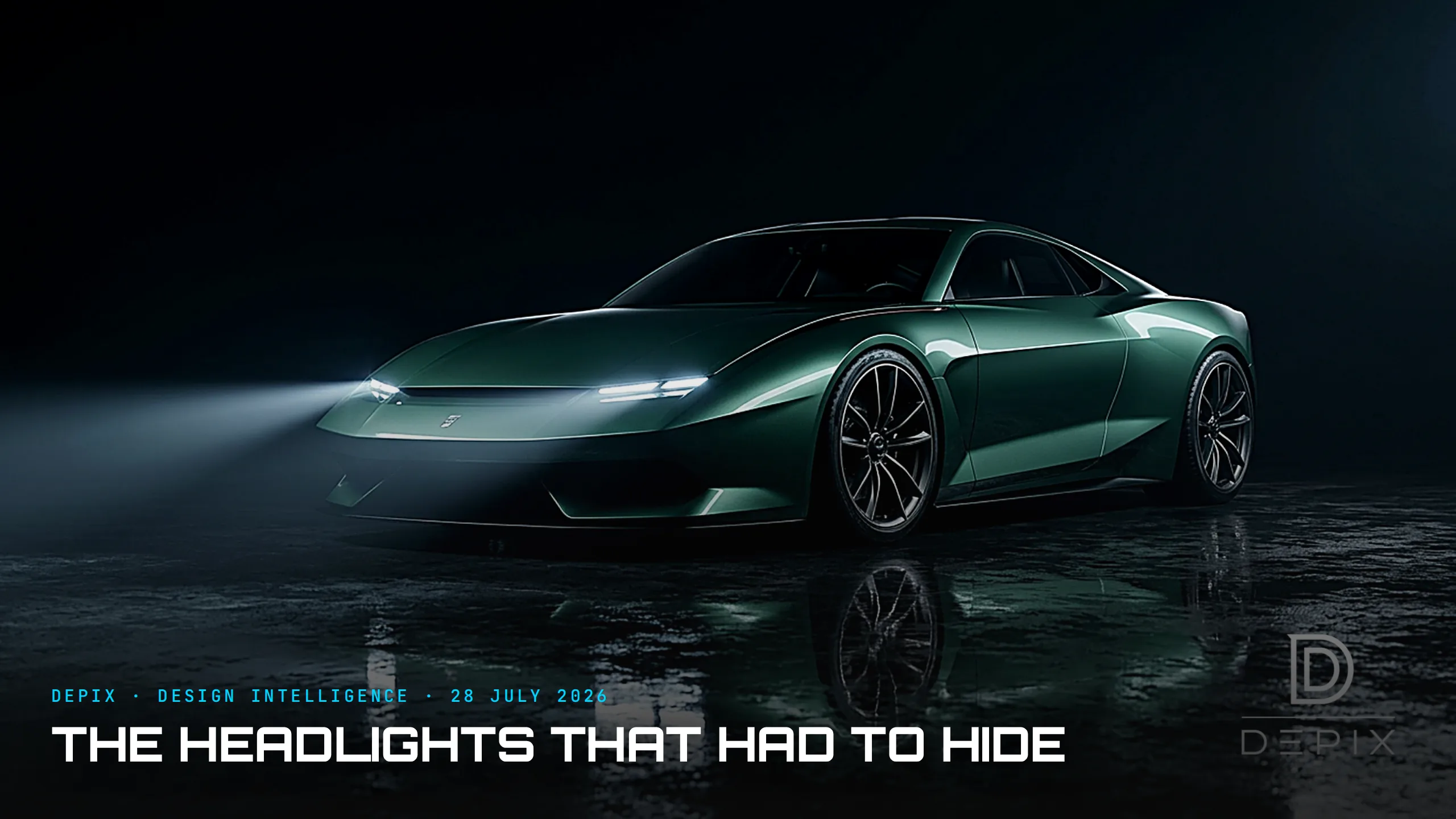
The Headlights That Had to Hide
For about thirty years, the most exciting cars on earth blinked. The Countach, the NSX, the Miata, the Testarossa, the C5 Corvette - their faces were clean, impossibly low wedges by day, and at night two headlamps rose from the bonnet like a creature opening its eyes. Pop-up headlights are remembered as the ultimate design flourish of the wedge era. They were nothing of the sort. They were a workaround.
The origin was regulatory, not stylistic. America's FMVSS 108 rule required every headlamp to sit between 22 and 54 inches above the road - a sensible minimum so lights actually illuminate the road. But designers in the 1970s and 80s wanted the opposite of a tall nose: they wanted the lowest, sharpest wedge they could draw, a bonnet you could almost slide a letter under. Those two demands are irreconcilable - a fixed headlight low enough for the wedge would be illegal. The pop-up dissolved the contradiction: hide the lights in the low bodywork, and raise them to legal height only when needed. The wedge nose that defined an era was not a style. It was what became possible once the headlight-height problem was engineered away.
Which is why the feature's death is so instructive. Pop-ups were not killed by fashion or by taste moving on. They were killed by a different regulation entirely. From the late 1990s, Europe and other markets introduced pedestrian-protection standards demanding smoother, more forgiving front ends. A raised pop-up headlight is a hard, protruding box with sharp edges and a rigid hinge - close to the worst thing you can put on the front of a car that might strike a person. The mechanism also added weight, cost, complexity and failure modes. By 2004 the last two holdouts, the C5 Corvette and the Lotus Esprit, ran out; the 2005 C6 Corvette arrived with fixed lights behind glass, and the pop-up era was simply over.
Here is the design-intelligence lesson, and it is bigger than headlights. The most powerful force shaping a car's face is almost never the stylist. It is an invisible constraint - a regulation, a hard-point, a packaging rule - decided long before anyone draws a surface. The wedge face existed because of a headlight-height number. It died because of a pedestrian-impact number. Two numbers, buried in regulation, authored and then destroyed one of the most beloved design languages in automotive history. The designers got the credit and the blame, but the real author was the constraint. Every wedge that ever turned a head was a negotiation with a rulebook, and almost no one who admired it ever knew the rulebook was there.
That is why constraints belong at the very centre of the concept phase, not treated as an annoyance to be handled later. A team that falls in love with the feature - the pop-up itself - has fallen in love with a symptom. The moment the underlying constraint moved, the feature was doomed no matter how beautiful it was. The teams that endure are the ones who design the constraint, not the ornament: who understand that the low nose, not the popping mechanism, was the actual goal, and that the goal could be reached another way.
And it was. As lighting shrank - composite lenses, then HID, then LEDs a few millimetres thick - the headlight-height problem quietly evaporated. You can now draw a nose as low as any Countach and light it with a sliver of LEDs that needs no concealment at all. The low, predatory face is everywhere again; it simply arrived without the trick, because the constraint that once demanded the trick had dissolved. The people who missed pop-ups were mourning the mechanism. The people who understood design saw that the thing they actually loved - the impossibly low face - had returned, free of its old workaround.
So the pop-up headlight is not really a story about a lost gadget. It is a story about where design authority actually lives: in the constraints, decided early, that most people never see. Fall in love with a feature and you are hostage to the rule that allowed it. Understand the constraint beneath it, and you can keep the thing that mattered long after the workaround is gone - and be ready, when the constraint finally lifts, to build the same dream a better way.
Sources:
- ●https://www.footmanjames.co.uk/blog/pop-up-headlamps
- ●https://automotivehistory.org/history-of-pop-up-headlights/
- ●https://www.headcountcoffee.com/blogs/the-motor-files/the-federal-mandate-that-ended-pop-up-headlights-safety-rule
- ●https://engineerfix.com/why-were-pop-up-headlights-banned/
- ●https://www.military.com/off-duty/autos/why-are-pop-headlights-banned-pedestrian-safety-when-giant-pickup-trucks-are-legal.html
- ●https://suparee.com/blogs/auto-led-bulbs/why-don-t-cars-have-pop-up-headlights-anymore
- ●https://www.carifex.com/blogs/news/why-don-t-modern-cars-have-pop-up-headlights
- ●https://www.motorbiscuit.com/the-2004-chevy-corvette-c5-was-the-last-vehicle-ever-to-have-an-iconic-feature/
- ●https://www.hotcars.com/2004-chevy-corvette-last-car-to-feature-pop-up-headlights/
- ●https://news.classicindustries.com/pop-up-headlights
- ●https://carlightvision.com/blog/why-pop-up-headlights-gone/
- ●https://notjustacar.com/the-real-reason-pop-up-headlights-disappeared/