The Cable You Can't Plug In Wrong
There is a small, universal ritual almost everyone on earth performs. You go to plug in a USB cable, you try it, it does not fit, you flip it, it still does not fit, you flip it back, and now it works. The joke - that a USB plug exists in a kind of quantum superposition, wrong until observed twice - is funny because it is true, and it is true for a specific, avoidable reason. The original USB-A connector, designed in the mid-1990s, is not reversible: it has a top and a bottom, and roughly half the time your hand guesses wrong.
Here is the part that makes it a design lesson rather than a gripe: the man who led the design agrees it was a mistake. Ajay Bhatt, co-inventor of USB, has called the non-reversibility his "biggest annoyance", and put it more bluntly still: in hindsight, "we blew it." And the reason they blew it is the most ordinary reason in engineering. A reversible connector would have needed roughly twice the wires and circuitry - about double the cost - and the team's overriding goal was to make USB cheap enough that every manufacturer would adopt it. They traded the user's daily friction for the industry's adoption. It worked; USB conquered the world. But it conquered one small irritation at a time, billions of times a day, for two decades.
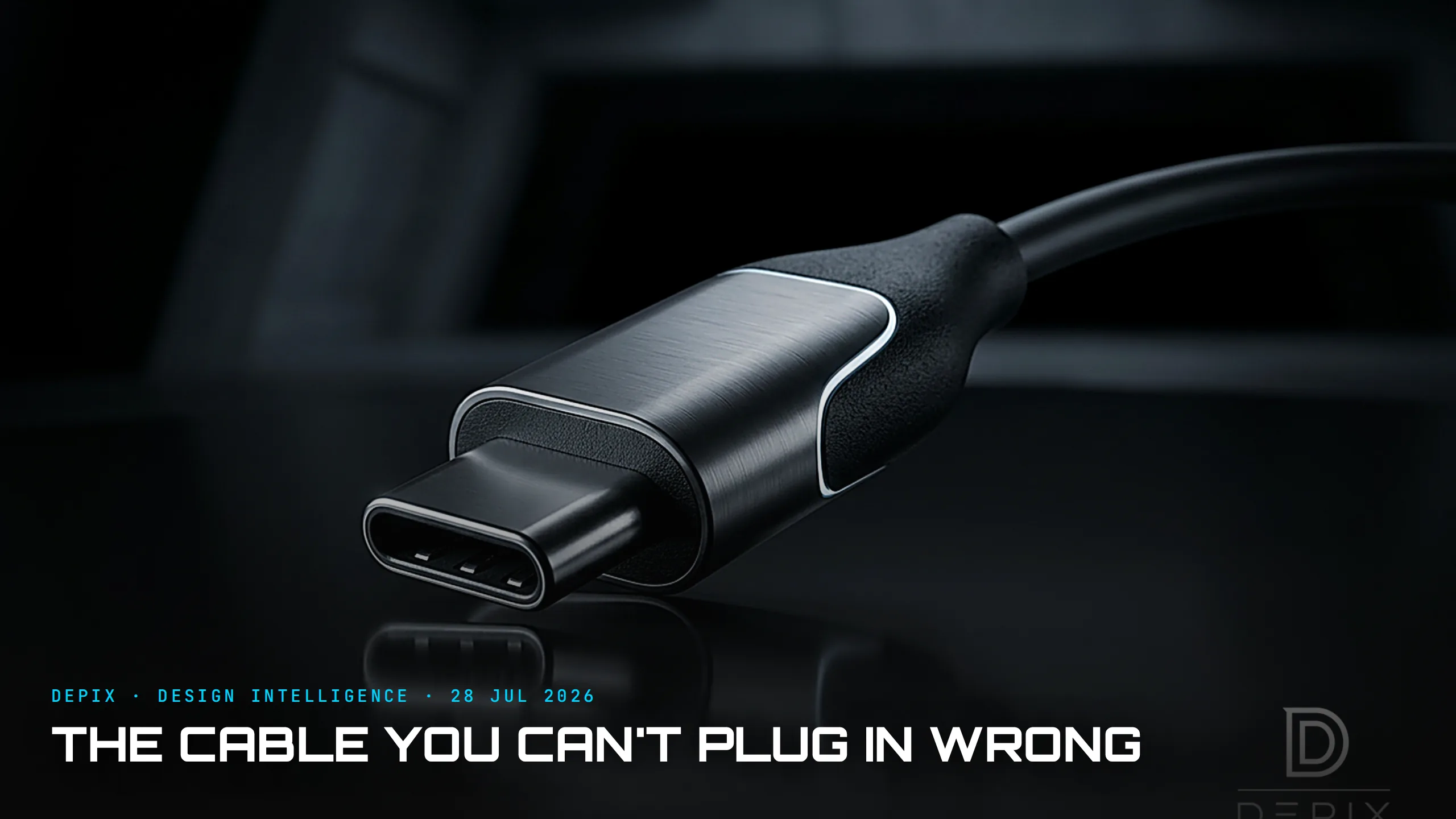
Then USB-C arrived in 2014 and simply deleted the problem. Its connector is rotationally symmetric and reversible - there is no top, no bottom, no wrong way. You do not learn to plug it in correctly; you cannot plug it in incorrectly. This is not a small convenience. It is one of the purest examples in modern product design of a principle the manufacturing world calls poka-yoke, or mistake-proofing: rather than train the user to avoid an error, you redesign the object so the error is physically impossible. The best interface is not the one with the clearest instructions. It is the one that cannot be operated wrong.
That distinction is the whole point, and it is decided at the concept phase. Reversibility is not a feature you can add later; it is baked into the geometry of the connector at its very origin - the symmetry is either designed in from the first sketch, or it is impossible to retrofit without inventing a new plug. USB-A could not be "updated" to be reversible. It had to be replaced. Which is exactly why the cost trade at the start mattered so much: a concept-phase economy, saving a few cents on wires, locked in twenty years of global friction that could only be undone by starting over.
The scale of that starting-over is now visible in law. The European Union has mandated USB-C as the single common charging port for virtually all small and medium electronics sold in the bloc, in force from the end of 2024 - a rule so consequential it forced Apple to abandon its Lightning port and put USB-C on the iPhone, with the standard becoming mandatory across the bloc. The stated aims are less e-waste and lower cost, but the reason it is even possible to standardise on USB-C is that it is a genuinely better-designed object - reversible, capable, symmetric. Good concept-phase design is what makes a thing worthy of becoming a standard. You cannot legislate a bad connector into being loved.
The lesson generalises far past cables. Every product has a version of the USB flip: a moment where the user is asked to supply, from memory or attention, information the design could have made unnecessary - which way the SIM tray goes, which end of the battery is positive, whether the car is really in Park. Each is a place where a designer, at the concept phase, chose to save a little - cost, complexity, symmetry - and quietly taxed the user forever. And each is a place where the better answer was almost always the same: make the wrong action impossible, not merely discouraged.
USB-C is beloved not because it does something dazzling, but because it removed a tiny, daily humiliation that never needed to exist. That is the quiet superpower of design done right at the start: the friction you never notice because it was engineered out before you ever arrived. The original USB taught the world to flip the plug and try again. Its successor taught the better lesson - that the finest thing a design can do is make sure you never had to.
Sources:
- ●https://www.npr.org/2019/06/21/734451600/ever-plugged-a-usb-in-wrong-of-course-you-have-heres-why
- ●https://www.pcworld.com/article/424209/happy-birthday-usb-the-standard-turns-20-and-proud-inventor-ajay-bhatt-tells-all.html
- ●https://www.foxbusiness.com/technology/usb-inventor-ajay-bhatt-annoyance-connector-design
- ●https://en.wikipedia.org/wiki/Ajay_Bhatt
- ●https://www.onlogic.com/blog/usb-type-c-and-usb-3-1-explained/
- ●http://www.monolithicpower.com/learning/resources/usb-type-c-charging-connectors-design-optimization-and-interoperability
- ●https://www.graniteriverlabs.com/en-us/industry-insights/eu-usb-c-regulation
- ●https://www.afnor.org/en/?p=72526
- ●https://eagleeyet.net/blog/it-news/usb-c-becomes-the-new-standard-in-the-eu-is-this-the-end-of-usb-a/
- ●https://www.techradar.com/news/eu-says-apple-must-add-usb-c-charging-ports-to-iphones-from-2024
- ●https://m.gsmarena.com/newscomm-54587p3.php