The Uncopyable Pattern
In 2026, Louis Vuitton is celebrating 130 years of its Monogram - the interlocking "LV" and flower pattern that has become shorthand for luxury itself. It sits on handbags, trunks, sneakers and phone cases; it is arguably the most recognised graphic in fashion. But the Monogram was not born as a status symbol. It was born as a security feature.
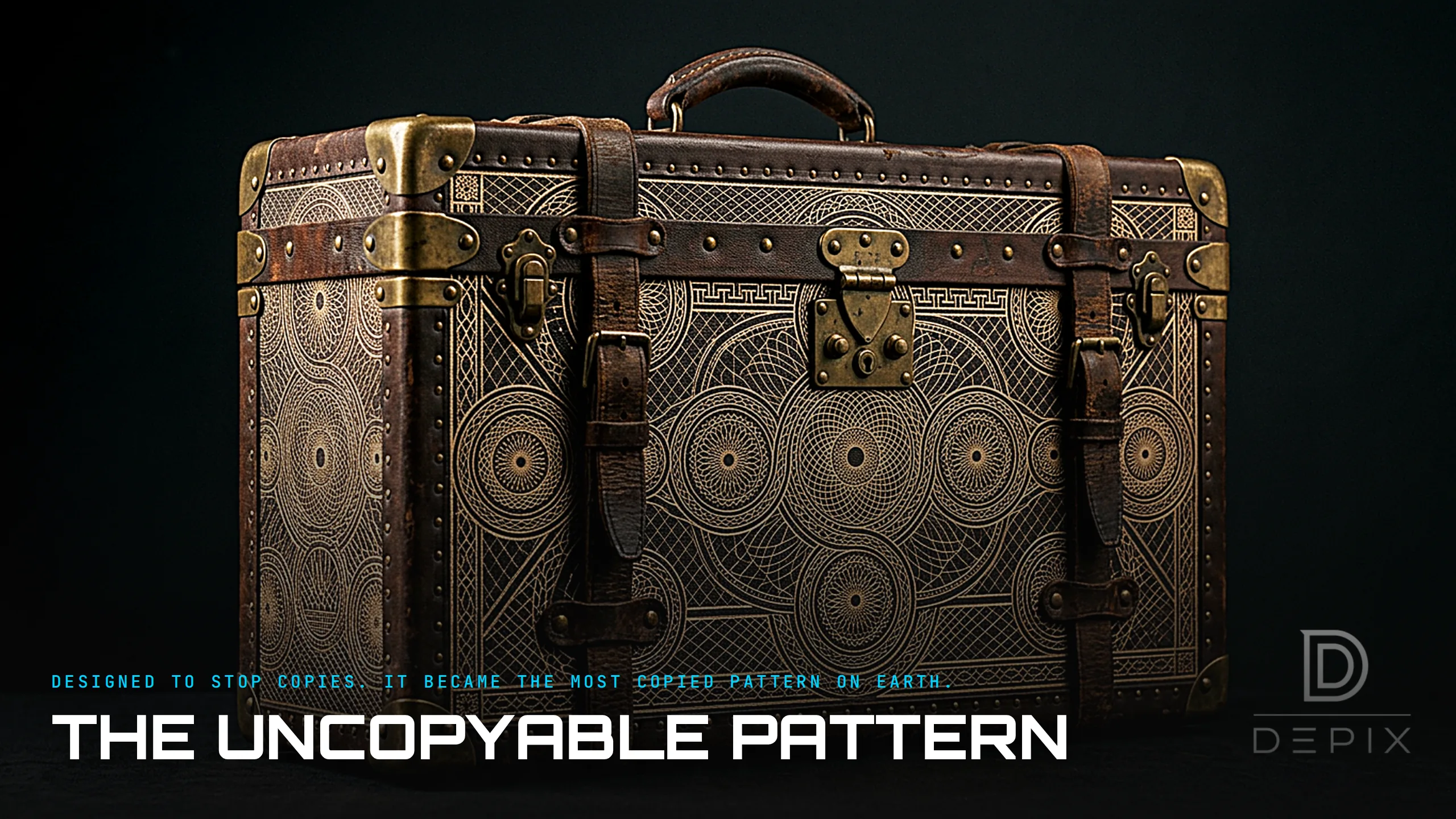
When Georges Vuitton designed the pattern in 1896, a tribute to his late father Louis, the firm that Louis had built since 1854 had a problem: it was being copied relentlessly. Vuitton's plain trunks had been imitated; so had the Damier checkerboard canvas of 1888, even down to its stamped "marque deposee." Georges' answer was to make a mark that was harder to fake and easier to spot. He combined the LV initials with quatrefoils and stylised flowers, motifs drawn from the Neo-Gothic ornament and the Japanese design then sweeping Paris, and registered it as a protected design.
The logic is pure anti-counterfeiting. A good security mark does two things at once: it is difficult to reproduce faithfully, and it is easy to verify at a glance. An all-over pattern, printed edge to edge across the whole surface of a trunk, does both. Registration, alignment, the fineness of the linework - a copyist has to get every one of them right, and any error shows. The Monogram was, in effect, a signature repeated a thousand times and applied everywhere, so that a fake would betray itself.
Then something happened that no security engineer plans for. It worked too well.
Because it was so distinctive, the Monogram stopped being merely a proof of origin and became the thing people wanted - a universal symbol of the brand's world, and eventually a cultural code that read as "luxury" on sight. And the moment a mark becomes that valuable, it becomes worth stealing. Today Louis Vuitton is routinely described as the most counterfeited brand in the world, and it pours vast resources into policing the fakes. The pattern drawn to stop copying is now the most-copied graphic in the history of design.
This is not a failure of execution. It is a structural truth that every identity designer eventually meets: you cannot make a mark that is both universally recognisable and uncopyable. Recognisability is copyability. The instant a pattern is legible enough to signal "authentic" to everyone, it is legible enough for anyone to imitate. A security feature that becomes a status symbol has, by that very success, stopped being a security feature - and the two properties cannot be pulled apart, because they are the same property seen from two sides.
What actually happened to the Monogram is subtler than "it failed." Authentication simply moved. Once the surface could be faked, the real proof of a genuine Louis Vuitton migrated off the pattern and into everything a flat copy cannot carry: the leather, the stitch count, the hardware, the date codes, the trunk itself, the provenance. The Monogram became pure equity - a flag, not a moat. What defends the original is no longer the graphic's secrecy but the coherence of the entire world behind it.
That is the real design lesson, and it is 130 years old. A signature's value and its vulnerability are one thing. What Georges Vuitton got right was not an uncopyable pattern - that is impossible - but a system so complete that the original always leads: a house of materials, craft, story and continuity that a copy of the surface can never fully inhabit. He set that system at the concept stage, in a single decision about a repeating motif, and it has never been redrawn.
Which is why the 2026 anniversary capsules - Monogram Origine, VVN, Time Trunk - do not modernise the mark so much as re-affirm it. After 130 years of continuous evolution in how it is applied, the four core motifs are essentially unchanged. That endurance is itself the authentication. Secrecy could never protect the Monogram; continuity can. The fact that it is exactly the same pattern your great-grandmother would have recognised is precisely what a forger chasing the trend of the season can only borrow, never own.
At Depix, we read the Monogram as a parable about identity design. The most consequential branding decisions are made early, at the concept stage, and they are double-edged: a mark strong enough to mean something is strong enough to be stolen. You do not win that arms race by designing a pattern that cannot be copied. You win it by designing an origin that cannot be moved.
Sources:
- ●https://fashionunited.uk/news/fashion/louis-vuitton-marks-130-years-of-its-monogram-with-heritage-led-collections/2025123085513
- ●https://www.lvmh.com/en/news-lvmh/louis-vuitton-celebrates-130-years-of-its-monogram-a-universal-symbol-of-creativity
- ●https://www.nssmag.com/en/fashion/43808/louis-vuitton-monogram-130-anniversary-2026
- ●https://www.aol.com/articles/real-story-behind-louis-vuitton-203320000.html
- ●https://www.barnebys.com/blog/louis-vuitton-the-man-behind-the-monogram
- ●https://www.hatchwise.com/resources/the-history-of-the-louis-vuitton-logo-and-the-brand
- ●https://en.wikipedia.org/wiki/Louis_Vuitton
- ●https://www.tbfashionvictim.com/130-years-of-the-louis-vuitton-monogram-heritage-in-motion/
- ●https://www.luxemagazineswitzerland.com/post/beyond-luxury-exploring-the-cultural-code-of-louis-vuitton-s-130-year-old-monogram
- ●https://en.wikipedia.org/wiki/Counterfeit_consumer_goods