Sealed and Proven
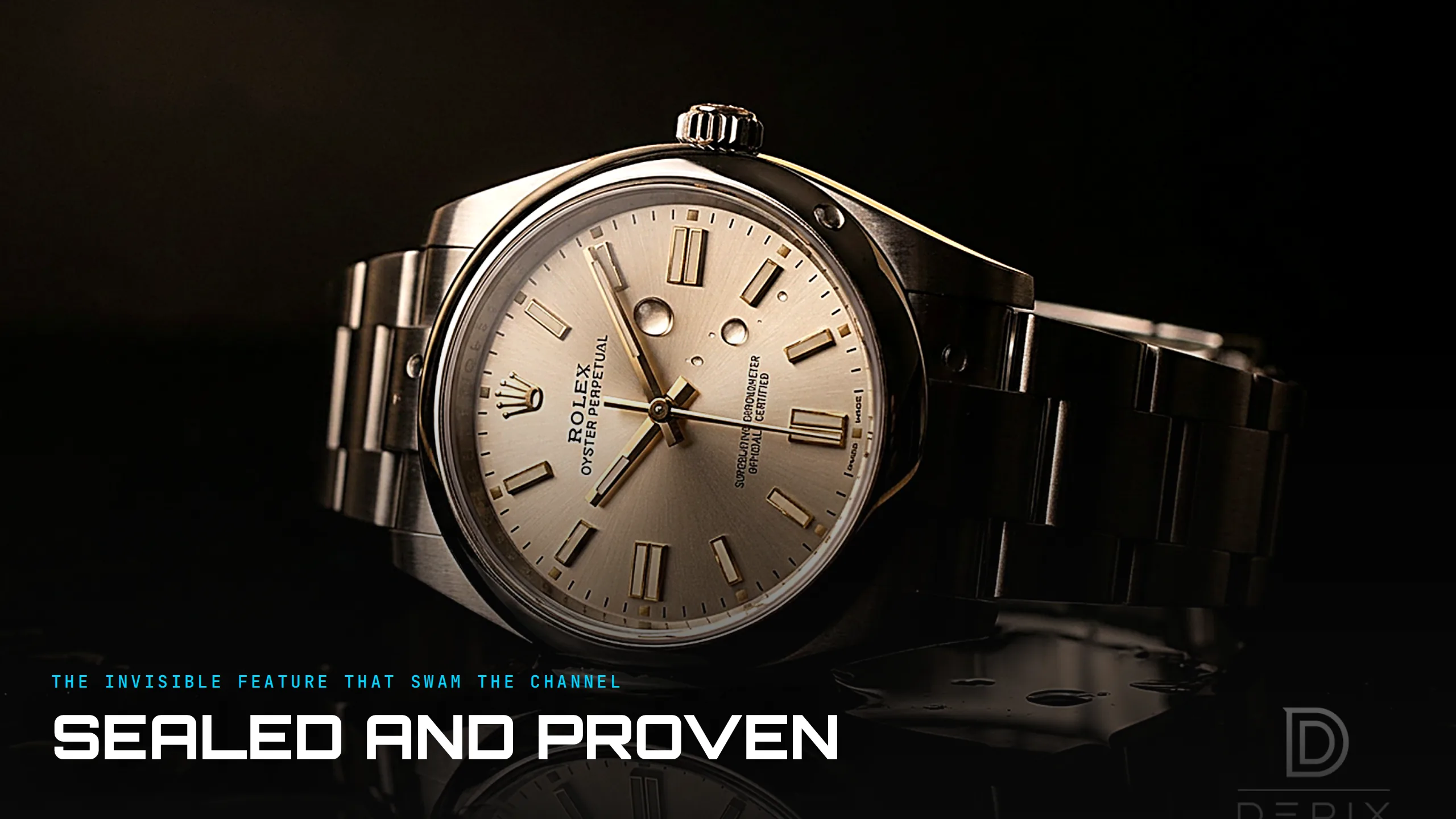
This year marks a quiet centenary that quietly shaped how we think about product design: in 1926, Rolex introduced the Oyster, the world's first genuinely waterproof wristwatch. Its breakthrough was invisible. The Oyster case sealed the watch by screwing down the bezel, the case back and — hardest of all — the winding crown against the middle case, so that, as founder Hans Wilsdorf put it, like an oyster it could stay underwater indefinitely without detriment to its parts. The single most important thing about the watch was something you could never actually see.
That is a peculiar kind of design problem. Waterproofing is not a part you bolt on; it is a property of the whole — every joint, every seam, every opening has to be reconceived around the seal. The winding crown was the crux: the one place a finger must reach into the sealed world to set and wind the watch, and therefore the hardest point of all to close. Wilsdorf's team made integrity the organizing principle of the entire case architecture, not a coating applied at the end. Later refined into Rolex's patented screw-down crown systems, that one detail remains among the few places in any watch where sealing and daily use are in direct tension — you must open the vault to wind it, then close it perfectly, every single time. Get that concept wrong and no amount of finishing saves it; get it right and the feature simply is — silently, permanently.
But here is the trap of an invisible feature: if nobody can see it, nobody believes it. A waterproof watch that looks identical to an ordinary one is, to a buyer, just a claim. Wilsdorf grasped that the Oyster's genius would be commercially worthless unless it could be demonstrated, publicly and unarguably. The design was only half the job. The other half was proof.
So in 1927, Rolex staged one of the most famous demonstrations in the history of marketing. Wilsdorf gave a Rolex Oyster to Mercedes Gleitze, an English long-distance swimmer, who wore it on a cord around her neck during her attempt to swim the English Channel. After more than ten hours immersed in cold sea water, the watch emerged in perfect working order. Gleitze became Rolex's first brand ambassador, and Wilsdorf built a campaign around the feat, taking out a front-page newspaper advertisement that called the Oyster "the watch that defied the Channel." Her original watch is today valued at over a million dollars. The timing was pointed: Gleitze's earlier crossing had been publicly doubted, so this was billed as her "Vindication Swim" — a feat staged to settle a dispute, which made it the perfect stage for a product whose central claim also needed vindicating. The invisible feature had been made visible — not by showing the seal, but by showing what the seal made possible.
This is the entire design lesson in a single object. Some of the most valuable decisions a designer makes are precisely the ones nobody can see when they succeed: waterproofing, structural integrity, crash safety, durability, the quality of a seal or a weld or a joint. They have to be committed to at the deepest architectural level — the concept phase — because they cannot be retrofitted later. And precisely because they are invisible, they carry a second, separate design burden: they must be proven, or they may as well not exist at all. Wilsdorf did both. He built the integrity in, and then he engineered a way for the world to witness it.
A hundred years on, the Oyster case remains the structural foundation of very nearly every Rolex made, and "Oyster Perpetual" is still the name on the dial — a permanent memorial to a decision about sealing taken before a single example could be sold. The centenary is a reminder that a product's soul often lives in what you cannot see: the invisible architectural commitment made early, and the theatre required to make people believe in it. Most features shout for attention, competing to be seen on a spec sheet. The best one Rolex ever designed worked in total silence — and then swam the Channel to say so.
Sources:
- ●SwissWatchExpo — 100 Years of Waterproof: why the 1926 Rolex Oyster is the most important watch ever made
- ●Wikipedia — Rolex Oyster
- ●Wind Vintage — How Rolex became Rolex: the Oyster case story
- ●Bob's Watches — The complete history of the Rolex Oyster case
- ●Sotheby's — The Rolex Oyster that survived the English Channel: the birth of the waterproof watch
- ●Bob's Watches — Rolex waterproof, as proven by Mercedes Gleitze
- ●Bob's Watches — Mercedes Gleitze Rolex: a waterproof Oyster for any swimmer
- ●Robb Report — Mercedes Gleitze's 1927 Rolex Oyster may fetch $1.3 million at auction
- ●Monochrome — Rolex Oyster Perpetual 41 review
- ●SwissWatchExpo — Rolex Oyster Perpetual ultimate guide