Taste Is the Bottleneck
For thirty years, the hard part of design was making the thing. You needed the craft to render it, the hours to iterate it, the skill to execute a vision faithfully. Generation was the bottleneck. In 2026, that bottleneck has quietly moved.
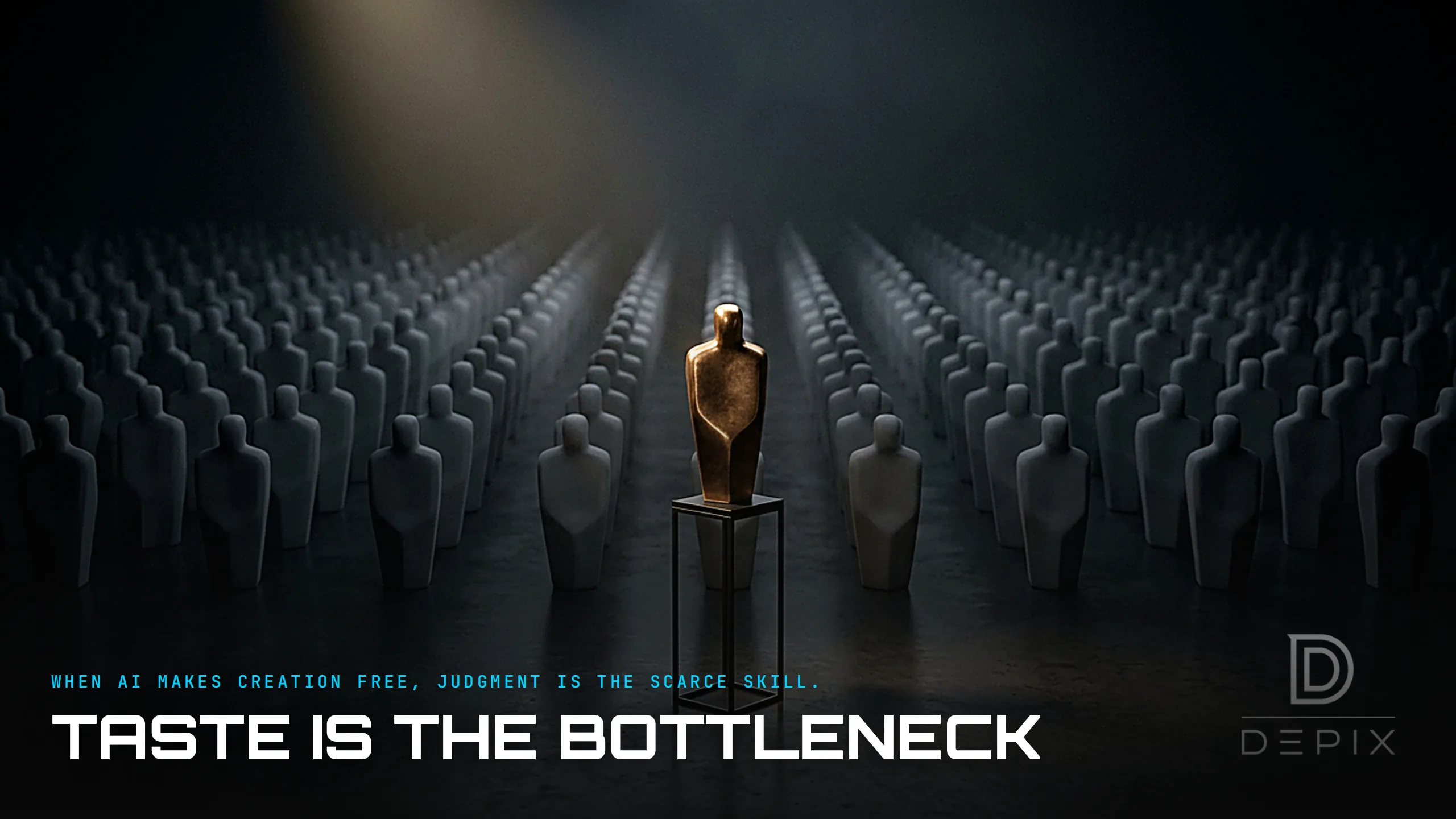
AI can now produce a hundred polished variations of almost anything - a logo, a car fascia, an interface, a room - in the time it used to take to sketch one. Generative tools have made execution nearly free. And the moment execution stops being scarce, something else becomes the constraint. As the design world has been discovering all year, when creation is cheap, value shifts to curation. The new bottleneck is taste.
This is not a soft or sentimental claim. It is a structural one. When access is infinite, value moves to the filter; when noise is ubiquitous, value moves to the signal. A model will happily hand you a thousand options; not one of them tells you which is right. That judgment - knowing what to make, when to stop, what is merely good enough versus what is actually good - is the scarce resource now. What used to distinguish a designer was the ability to generate ideas. What distinguishes them now is the ability to discriminate between them.
You can watch this play out in the rise of vibe-coding and agentic design tools, where anyone can conjure a working app or a finished layout just by describing it. The result is often impressive and just as often subtly wrong - generic where it should be distinctive, tidy where it should be surprising. The gap between "it works" and "it's good" is precisely the gap taste fills, and it has never been more exposed than now, when the first ninety per cent is effectively free and the last ten per cent is entirely judgment.
Taste has turned out to be far harder to automate than many expected. A generated interface can look immaculate and still quietly miss the emotional nuance, cultural context, brand personality or strategic clarity that make it right for this company, this moment, this audience. The machine optimises for plausible; only a person can decide what is true. Good taste has become the new strategy - the durable advantage that survives when everyone owns the same tools.
Where does taste live? Not at the end of the process, in a final polish, but at the very beginning - in the brief, the reference, the target, the definition of "good" that everything after is measured against. This is the concept phase, and it is exactly where AI is weakest and humans are most needed. The most valuable designers of 2026 are not the fastest renderers; they are the ones who write the sharpest briefs, hold the strongest opinions about direction, and can edit a machine's output ten times faster than they could draw it. The work has shifted from making to choosing.
There is a deeper reason taste resists automation. Taste is not a preference; it is cultivated judgment), a compressed history of everything a person has seen, rejected and understood about a field. It encodes context a model does not carry: why this curve feels expensive, why that shade reads as cheap, what a brand must never do. What you choose to build matters more than how you build it - and choosing well is a human act of accumulated discernment, not a computable one.
This reframes what an AI design tool is actually for. It is not a replacement for the designer; it is an amplifier of the designer's taste. Point a strong sensibility at infinite generation and you get a creative superpower - a hundred options triaged in minutes by someone who knows. Point a weak one at the same tool and you get a hundred confident, polished, wrong answers, shipped faster than ever. The tool multiplies whatever judgment you bring to it, including none.
At Depix, this is not an abstraction; it is the whole premise. We build design intelligence precisely so a human's taste can direct machine capability instead of being replaced by it. The concept-phase decision - what to aim for, what to reject, what "right" means for this exact problem - is the one part of design that does not get cheaper as the models get better. If anything it grows more valuable, because it is now the only scarce thing left. The bottleneck did not disappear. It moved upstream, to where it always really was: the moment a person with judgment decides what is worth making at all.
Sources:
- ●https://en.wikipedia.org/wiki/Generative_artificial_intelligence
- ●https://fferoz.medium.com/the-bottleneck-economy-the-real-ai-opportunity-in-2026-13ea9acb2a03
- ●https://www.designative.info/2026/02/01/taste-is-the-new-bottleneck-design-strategy-and-judgment-in-the-age-of-agents-and-vibe-coding/
- ●https://techglock.com/blog/ai-in-design-what-actually-ships-in-mid-2026-and-what-still-falls-apart
- ●https://designerfund.com/blog/ai-in-design-2026
- ●https://edesigninteractive.com/blog/good-taste-ai-strategy-creative-advantage
- ●https://uiuxshowcase.com/resources/ai-in-design-report-2026/
- ●https://aiera.blog/ai-driven-design-trends-in-2026-what-every-designer/
- ●https://en.wikipedia.org/wiki/Taste_(sociology))
- ●https://www.mindstudio.ai/blog/taste-as-durable-ai-asset