The 144-Year Concept Phase
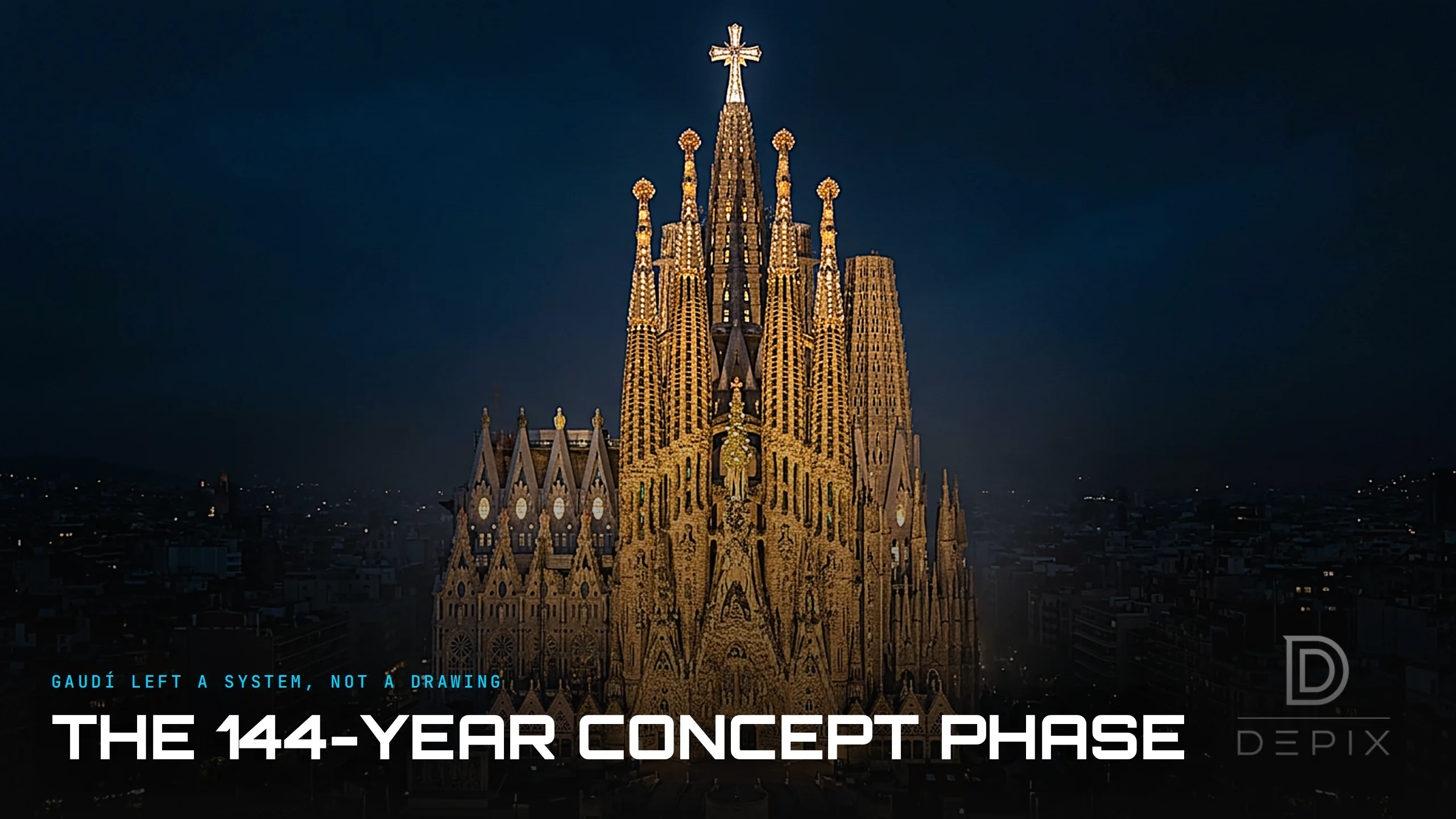
In 2026, something happened that had seemed impossible for over a century: Barcelona's Sagrada Família topped out its central Tower of Jesus Christ, a 172.5-metre spire that makes the basilica the tallest church in the world and finally sheds its long-standing "incompletable" reputation. It arrived exactly one hundred years after the death of its architect, Antoni Gaudí, and 144 years after the first stone was laid. No designer has ever been so absent from the completion of their own masterpiece.
Consider what the builders were actually working with. Gaudí died in 1926 having seen only a fraction of the basilica built, and a decade later, during the Spanish Civil War, almost all of his original drawings and plaster models were destroyed by vandals and looting. The people finishing the building in 2026 could not simply follow his blueprints, because his blueprints were ash. And yet the result is coherent and unmistakably Gaudí. How?
The answer is the most important idea in the whole story, and it is a concept-phase idea. Gaudí did not leave behind a set of pictures to be copied; he left a geometric system and a working method. His forms are built from ruled surfaces — hyperboloids, paraboloids, helicoids and conoids — a rule-based geometry that dispenses with the Gothic buttress altogether. And he designed structure with hanging-chain models: upside-down funicular models in which weighted chains naturally find the ideal load-bearing curve. What he left was something you could re-derive, not merely a shape you had to trace.
This is why architects now describe Gaudí's method as proto-parametric — parametric design a full century before the computer. In a hanging-chain model, move a single anchor point and the entire geometry re-settles into a new optimal form, exactly as a parametric CAD model behaves today. Gaudí encoded his cathedral not as a fixed drawing but as a set of relationships — and relationships survive what drawings cannot. A drawing is a single frozen output; a rule is a machine for producing outputs, and you can rebuild a machine from a fragment of its logic long after every copy of its results has been lost. When the drawings burned, the system itself remained recoverable, from photographs, surviving fragments and the internal logic of the geometry.
Here the story loops. From 2001, the basilica's own workshop adopted 3D printing to reconstruct Gaudí's models and drive the construction forward, translating his ruled-surface geometry into digital models and printed forms. His analog, hand-built parametric method met its digital descendant, and the tools finally caught up to the concept. As one of the project's architects observed, if Gaudí were alive today he would have pushed 3D technology to its limit, because so much of his work was already conceived three-dimensionally. The completion of the tower — blessed by the Pope before roughly 120,000 people on the centenary of Gaudí's death — is a hundred-year-old concept executed with instruments its author never lived to see.
There is even a humility encoded in the geometry: Gaudí deliberately capped the tower just below the height of Barcelona's Montjuïc hill, on the principle that a human creation should not rise above the work of nature. It is a reminder that his system carried not only structure but intent, with interior and finishing work set to continue past the 2026 milestone.
That is the lesson, and it is the most extreme version of one this feed keeps circling. The concept phase is the highest-leverage moment in any project — but Gaudí shows what leverage can really mean. A concept resolved into a system of rules, rather than a single frozen image, can outlive its author, survive the destruction of every drawing, absorb a century of unforeseen technology, and still arrive coherent. Most designers leave behind a picture of the answer; Gaudí left the answer's underlying logic. That is why a man dead for a hundred years could still, in effect, design the tallest church in the world in 2026. In an era racing to generate finished images faster than ever, the Sagrada Família stands as a 144-year argument that the most valuable thing a designer can author is not the drawing — it is the system that can redraw itself.
Sources:
- ●Vatican News — Central tower of Barcelona's Sagrada Família completed (Tower of Jesus Christ)
- ●ArchDaily — Gaudí's Sagrada Família to become the tallest church by 2026
- ●The Art Newspaper — Sagrada Família finally shakes off its 'incompletable' tag
- ●Wikipedia — Sagrada Família
- ●Criticalista — Gaudí's hanging chain models: parametric design avant la lettre?
- ●Parametric Architecture — The idea behind La Sagrada Família: Gaudí's hanging chain model
- ●ArchDaily — Construction of Sagrada Família accelerated by 3-D printing technology
- ●Materialise — Sagrada Família: Magics meets modernism
- ●TCT Magazine — Modernism meets 3D printing: Sagrada Família
- ●Euronews — Pope blesses completion of Sagrada Família's tallest tower, drawing 120,000
- ●Sagrada Família 2026 — 100th anniversary of Antoni Gaudí's death