The Planted Look
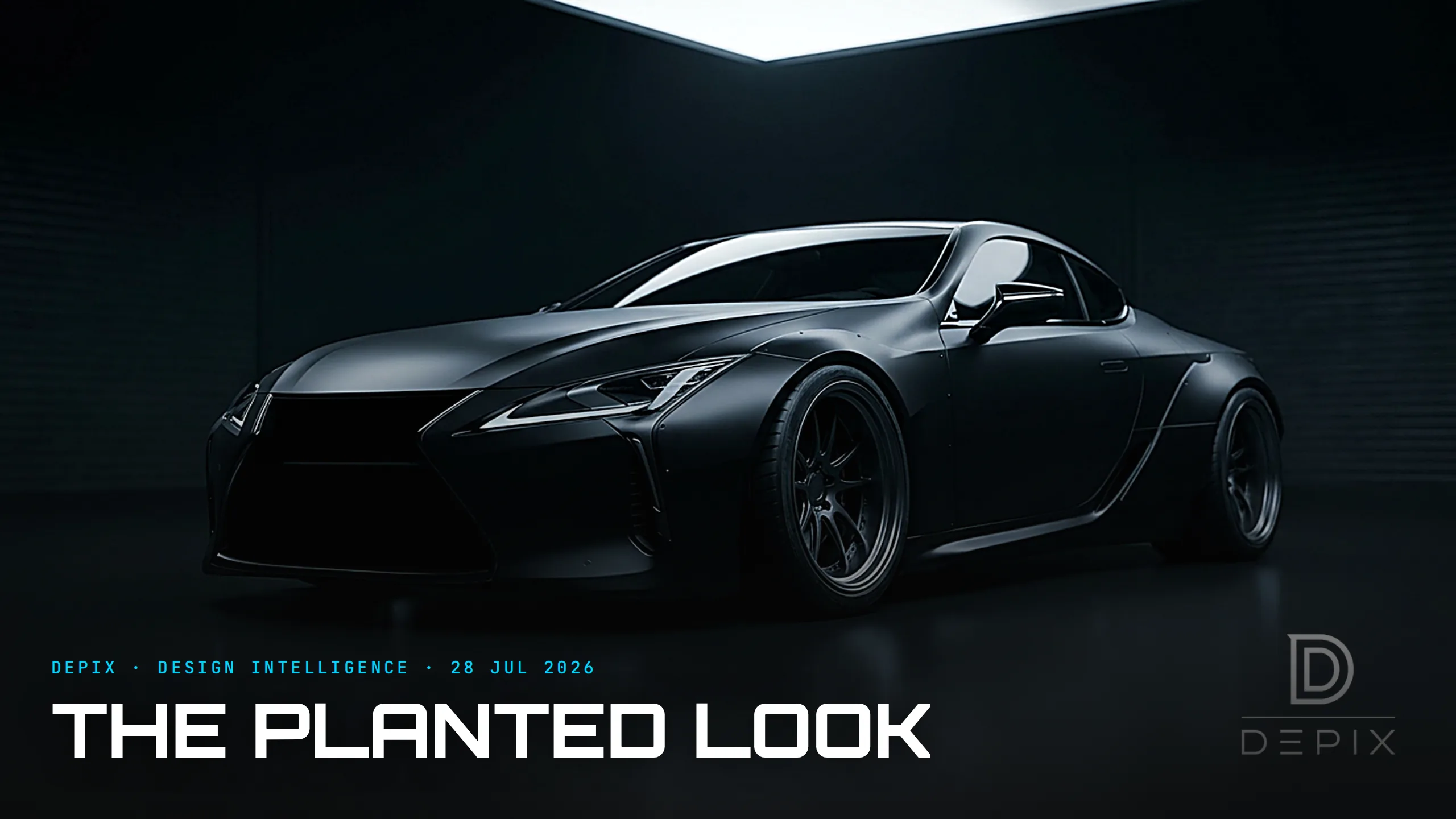
Before a car has a face, a grille, a light signature or a badge, it has a stance. Stand a great design and a forgettable one side by side and the difference you feel before you can name it is almost never the surfacing - it is the way the car sits on its wheels. How wide the track is, how far the wheels are pushed toward the outer edges of the body, how tightly they fill their arches. Get that right and a shape reads instantly as planted, athletic, confident, expensive. Get it wrong and the same car looks tippy, cheap and forgettable, no matter how carefully the lines were drawn.
This is the least-discussed and most powerful lever in car design, and every designer knows it - which is why concept sketches are drawn the way they are. Ask why designers always draw absurdly huge wheels pushed hard into the corners, and the honest answer is that the wheels and the stance ARE the emotion: a big wheel filling a tight arch, a wide track, almost no overhang, and the car looks fast standing still. Sports-car design is, at its foundation, the management of this stance - the wheel-at-corner look, with only around 40-60mm of body overhang past the tyre on a performance car versus 85-90mm on a mainstream one, communicates intent before you have consciously registered anything. Even Pontiac built a whole campaign on it in the 1990s: "wider is better."
The width itself has a name - track width, the distance between the left and right wheels - and it does double duty. Engineered wide, it lowers the car's centre of gravity and genuinely improves stability and cornering; drawn wide, it lowers the car's visual centre of gravity and makes it look planted. The enthusiast world has turned the aesthetic half of this into an obsession: the entire culture of wheel offset and fitment, of getting the wheel face flush with the arch, of stance, exists to claw back the planted look the factory left on the table.
And that is the quiet tragedy of the stance: it is the first thing production takes away. Nearly every concept car is more beautiful than the car it becomes, and the reason is almost always the stance. A concept is designed in a vacuum - no real engine, no cooling, no crash structure, no wiring harness, no shared platform - so the designer can put the wheels exactly where the eye wants them. Then reality arrives. The wide track narrows to fit existing suspension pickup points; the ride height rises to clear the hardware and hit ride-quality targets; the overhangs grow; and the huge concept wheels shrink into smaller wheels with taller sidewalls, opening up the dreaded gap between tyre and arch. What enthusiasts feel as disappointment when a concept becomes just another car is, more than any single line, the collapse of the stance.
Here is why it matters so much: stance is not a styling choice made late, it is an architecture decision made first. Track width, wheel position, ride height and overhang are hard-points, set when the platform and the package are laid out, and they cascade into everything - proportion, aerodynamics, interior space, dynamics. By the time a designer is refining surfaces, the wheels are already where the architecture put them. You cannot style your way to a planted look on a car whose hard-points sat the wheels too narrow and too far inboard; no amount of beautiful surfacing rescues a bad stance. It is the foundation the entire design stands on, and it is nearly impossible to recover once the architecture is frozen.
Which is exactly why the studios that care fight for stance at the very start - widening the track a few millimetres, pushing the wheels outboard, holding the ride height down, shaving the overhang - long before anyone argues about the shape of a lamp. They are not fussing over a detail; they are protecting the single decision that determines whether the finished car will look like the concept everyone fell in love with, or like the deflated version that turns up in traffic four years later.
That is the whole case for treating stance as a first-class concept-phase decision rather than something admired in a sketch and quietly surrendered in engineering. The planted look the concept promised only survives if it is defended against the hard-points from the beginning - locked with the real package, not drawn in a vacuum and mourned in production. Because the truth every designer knows and every spec sheet hides is simple: a car is its stance first, and everything else second. The face sells the photo. The stance sells the car.
Sources:
- ●https://www.theautopian.com/this-is-why-car-designers-always-draw-absurdly-huge-wheels-on-everything/
- ●https://vizcom.com/blog/sports-car-design
- ●https://journal.classiccars.com/2026/07/22/pontiac-claimed-wider-is-better-in-the-late-1990s/
- ●https://carxplorer.com/what-is-car-track-width/
- ●https://www.linkedin.com/pulse/what-track-width-tw-hugo-cheng-6k9ac
- ●https://curvaconcepts.com/resources/offset-optimization/
- ●https://www.detailingempire.com/the-aesthetics-of-wheel-alignment-how-it-impacts-car-stance
- ●https://www.jalopnik.com/2217799/which-concept-cars-spawned-most-disappointing-production-vehicles-reader-question/
- ●https://www.hotcars.com/disappointing-cars-that-look-nothing-like-their-concepts/
- ●https://carcody.com/20-concept-cars-that-went-so-wrong-in-production/
- ●https://www.carthrottle.com/features/10-concept-cars-disappointing-transitions-production
- ●https://carbuzz.com/10-car-designs-worse-than-concept/