The Mirror That Became a Camera
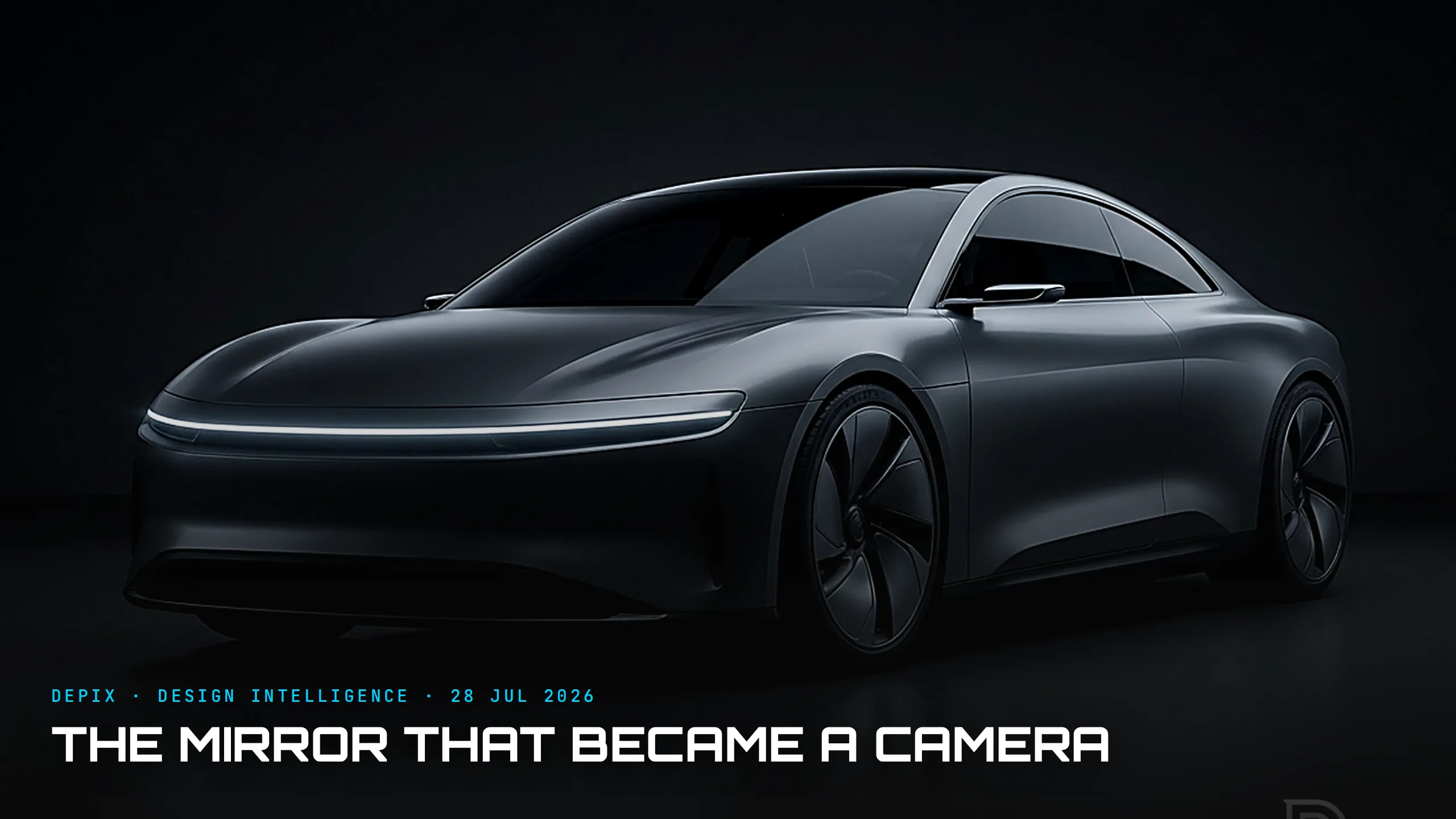
The exterior wing mirror is a strange survivor. It is a lump of glass on an aerodynamic stalk, essentially unchanged since the 1910s, and one of the last purely mechanical interfaces left on a car in an age when almost everything else has become a screen or a sensor. It is also a designer's headache: a fixed protrusion that interrupts the flank, adds drag, generates wind noise, and creates its own blind spot. So the obvious move, the one every studio has sketched, is to delete it - replace the glass with a small camera and an interior screen, the Camera Monitor System (CMS), or "virtual mirror."
The technology is real and shipping. Japan allowed it first, in 2016, and the Lexus ES got digital side monitors there in 2018; Audi's e-tron brought slim camera stalks feeding door-mounted OLED screens to Europe in 2019. The engineering case is genuine: the virtual mirror lowers the drag coefficient by about 0.02 Cd and adds roughly 5% to range and efficiency, on top of a cleaner surface and narrower overall width. For years the United States kept it effectively locked out - FMVSS 111 is still written around a required driver-side outside mirror - which is why Audi petitioned NHTSA for an exemption and one writer fairly called the feature "forbidden technology."
But the camera is not a free win, and the reason is pure design intelligence: it does not just replace a mirror, it moves the driver's eyes. A mirror sits out in the world, in your peripheral vision, at roughly the distance your eyes are already focused on the road. A screen sits inside the cabin, at a different depth, and asks your eyes to refocus and your brain to rewire itself, at least a little. Reviewers who lived with the system describe exactly this: an adaptation period and odd depth perception, and the discovery that a door-mounted screen can be blocked by a passenger or a bag in a way a mirror never is. The designer has traded a small aero-and-surface gain for a new cognitive cost, and has opened a fresh problem - where does the screen go: the top of the door, the base of the A-pillar, the dashboard? - that simply did not exist with a piece of glass.
Here is the concept-phase point. Mirror-versus-camera is not a trim option bolted on at the end; it is an architecture decision. It changes the door (a stalk mount versus a screen housing), the A-pillar, the interior display layout, the wiring loom and the aero targets - all of which are fixed at the very start of the program. You cannot add virtual mirrors to a car designed around glass ones, or the reverse, without redoing the door and the dashboard. By the time anyone is choosing paint colours, the decision has already shaped the car. Audi even had to build the OLED screens and their housings into the door architecture from the outset.
And underneath the packaging is a genuinely philosophical choice, also made at concept: are we optimising for the clean surface and the drag number, or for the driver's instinctive, eyes-on-the-world glance? Both are defensible. What is not defensible is deciding by default - letting "a camera looks like the future" quietly win over "does this actually help the person driving," or letting "mirrors are what we have always done" win over a real improvement, without ever modelling the human cost. The safety case cuts both ways: cameras can shrink blind spots and see better in rain and dark, but they add a failure mode a mirror never had - a dead camera or a frozen screen leaves you blind on that side.
The mirror-to-camera switch is a near-perfect small case study in what we care about at Depix. It looks like a styling upgrade - a cleaner flank, a lower drag figure, a screen that signals "future" - but it is really a human-factors and architecture decision that reshapes how the driver sees the road. The best version of it is not "camera good, mirror bad"; it is a team that modelled the actual trade at the concept phase - the aero gain against the refocus cost, the screen placement, the new failure mode - and chose on purpose.
Because the wing mirror lasted a century for one honest reason: you looked out at the world, and you saw the world. A camera can beat it. But only if the team designs for the eyes and not just the surface, and does it first - while the door, the dashboard and the drag budget are all still on the table.
Sources:
- ●https://www.radiantvisionsystems.com/blog/quality-testing-camera-monitoring-systems-cms-meet-automotive-standards
- ●https://evcentral.com.au/virtual-mirrors-audi-e-tron-digital-first/
- ●https://www.techradar.com/news/audi-e-tron-sportback-its-digital-mirrors-will-prepare-you-for-the-future-of-driving
- ●https://www.whichcar.com.au/car-style/audi-virtual-mirror-explained
- ●https://betalight-tactical.com/knowledge-base/regulations/fmvss-111
- ●https://www.federalregister.gov/documents/2019/10/10/2019-22036/federal-motor-vehicle-safety-standard-no-111-rear-visibility
- ●https://www.motorbiscuit.com/forbidden-technology-virtual-mirrors-work/
- ●https://caraiblog.com/are-digital-side-mirrors-the-future-or-a-safety-risk/
- ●https://www.thedrive.com/tech/24309/testing-the-audi-e-trons-virtual-side-view-mirrors-is-the-camera-based-system-ready
- ●https://www.energytrend.com/news/20201123-19958.html
- ●https://magazine.audi.com.au/article/mirror-image