The Surface You Never Notice
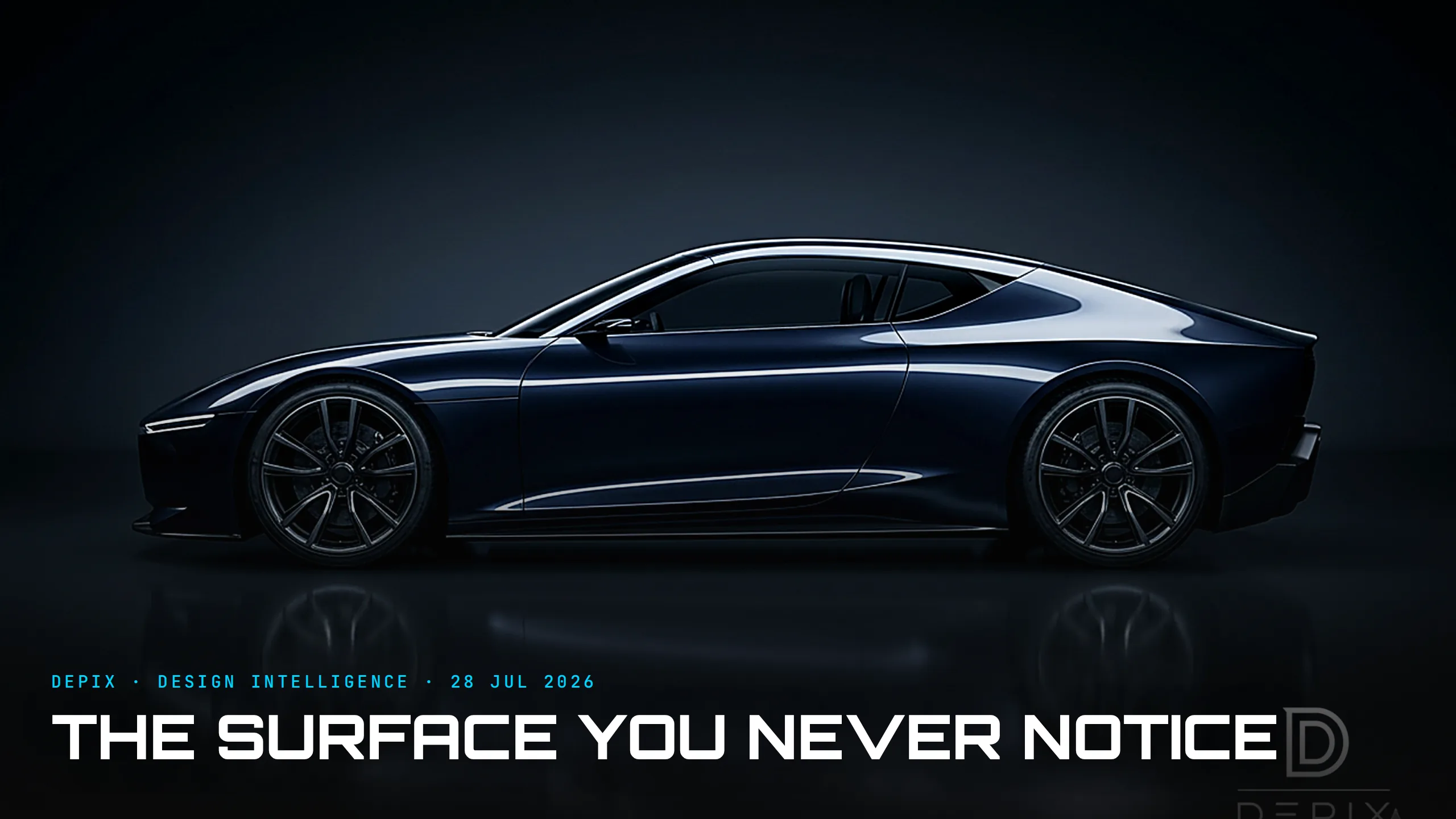
Walk past two cars - one premium, one budget - and you will feel which is which before you read a badge, often before you consciously look. A surprising amount of that instant read is something almost nobody can name: the way light flows across the body. On a great car, a reflection - a strip light, the edge of a building, the sky - glides across the panels in one continuous, unbroken sweep. On a cheap or poorly made one, that same reflection wobbles, kinks, or snags at a panel edge. This is Class-A surfacing: the elite, near-invisible craft of making a car's visible surfaces mathematically perfect so the highlights run clean.
The technical heart of it is curvature continuity. Two surfaces can meet in deepening degrees of smoothness: G1, where they are merely tangent and there is no hard edge; G2, where their curvature actually matches so a reflection does not jump as it crosses the join; and G3, where even the rate of change of curvature matches and the reflection glides with no ripple at all. Class-A work demands G2 and often G3 across every patch of the body. It is regularly called the "holy grail" of surface modelling, and it is done by a specialist - the Class-A modeller, working in tools like Alias, ICEM Surf and Catia - whose whole job is to judge, patch by patch, which mathematics will make sunlight run smooth on the finished car.
It is invisible when it is right. Nobody has ever stood in a showroom and thought "what beautiful G3 continuity." You only ever notice the surface when it is wrong: the flat spot, the highlight that catches, the reflection that waves down the flank of a car that somehow just looks cheap. And that is precisely where premium is quietly won or lost. In the upper segments, brands differentiate substantially on the quality of the painted body - the perceived quality that flawless surfacing delivers. The customer never sees the mathematics; they see and feel the result: a surface that reads as expensive, cared for, resolved. The entire discipline exists to convert invisible geometric precision into a visible sense of quality - and it has become rigorous enough that manufacturers now measure it with metrology rather than trusting the eye alone, and even work to take the subjectivity out of judging it.
Here is the concept-phase point, and it is a subtle one. Class-A is usually described as the "craftwork end" of the process - the final polish after the design is decided. But which surfaces can be made Class-A is largely determined much earlier. A feature line drawn carelessly in the sketch, a proportion that forces an awkward transition, a section that simply cannot hold its curvature - these bake in problems that the modeller can only mitigate later, never fully fix. The best studios surface with the end in mind from the very start: they design forms that WANT to be Class-A, where the highlights already flow in the concept, rather than forms that fight the mathematics and hope a modeller can rescue them at the end. Getting a surface right is cheapest while the surface is still only an idea.
The deeper lesson is about invisible quality in general. The most expensive craft on a car is the one nobody can point to: the reflection that does not wobble, the highlight that runs clean from headlamp to tail. It costs enormous skill and time, and it announces itself only by the absence of flaws. That is a hard thing to fund and a harder thing to sell, because the reward for perfect Class-A surfacing is that no one ever notices it. Yet it is exactly the quality that separates a car that feels premium from one that merely wears the same shape.
Which is why surface quality has to be a concept-phase intention, not a late rescue. You cannot bolt "flows beautifully" onto a form that was never drawn to flow. You decide, right at the beginning, whether this car will have surfaces that make the light behave - or surfaces a modeller will spend two years fighting. The reflection you never notice is the one somebody chose, on purpose, before the shape was even real.
Sources:
- ●https://en.wikipedia.org/wiki/Class_A_surface
- ●https://help.autodesk.com/cloudhelp/2024/ENU/Alias-Getting-Started/files/theory-builders/GUID-64611955-D2CC-44F2-98F0-D4F1FE931D8B.html
- ●https://pshdesign.com/understanding-class-a-modeling/
- ●https://skill-lync.com/blogs/all-about-class--a-surfaces
- ●https://pshdesign.com/class-a-surfacing/
- ●https://themodeldesign.net/class-a-surfacing-big-deal/
- ●https://www.autoform.com/en/glossary/class-a-surface/
- ●https://www.inorigin.eu/class-a-surface/
- ●https://industrial-ia.com/metrology-of-class-a-surfaces-in-automotive-manufacturing/
- ●https://www.compositesworld.com/articles/automotive-composites-taking-subjectivity-out-of-class-a-surface-evaluation
- ●https://pshdesign.com/cas-design-and-class-a-from-concept-to-perfection-psh-design/