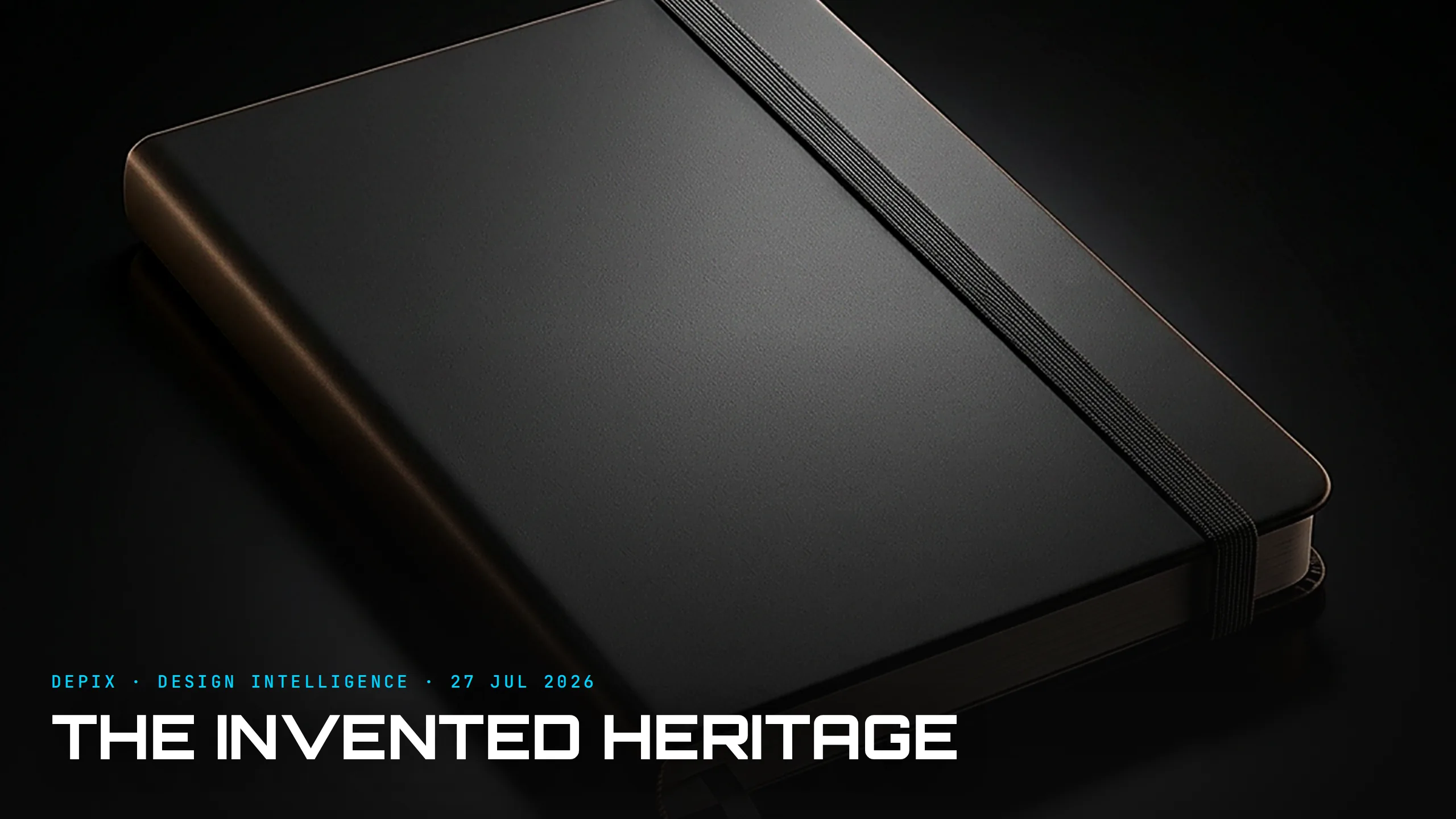
The Invented Heritage
Open the back cover of a Moleskine notebook and you will find a small printed legend: this is the heir and successor to the legendary notebook used by artists and thinkers over the past two centuries - the notebook of Van Gogh, Picasso, Hemingway and Chatwin. It is a lovely story, and it sells beautifully. It is also, in almost every meaningful sense, an invention of 1997.
Start with what is true. For roughly a century, small French bookbinders made plain black notebooks with oilcloth covers, rounded corners and an elastic band. They had no brand name; "moleskine," lowercase, was simply the generic word for the covering. The writer Bruce Chatwin loved them, and in his 1987 book The Songlines he mourned that his Paris stationer's supplier had died and the little notebooks were no longer made. That elegy is the seed of everything that followed.
In 1995, an Italian consultant named Maria Sebregondi read Chatwin and had an idea. She took it to Modo & Modo, a small Milanese stationery firm, which trademarked the generic word "Moleskine," revived the format, and in 1997 sold its first 5,000 notebooks. Within a year it was 30,000; soon it was a global lifestyle brand, eventually manufactured in China and floated on the Milan stock exchange.
Here is the sleight of hand. Van Gogh and Picasso did use plain black notebooks - but they never used a Moleskine, because as a brand it did not exist until more than four decades after Picasso died. The company took a genuine, ownerless tradition and did something audacious: it attached a specific, romantic provenance to a newly trademarked product. The heritage is real in spirit and manufactured in fact. What Modo & Modo actually invented was not the notebook. It was the story of the notebook.
And that is the point, not the scandal. The Moleskine is a competent object - decent paper, a nice band, rounded corners - but on the shelf it is unremarkable, and blind-tested against a dozen rivals it would be hard to pick out. What you are buying, and what commands the premium, is meaning: the sense that this small black book connects you to a lineage of artists and travellers, that it is not a commodity but a book yet to be written. The physical design is ordinary. The narrative design is extraordinary.
Look closely and you can see the story engineered into the object itself. The printed heritage note inside the cover; the "in case of loss, please return to..." page with a blank space for a reward; the little expandable pocket in the back for loose notes and mementos. None of these makes the notebook write better. All of them are narrative hardware - physical details whose only job is to make the myth tangible, to turn a blank book into a companion with a biography. The meaning was not merely claimed in an advert; it was built into the product.
We are trained to treat a product's story as marketing's job, bolted on after engineering and industrial design have finished the "real" work. The Moleskine is a reminder that this is backwards. Narrative is a design material, and provenance, meaning and myth are decided - authored - as deliberately as a radius or a finish. Two physically identical notebooks, one anonymous and one carrying a hundred years of borrowed romance, are not the same product at all. The difference was designed.
There is an ethical edge here, and it is worth naming: a manufactured heritage shades easily into a dishonest one, and the Songlines connection is the honest half while "the notebook of Van Gogh" is the embellished one. Story is powerful precisely because it is not neutral. But the more common mistake, by far, is not over-storying a product - it is under-designing its meaning entirely, and shipping something excellent that no one can be bothered to care about.
At Depix, we treat the concept phase as the moment you decide not only what a thing is, but what it means - because those are the same decision, made at the same time. A shape can be owned; so can a story. The Moleskine did not win by being the best notebook in the room. It won by being the only one with a past - and it wrote that past itself.
Sources:
- ●https://en.wikipedia.org/wiki/Moleskine
- ●https://www.moleskine.com/en-us/the-world-of-moleskine/our-heritage/
- ●https://en.wikipedia.org/wiki/Bruce_Chatwin
- ●https://en.wikipedia.org/wiki/The_Songlines
- ●https://www.finestresullarte.info/en/works-and-artists/the-whole-story-of-the-moleskine-notebook-a-book-to-write-and-a-story-to-tell
- ●https://notedinstyle.co.uk/blog/2020/01/moleskine-history-buliding-a-legendary-brand/
- ●https://www.gourmettraveller.com.au/travel/travel-news/how-moleskine-transformed-the-humble-notebook-into-a-travel-essential-15894/
- ●https://thewalrus.ca/moleskine/
- ●https://www.newsweek.com/resurrecting-moleskine-notebooks-67817
- ●https://en.wikipedia.org/wiki/Storytelling
- ●https://writingatlarge.com/2019/06/07/moleskine-bruce-chatwin-songlines-anniversary-limited-edition/
- ●https://www.tannerbates.co.uk/blogs/news/behind-the-cover-the-fascinating-historical-tale-of-moleskine-journals