The Inside-Out Car
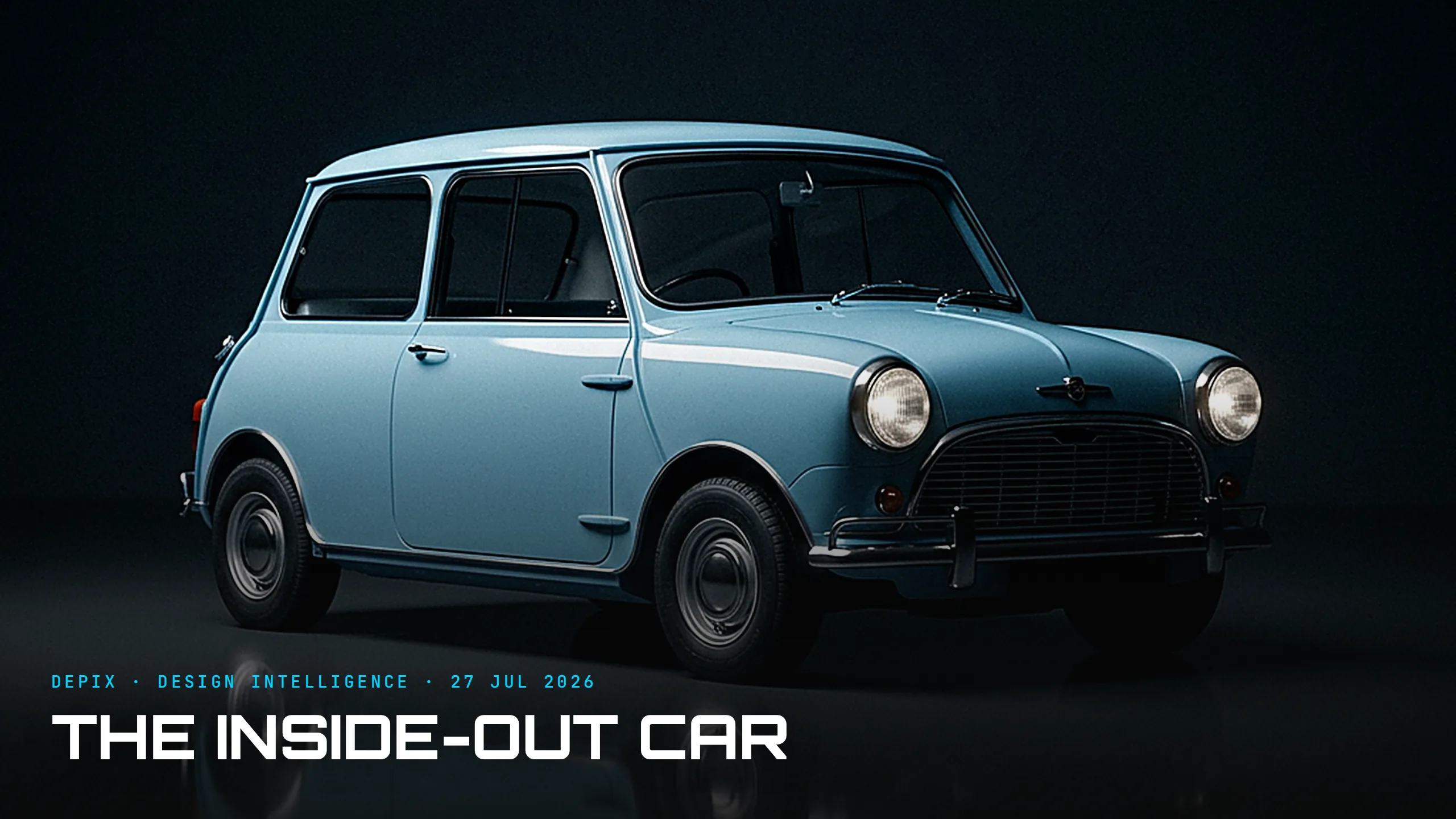
In 1959, Alec Issigonis unveiled a car that was ten feet long and yet handed roughly eighty percent of its floor to the people inside it. The original Mini) is remembered for its cheeky face and its giant-killing runs at Monte Carlo, but the face was a by-product. What actually made it revolutionary was invisible: the order in which its designer chose to solve the problem.
The brief came from a crisis. The 1956 Suez emergency triggered petrol rationing in Britain and a sudden appetite for tiny, frugal cars. BMC asked Issigonis for a proper small car - room for four adults and their luggage, cheap to buy and to run, in the smallest possible footprint. That last constraint is where most engineers would have started shrinking a conventional car. Issigonis did something stranger. He started from the inside.
Convention builds a car outward from its machinery: lay down an engine and gearbox, add a drivetrain, then package the passengers into whatever room is left. Issigonis inverted the sequence. He first drew the box the humans needed - four seats and a boot - and then treated every mechanical component as a problem to be folded into the leftover margins. Almost nothing about the Mini's engineering makes sense except as a consequence of that decision.
To claw back the space a conventional engine bay would eat, he turned the engine sideways - a transverse layout - and, when even that was not compact enough, stacked the gearbox underneath it in the sump), sharing the same oil. He drove the front wheels, which deleted the propshaft and the transmission tunnel running through the cabin. He specified ten-inch wheels - absurdly small - and pushed them hard into the four corners, which freed the middle for people and, as a bonus, gave the car its famous go-kart agility. Every one of those now-legendary features is not a styling flourish. It is space, reclaimed for a passenger, by moving a machine out of the way.
The result reset the industry. Front-wheel drive with a transverse engine, wheels at the corners, the mechanicals compressed into the ends - this is now the near-universal layout of small and medium cars worldwide, the template every manufacturer eventually copied. The specific car went out of production, was reborn as a fashion icon, changed owners across decades. But the architecture Issigonis chose in 1959 is still under the floor of the car in your driveway. The decision outlived the object by generations.
Here is the concept-phase lesson, and it is a subtle one. The most influential move Issigonis made was not a shape, a material or a feature. It was an ordering. He changed which decision came first. Design almost always inherits a sequence - engine, then platform, then body, then interior, then styling - and teams spend their careful energy optimising within that inherited order, making the eventual result a little better at each stage. What they rarely do, because it is expensive and requires authority, is question the order itself. Issigonis did, and by putting the human experience at the front of the queue he made every downstream decision serve it. The famous silhouette simply fell out of the packaging; it was an outcome, not a goal.
This is not free. Inside-out design turns the mechanical packaging into a fiendish puzzle - the gearbox-in-sump was clever and also, for years, temperamental - and it demands the rare standing to overrule the way things have always been done, plus the nerve to hold that line for years while the packaging fights back. But when it works, the order of priorities you set becomes the one thing about a product that cannot be retrofitted later. You can restyle a car forever. You cannot, after the architecture is frozen, decide that the passengers should have come first.
At Depix, we treat this as the real work of the concept phase: not "how should this look," but "in what order should we decide?" Because the sequence of decisions silently determines everything that follows, and it is the earliest, cheapest, and most permanent choice a design ever makes. Issigonis did not draw a small car. He asked the question in a different order - and the world has been copying his answer ever since.
Sources:
- ●https://en.wikipedia.org/wiki/Alec_Issigonis
- ●https://en.wikipedia.org/wiki/Mini_(Mark_I))
- ●https://en.wikipedia.org/wiki/Mini
- ●https://carbuzz.com/first-mini-built-66-years-ago/
- ●https://carorigins.com/the-history-of-mini/
- ●https://en.wikipedia.org/wiki/Transverse_engine
- ●https://en.wikipedia.org/wiki/Front-wheel_drive
- ●https://classiccarhub.co.uk/classic-mini-specs-values-guide/
- ●https://philmiresclassiccars.co.uk/blogs/blog/the-designer-behind-the-mini-sir-alec-issigonis
- ●https://automotivehalloffame.org/honoree/alec-issigonis/