The Meaning You Cannot Design
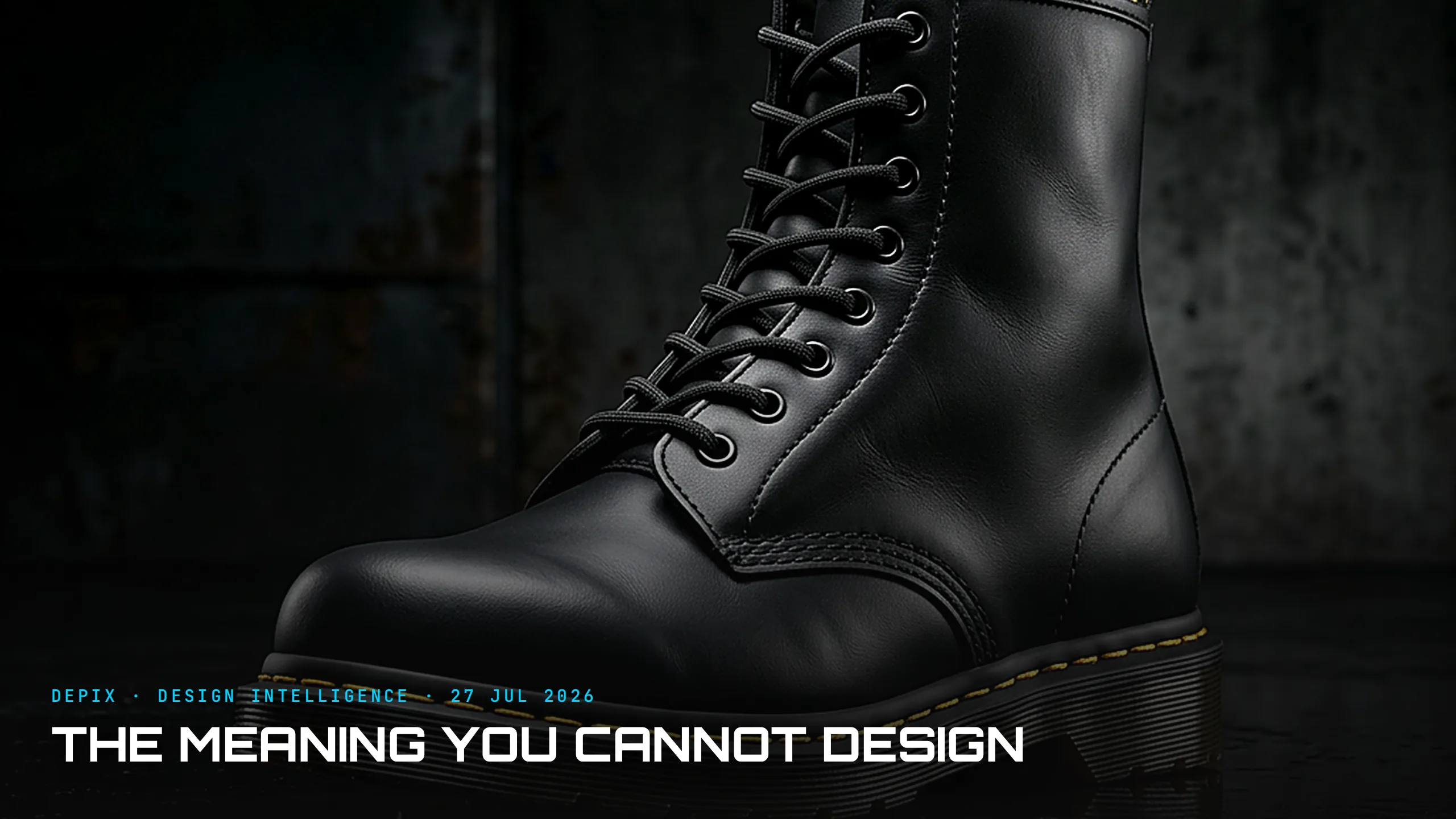
The Dr. Martens boot means rebellion. Punk, protest, working-class defiance, a certain refusal to be told what to do. That meaning is so fixed that it is hard to believe the boot was invented, in earnest, as a piece of gentle orthopaedic footwear for a recovering patient - and that nobody who made it ever chose what it would come to stand for.
Begin in Munich, 1945. A 25-year-old doctor, Klaus Maertens, broke his foot skiing and found ordinary hard-soled shoes agonising during recovery. Using a salvaged cobbler's last and scavenged materials, he built himself an air-cushioned sole - soft, bouncy, kind to a healing foot. With an engineer friend, Herbert Funk, he began making comfortable shoes, and his early, enthusiastic customers were mostly older German women. This was a health product. Its promise was relief.
The second act moved the object without changing it. In the late 1950s the Griggs family, boot-makers in Northamptonshire, licensed the sole, anglicised the name, and on 1 April 1960 launched the eight-eyelet 1460 - black leather, yellow welt stitching, a heel loop reading AirWair. They sold it as honest, durable workwear, and its first wearers were postmen, factory hands and police officers. Still no rebellion anywhere in the brief. Just a good, cheap, comfortable boot for people on their feet all day.
Then the meaning escaped. In the late 1960s, working-class London skinheads - originally a multi-racial, mod-descended, working-class scene - adopted the work boot precisely because it was a work boot: an emblem of proletarian pride and hardness. From there it passed into punk, which recast it as anti-establishment armour, then into goth, grunge and beyond. The same unaltered object came to signify working-class resistance for some and, once neo-Nazi factions co-opted the skinhead aesthetic, its very opposite for others - two contradictory meanings, worn on identical boots, at the same time.
The wearers even authored a language the makers never drew. Faced with that skinhead-punk ambiguity, subcultures invented a lace code: the colour of your laces silently signalled your politics - anti-fascist, socialist, or something uglier - a whole semiotic system bolted onto a boot by the people who bought it. Nothing about the product changed. The meaning was manufactured entirely on the street.
The final twist is that the meaning never stopped moving. The boot that signalled outsider defiance became, in time, a high-street and catwalk staple; Dr. Martens is now a public company selling millions of pairs a year, its rebellion neatly packaged and sold back to the mainstream it once refused. Even the resistance became a product. Meaning does not escape the maker just once - it keeps changing hands forever.
Here is the uncomfortable, essential truth for anyone who makes things. You design the object; you do not design its meaning. Maertens designed a sole. Griggs designed a boot. Culture designed the icon - and it did so unpredictably, contradictorily, and utterly beyond anyone's control. Meaning is not a property you can machine into a product like a radius or a finish. It is co-authored, after release, by whoever adopts the thing, and it can migrate to places its maker never imagined and would sometimes disown.
This is not an argument for fatalism about meaning. A brand can seed a story deliberately - that is a different, real discipline. But the Dr. Martens lesson is the counterweight: past a certain point, meaning is negotiated by the crowd, not dictated by the studio. What you actually control at the concept phase is the set of initial conditions - the form, the affordances, the price, the honesty of the thing, and crucially where and on whom it first appears. Those seeds bias what a product can come to mean, without ever guaranteeing it.
At Depix, we treat that as the real work of concept: designing the conditions for a meaning, then having the humility to know the culture will finish the sentence. The most powerful property of almost any design - what it ends up standing for - is the one the designer has the least authority over. The best you can do is build something honest and distinctive enough to be worth adopting, put it in the right hands first, and let go. Klaus Maertens set out to soothe a sore foot. Sixty years later his sole is stamping through a protest. He designed the boot. The world designed the rest.
Sources:
- ●https://en.wikipedia.org/wiki/Dr._Martens
- ●https://www.drmartens.com/us/en/history
- ●https://www.heddels.com/2018/08/dr-martens-history-philosophy-iconic-products/
- ●https://www.grailed.com/drycleanonly/dr-martens-history
- ●https://en.wikipedia.org/wiki/Skinhead
- ●https://www.beyondretro.com/blogs/news/the-history-of-dr-martens
- ●https://en.wikipedia.org/wiki/Punk_subculture
- ●https://thelinknewspaper.ca/article/dr-martens-laced-with-history
- ●https://www.hercampus.com/school/psu/skinheads-and-socialism-the-history-of-doc-martens-lace-codes/
- ●https://en.wikipedia.org/wiki/Punk_fashion
- ●https://hankeringforhistory.com/the-history-of-dr-martens-in-youth-culture/
- ●https://tower-ldn.com/blogs/all/the-dr-martens-1460-boot