The Floating Roof
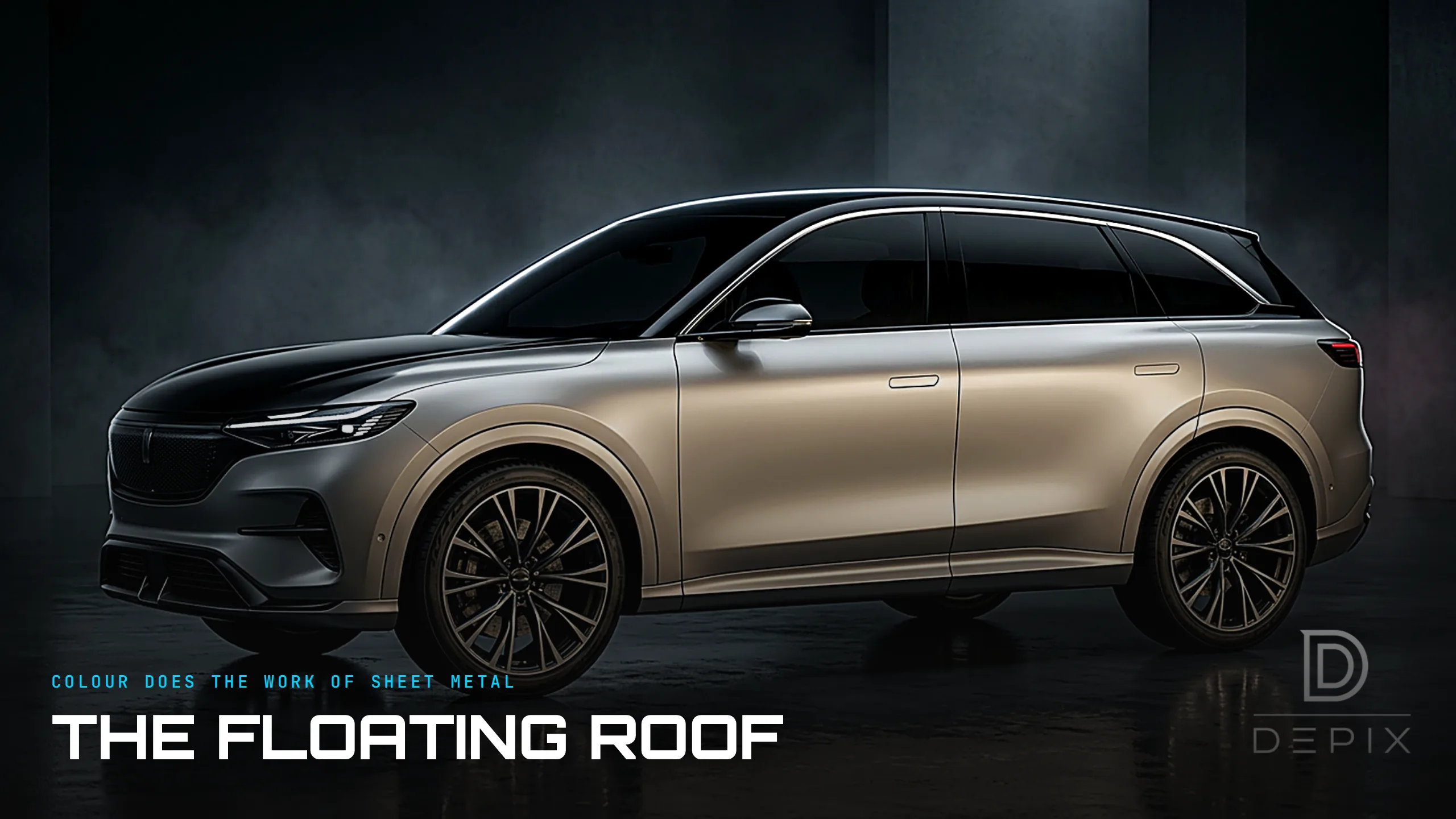
Look at almost any SUV from the last decade and the roof appears to hover — detached from the body, held up by nothing but glass. It is called the floating roof, and it is one of the most widespread devices in modern car design. And here is the thing worth noticing: not a single panel of metal has moved. The whole effect is colour — a dark roof and blacked-out pillars that merge with the side glass so the greenhouse reads as one continuous dark band and the roof seems to lift clean off the body.
This is CMF doing the work of sheet metal. The band of glazing down the side of a car is its Daylight Opening, or DLO — the visual signature of the whole greenhouse. By finishing the pillars in black so they blend into that glass, a designer makes the DLO look larger and more cohesive and the car longer and more upscale. More than that, a dark roof blends with the glasshouse into a single bubble atop the body and pushes the apparent mass downward, so a tall vehicle reads as lower and more planted — owners have blacked out their own pillars for exactly this reason for years. The metal is fixed; the colour changes what your eye believes about it.
This is why designers reach for it. A car's hard proportions — the height, the beltline, the pillar positions — are frozen early by packaging, crash structure and cost. Once they are locked, the remaining move is to "massage" the side view graphically, altering the car's apparent visual weight and stance without touching the shape. The floating roof is the headline trick, but the whole language of black trim, contrast sills and where the colour breaks is a designed optical layer laid over hard-points nobody can change. The tall modern crossover is the classic beneficiary: raise the ride height for packaging and ground clearance and you inherit a slab-sided, top-heavy silhouette, so the dark roof and blacked-out pillars are conscripted to shave that visual height back off and hand the eye the low, planted stance the sheet metal alone can no longer deliver. It is one of a handful of quietly technical moves designers use to bend how a car reads, and a designer can make the same body look taller or lower, longer or stubbier, purely by where they place the dark.
That optical layer is now also a business. Two-tone paint has become one of the biggest trends in car design, spreading across brands and segments. A PPG report found two-tone finishes and personalisation gaining real favour among buyers, who now treat the roof as a canvas — a contrasting colour that makes a car look higher-end and more distinctive and, conveniently, adds margin for the maker. Colour has become a proportion tool and a personalisation product at the same time.
There are two catches, and both are instructive. Done badly, the illusion betrays itself — the infamous "DLO fail," a wedge of black plastic pretending to be glass that fools no one and looks cheaper than honest metal ever would. And a trick everyone uses stops being a trick: the floating roof is now so universal that it has begun to feel generic, the device itself quietly sinking. When every SUV floats its roof, floating stops saying anything, and the optical shortcut, over-applied, becomes the very visual brick it was invented to hide.
This is the concept-phase lesson, and it is a subtle one. The "graphics" of a car — the DLO shape, where the colour breaks, what gets blacked out — are not late decoration sprayed on at the end. They are decided at the sketch stage as a deliberate optical strategy layered over the engineering hard-points, and they carry real power: they can make honest proportions sing, or disguise awkward ones just long enough to win a customer. The most striking thing the floating roof proves is that in car design, colour is not simply the finish applied once the form is resolved. Colour is form — or at least it is what the eye accepts as form. Decide where the dark goes, and you have decided how big, how low and how expensive the whole car looks, before a single panel is ever pressed.
Sources:
- ●Car Design News — The rise of the floating roof
- ●Hagerty — Car Design Fundamentals: Graphics and DLO
- ●The Truth About Cars — Vellum Venom: Daylight Opening (DLO), Defined
- ●Auto Styling — Floating on the C (visual mass and the floating roof)
- ●Lexus Enthusiast — Blacked out C/D Pillars: Let's talk about them
- ●UX Collective — Five weird car design terms, explained
- ●Jalopnik — Two-Tone Paint Is The Big New Trend In Car Design
- ●Motor1 — Two-Tone Trends: 15 Cars With Contrasting Roofs
- ●PPG (via FinancialContent) — Two-tone Finishes, Personalization Gaining Favor Among Car Buyers
- ●Devil's Customs — Top 5 Custom Paint & Finish Trends in 2026
- ●Ford Inside News — 'DLO Fail' in modern automotive design
- ●Indie Auto — Infiniti's dog leg is gone: all hail the floating roof