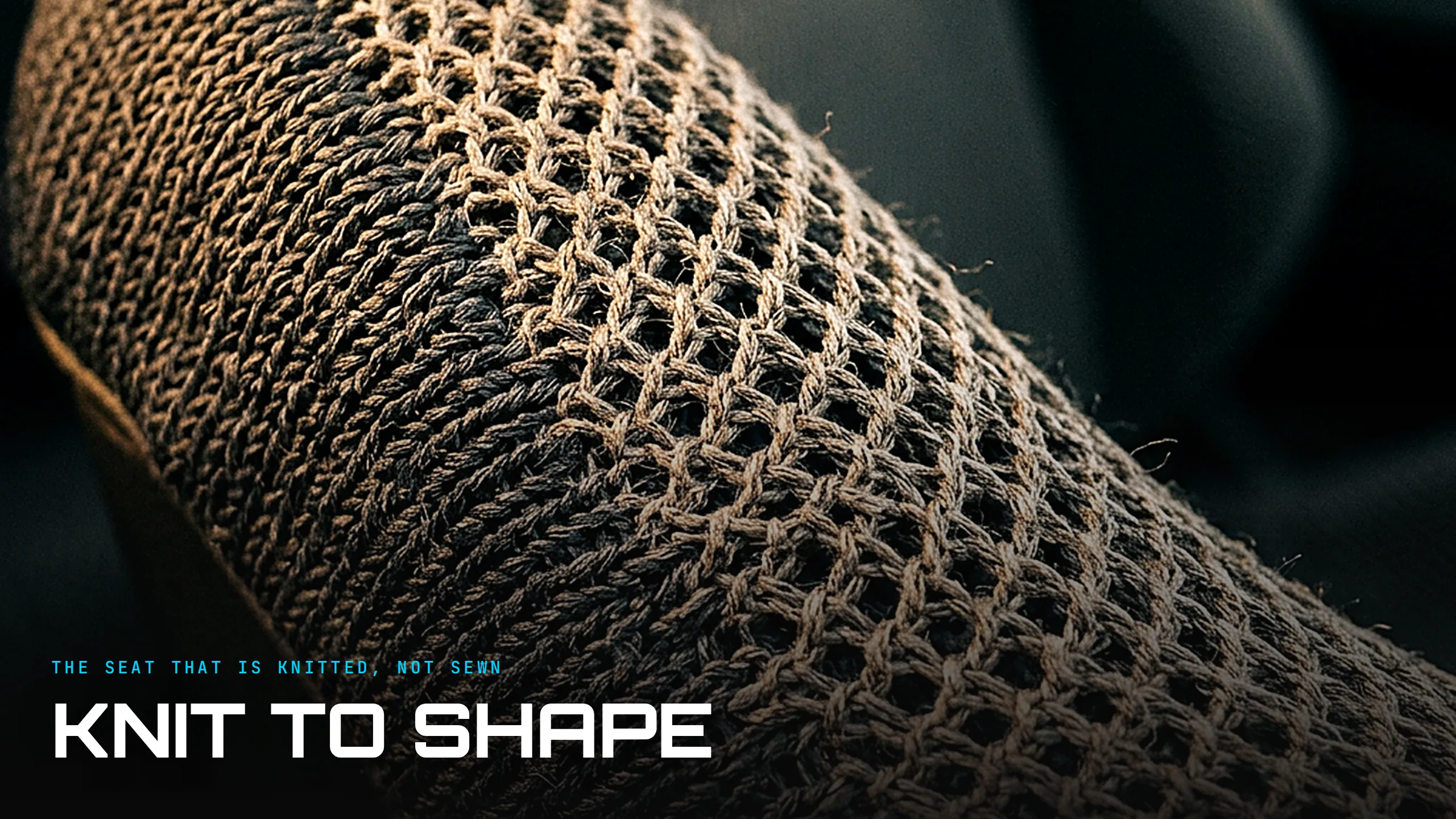
Knit to Shape
The car seat is one of the last things in a car still built the way furniture was a hundred years ago: cut and sew. Flat fabric is cut from rolls into dozens of panels, the offcuts thrown away, then stitched back together by hand and machine into a three-dimensional cover that is finally stretched over the foam. It is genuine craft, it is quietly wasteful, and it is being replaced by a knitting machine.
The replacement knits the whole cover as one piece. Ford has shown a full seat cover produced as a single seamless piece, knitted to the exact three-dimensional shape of the seat in one process, with no cutting and no stitching at all. Because the machine builds it stitch by stitch under digital control, it uses precisely the thread the cover needs and leaves almost nothing on the floor, deleting the cut-and-sew step entirely. It is, in effect, a knit-to-shape running shoe applied to the thing you sit on. And because the pattern is only software, two adjacent seats coming off the same machine can be completely different — a bespoke cover knitted to order is no harder to make than a standard one, which quietly upends the entire economics of how personalisation in a car has always worked.
Here is where it stops being merely a cheaper cover and becomes a design tool. A knitted surface can change its structure across a single unbroken piece: a firmer, denser knit in the bolsters, an open breathable knit in the centre, softer zones exactly where the body wants give. It can be knitted from almost any yarn — recycled polyester, wool, even carbon fibre, and Ford already runs dozens of recycled-yarn fabrics across its range. The company has even talked about knitting heating, sensors, controls and wireless charging into the textile itself. The cover stops being a skin wrapped over a seat and becomes an engineered, programmable surface.
The revolution goes deeper than the cover, because it is coming for the foam too. The block of polyurethane under the fabric — comfortable, but genuinely hard to recycle — is being challenged by warp-knitted "spacer" fabrics: two knitted faces held apart by spacer yarns, a springy three-dimensional textile that can do the cushioning job and is far easier to recycle than moulded foam. Suppliers now knit variable-thickness three-dimensional fabrics that fold the padding and the surface into a single material. The whole seat — cover and cushion — is drifting toward being knitted rather than cut, moulded and glued. Assembled the old way, a single seat can involve dozens of separate cut pieces, layers of adhesive and a frame of staples and hog rings pulling the cover tight; the knitted seat collapses most of that into one continuous, self-tensioning textile.
It is not free of loss. Trimmers, the trade that has hand-upholstered car seats for a century, see exactly what is happening: 3D knitting "kills the craft" of auto upholstery, swapping skilled cut-and-sew hands for a programmed machine. It is the same trade we have watched play out elsewhere in the car — the panel gap erased by a single casting, the hand-laid seam replaced by an algorithm. Something genuinely skilled disappears. What replaces it is honest in a colder way: no waste, no hidden staples, a recyclable, made-to-measure surface tuned precisely to one body.
This is the concept-phase lesson, and it is a sharp one. A cut-and-sew seat is designed as a shape and only resolved in fabric late — panels drawn, cut, fitted and adjusted on the line. A knitted seat is the inverse: the entire cover is a single digital file, every zone and density and embedded function decided as one knit program before a thread is spun. Comfort, breathability, sustainability, even the electronics, stop being things you add to a finished seat and become things you knit into it from the very first line of the pattern. The seat is quietly moving from something you build to something you print — and the whole decision slides to the front of the process. The most personal surface in the car is about to be made in one piece, to fit one person, with nothing left on the floor.
Sources:
- ●The Hog Ring — Ford is Killing the Craft of Auto Upholstery with 3D Knitting
- ●Knitting Industry — Ford's 3D-knitted car seat covers target infinite personalisation
- ●Digital Trends — Ford 3D Knitting Technology is the Future of Car Upholstery
- ●Knitting Industry — Ford explores the future of automotive interior fabrics
- ●Textile School — 3D Knitting Technology Advancements: Shaping Sustainable Textiles
- ●Torque News — How Ford is helping to bring sustainable auto fabrics to the globe
- ●EVKX — Seat Upholstery & Materials (foam recyclability)
- ●Acme Mills — Advanced 3D Spacer Fabrics: strength & comfort
- ●Acme Mills — Warp-Knit & Spunlace Fabrics for Automotive Seat Trim & Interior Components
- ●Textile Learner — 3D Knitting: Structures, Techniques and Applications
- ●Made-in-China Insights — Future of Car Seat Fabrics: Emerging Trends and Evolving User Needs