The Beige Recession
Walk any car park and it reads as a single monochrome sea. It is not your imagination: white, black and grey now account for roughly 74% of the world's new cars, with white alone at 29%, black at 23% and grey at 22%. Silver, once nearly a third of the market, has quietly collapsed to 7%, and by some counts the achromatic shades top 80% of cars globally. The most emotional decision in car design — its colour — has effectively been voted out of the room.
It was not always so. Post-war roads were full of two-tones and pastels; the restraint we now treat as default set in later, and grey has been slowly taking over the built world ever since. The car simply followed culture. Around 2010, minimalism stopped being an aesthetic and became an aspirational identity: Apple made white read as premium rather than plain, "millennial grey" became a form of conspicuous restraint, and colour started to feel like a risk that only the unsophisticated would take. As one writer put it surveying the market, we have seen the future, and for now it is grey.
The deeper driver, though, is money, not taste. Neutral colours hold their resale value better, so a buyer keeping one eye on the trade-in hedges toward grey. Dealers, making the same bet, stock their lots with neutrals on the assumption whites and silvers offend no one — so buyers are only ever shown grayscale, and duly choose from grayscale. Colour became a financial liability to be engineered out. And that is the quiet tragedy of it, because colour is the single cheapest lever in CMF with the largest emotional payoff — and it is the one the industry learned to abandon first.
That is a genuine design cost. Colour is the C in CMF and the very first thing a human perceives about a car, decided at the concept stage as the object's emotional signature. Yet it is routinely the first thing value-engineered back to safe. The paradox runs deeper still: Apple-flavoured "premium minimalism" gave makers cover to strip colour out while charging more for the privilege — a four-figure option, on many cars, for a shade of grey. Studios spend fortunes perfecting surfacing and stance, then hand most of it to the one finish that hides the lot. A single colour chip, chosen in the first weeks of a programme, can decide whether a car reads as menacing or cheerful, expensive or anonymous — a character-defining call made long before the clay is even finished, and too often surrendered to the safest possible answer.
The good news is that the pendulum is visibly swinging. The era of boring car colours may finally be ending, with chromatic hues rising, and white has already begun slipping in North America as those chromatic colours gain ground. At the top of the market the shift is loudest, because that is where personalisation pays: Porsche has expanded its Paint to Sample programme to more than 190 pre-approved colours, plus a Paint to Sample Plus tier that creates a bespoke exterior colour from scratch — letting a buyer match a car to a handbag, a favourite piece of furniture, or a model car from their childhood. Colour, at the high end, is becoming the ultimate personalisation product.
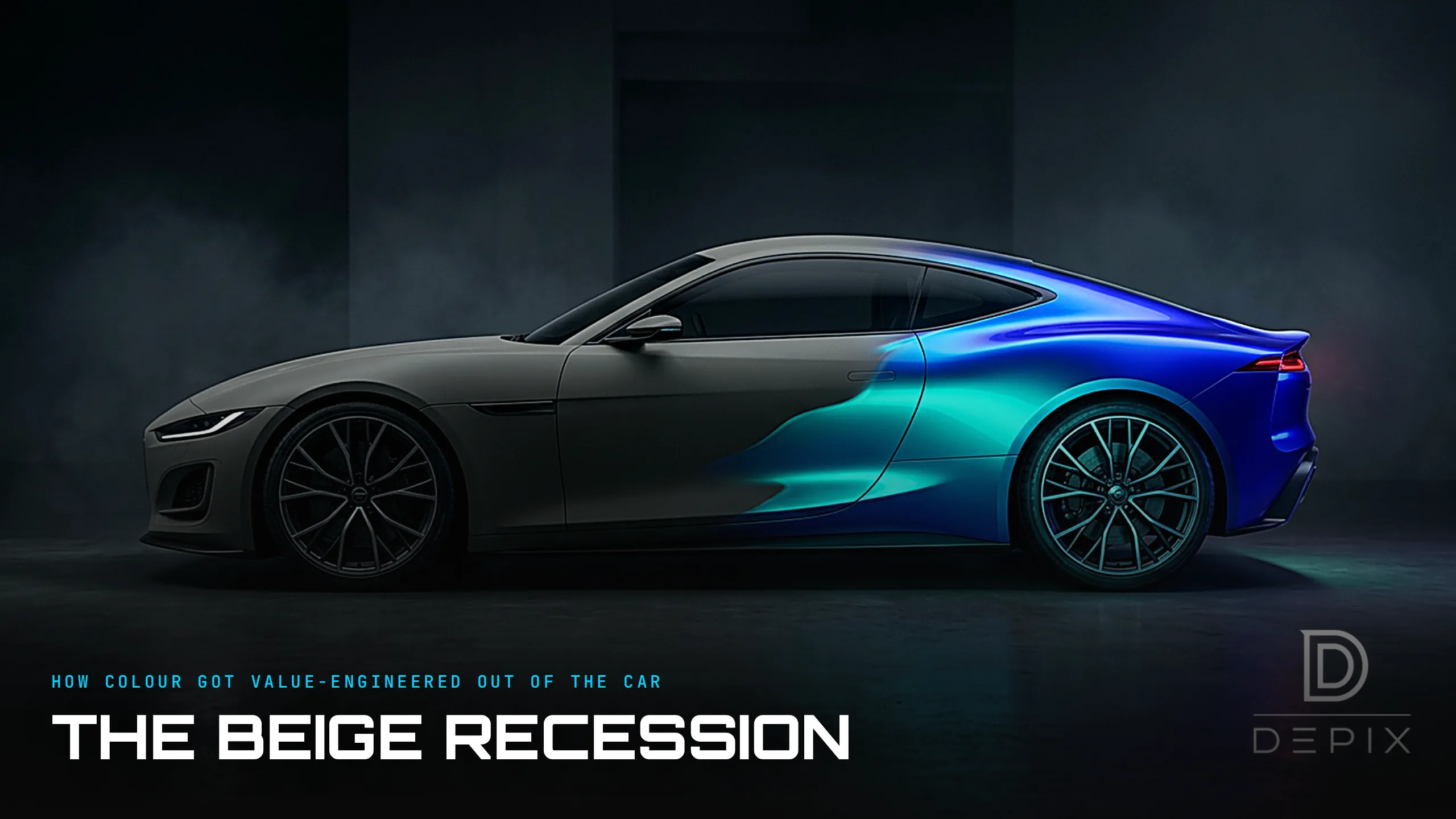
The most radical move, though, is to stop treating colour as a single permanent choice at all. BMW's iX Flow wraps the body in E Ink — millions of microcapsules that migrate black or white pigment to the surface under an electric field, changing the car's colour on demand. BMW frames it as adapting the exterior to the driver's mood, the weather, even a functional need — a finish that, like ambient cabin light, can change its mind after it leaves the factory. When the paint itself is reprogrammable, the entire logic of picking one safe neutral quietly falls apart.
That is the concept-phase lesson. Colour is the most emotional, the cheapest, and the most abused decision in car design — and we spent two decades value-engineering it into a full greyscale recession. The way out is not a slightly bolder swatch on the same fixed panel. It is to make colour dynamic, personal and alive again: decided not once, by a risk-averse committee, but continuously, by the person who actually lives with the car.
Sources:
- ●European Coatings — Axalta global automotive colour report: white remains top choice
- ●Axalta — 2025 Global Automotive Color Popularity Report (US newsroom)
- ●Axalta — 73rd Global Automotive Colour Popularity Report
- ●CarBuzz — Fifty Shades of Gray: America's Obsession with Bland Car Colors
- ●CarBuzz — The Era Of Boring Car Colors Is Finally Ending
- ●Hagerty — Color Commentary: We Have Seen the Future, and It Is Gray… for Now
- ●Big Think — Agreeable Gray: how colour vanished from the modern world
- ●Porsche Newsroom — How custom colours are created (Paint to Sample, 2025)
- ●Porsche Newsroom — Paint to Sample programme expands (2021)
- ●Porsche — A Porsche innovation powered by your imagination (Exclusive Manufaktur)
- ●STIR World — BMW unveils the iX Flow with colour-changing E Ink technology
- ●BMW Group Press — Magical exterior colour-change: the BMW iX Flow featuring E Ink