The Chair That Shipped Flat
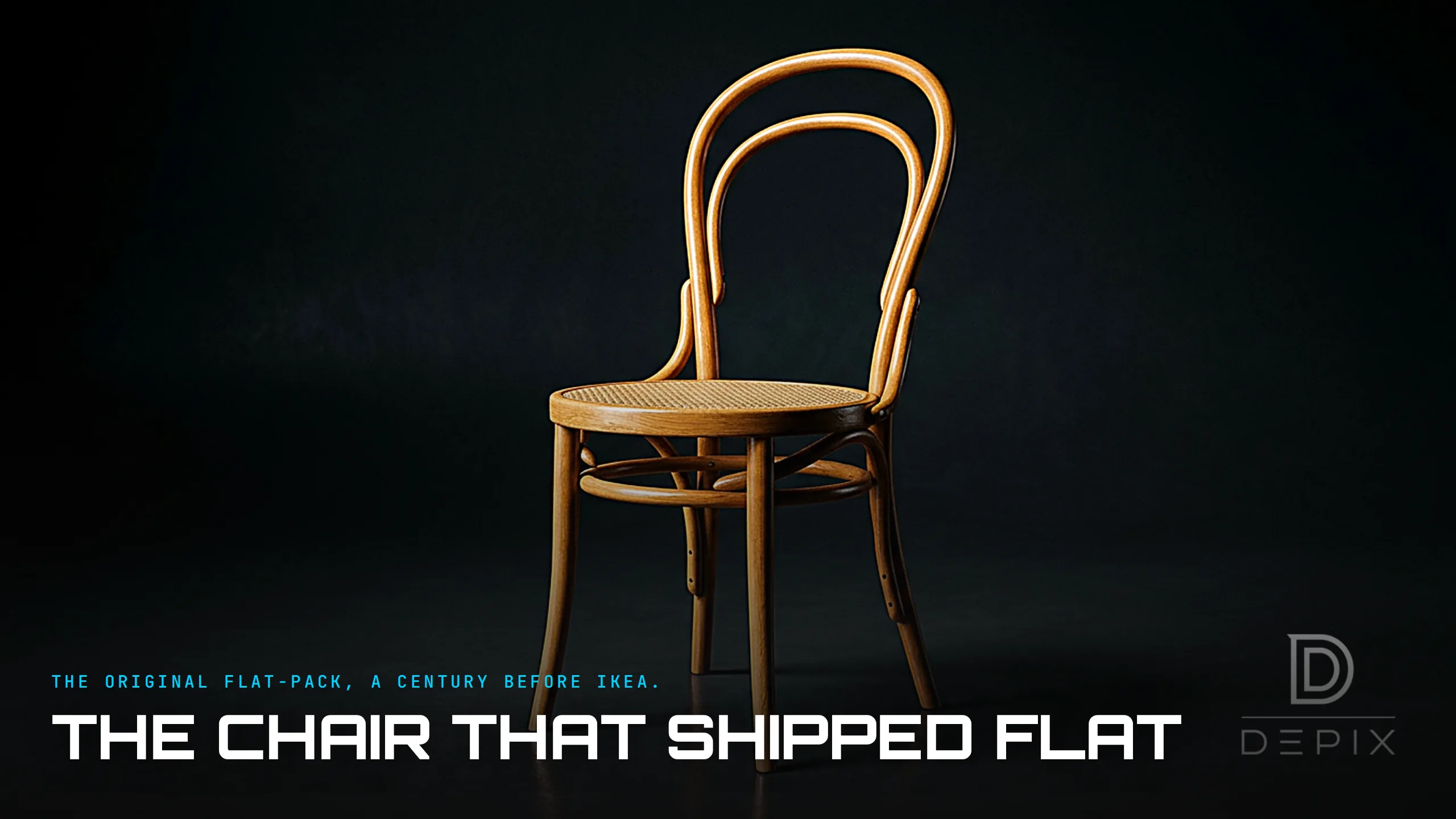
You have almost certainly sat in it. The light bentwood cafe chair with the round back and the caned seat, in bistros and kitchens the world over, is the Thonet No. 14 - often called "the chair of chairs." It looks effortless, almost anonymous. But its real genius is invisible: in 1859, Michael Thonet designed the chair, the way it was made, and the way it was shipped as a single, inseparable idea.
Start with how it is made. Thonet spent years perfecting bentwood - a way of steam-bending solid beech into strong, flowing curves. Beechwood rods were heated to around 100 degrees, clamped into cast-iron moulds, and dried until they held their shape permanently. This replaced the old world of carved joints and glued-up frames with something radical: a long, elegant curve made from one continuous piece of wood, cheaply and identically, by the thousand. The famous round back of the No. 14 is not a decorative flourish; it is the shape the process could produce. The form is the manufacturing method, made visible.
Then look at how little there is. The entire chair is six pieces of bent wood, ten screws and two nuts. There are no complex joints for a master craftsman to cut. That radical simplicity is what let it be assembled by unskilled workers on something close to a production line - which is why it is remembered as the world's first mass-produced piece of furniture, decades before the car industry made mass production famous.
And now the punchline, the part that feels startlingly modern. Because the No. 14 is only six parts and a handful of screws, it ships disassembled. Thirty-six chairs, taken apart, pack into a single cubic metre. A chair made in a Vienna workshop could be flat-packed into a crate, shipped across an ocean, and screwed together on arrival by anyone. This is flat-pack furniture - IKEA's whole logistical premise - invented a full century before IKEA existed.
Here is what makes the No. 14 a masterpiece of design intelligence rather than just a pretty chair. Most design happens as a relay race. A designer draws the object; then engineering works out how to manufacture it; then logistics works out how to ship it - each stage inheriting the previous one's decisions and fighting them. Thonet collapsed the relay into a single move. The curve serves the bending process. The six-part construction serves both the unskilled-labour assembly and the flat-pack crate. Cheap, light, strong and beautiful were not competing goals traded off against each other; they were the same decision, taken once, at the start. Form followed manufacture followed distribution - and all three were designed at the same instant.
The result changed the world's furniture. Gebruder Thonet sold around fifty million No. 14s between 1859 and 1930, and millions more have followed. Le Corbusier furnished his interiors with it and adored it; it sits in every serious design museum. It is, quite simply, the chair you picture when you picture a chair - so ubiquitous that it turned invisible, which is close to the highest compliment a mass-produced object can be paid. It was arguably the first time good design was made genuinely cheap - elegant enough for a museum, affordable enough for any cafe - and it got there not by cutting corners on beauty but by designing beauty, making and shipping as one system.
At Depix, this is the lesson we return to again and again. The most consequential facts about a product - what it costs, whether it can actually be made at scale, how much space it takes in a shipping container, how it goes together - are treated by most teams as downstream problems, to be solved after the "design" is finished. Thonet's chair is the standing refutation. A team that leaves cost, tooling and packaging until after the shape is locked will spend the rest of the project fighting its own earliest decisions. Those facts are not constraints on the design; they are the design. The No. 14 is beautiful because of how it is made and shipped, not in spite of it. The concept phase is precisely where form, manufacture and logistics should converge into one gesture - and a humble cafe chair worked that out 165 years ago, and has been quietly proving it in every bistro since.
Sources:
- ●https://en.wikipedia.org/wiki/No._14_chair
- ●https://en.wikipedia.org/wiki/Michael_Thonet
- ●https://www.vam.ac.uk/articles/thonet-and-the-invention-of-bentwood-furniture
- ●https://designmuseum.org/discover-design/all-design-objects/thonet-chair-no-14
- ●https://www.minniemuse.com/articles/musings/the-no-14-chair
- ●https://www.furniturelibrary.com/ubiquitous-no-14/
- ●https://mainehomedesign.com/design-lesson/thonet-no-14-chair/
- ●https://www.sarasotaartmuseum.org/thonet/
- ●https://www.stablemark.com/blog/thonet-history
- ●https://en.wikipedia.org/wiki/Bentwood
- ●https://www.thonet.de