Designed to Be Found
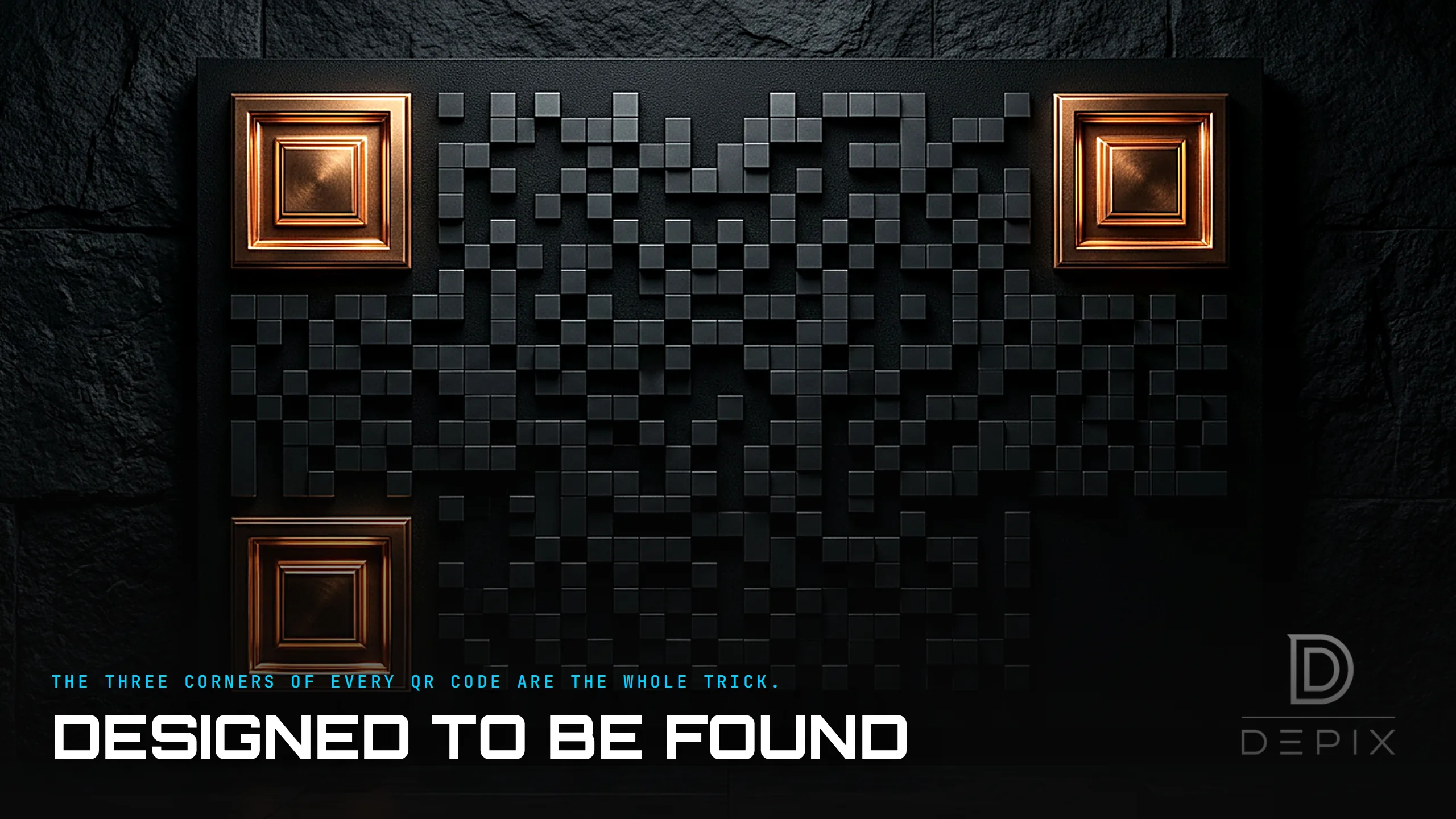
You have scanned thousands of them - restaurant menus, payments, boarding passes, parcel labels. In 2026 the QR code is the invisible connective tissue of daily life, the little black-and-white square that quietly links the physical world to the digital one. And almost nobody notices its cleverest feature, hiding in plain sight: the three squares in the corners.
The code was born in a factory. In 1994, Masahiro Hara at Denso Wave - a company in the Toyota group that made automotive parts - was trying to solve a dull, specific problem. The barcodes then used to track parts on fast-moving assembly lines held too little data and were too slow to scan; a worker might have to read a box several times over. Hara built a two-dimensional matrix that could hold thousands of characters instead of a barcode's couple of dozen, replacing the one-dimensional barcode's single row with a dense grid.
But storing the data was the easy part. The hard problem was findability. A one-dimensional barcode you hold up and align by hand. A code on a box hurtling down a conveyor arrives at any angle - rotated, skewed, upside down, surrounded by text and graphics and grease. The real design challenge was not "how do we store more?" but "how does a machine instantly find this thing among all the visual noise, and work out which way up it is, in a fraction of a second?"
That is what the three square finder patterns are for. The scanner hunts for those three "eyes" first. Three points are the minimum that uniquely fix a shape's position, rotation and skew - a fourth corner would be redundant, so Hara used three and left the last corner open. But the genius is in the detail of the square itself. Scan a straight line through any finder pattern, in any direction, and you get the same sequence of dark and light in a ratio of 1:1:3:1:1. That precise ratio was not chosen for looks. Hara's team analysed a huge sample of printed material - magazines, boxes, labels - to find the sequence of black and white that appeared least often in the real world. The rarest pattern was 1:1:3:1:1. So the scanner can look for exactly that signature and almost never be fooled by ordinary print around it. The finder is designed to be unmistakable by being statistically unique. (Hara, a Go player, took a cue from the black and white stones on the board.)
Then there is survival. QR codes carry Reed-Solomon error correction - redundant data woven through the grid - so a code still reads when up to roughly a third of it is torn, smudged or covered. That is why a brand can drop a logo in the middle of one and it still works. The code was engineered for the hostile real world of dirt and damage and bad light, not for a clean lab.
And the single most consequential decision was not in the pixels at all. Denso Wave holds the patent but chose, in the late 1990s, not to charge royalties for using the format. It kept the standard open. That strategic choice - made at the concept level, not the drawing board - is why the QR code, rather than some locked-down proprietary rival, became the global default. A brilliant design that is fenced off loses to a good-enough one that is free.
Here is the design-intelligence lesson. The QR code is a masterclass in designing for the real conditions of use rather than the ideal ones. The three squares are not decoration; they are the physical answer to a precisely framed question - how does a machine find and orient this, among noise, at speed - solved from first principles by studying the actual statistics of the world the code would live in. The most important work was invisible: choosing the rarest ratio, building in redundancy, giving the thing away. The part everyone sees, the pretty pixel pattern, is downstream of decisions no one sees.
At Depix, we read it as proof that the decisive design happens at the level of the problem. Get the framing right at the concept phase - what exactly must this survive, be found among, be oriented against - and the form becomes almost inevitable. The three squares were the only possible answer, but only once Hara had asked the exact right question. Most designs fail not because the execution was poor, but because that question was never framed sharply enough to have a right answer at all.
Sources:
- ●https://en.wikipedia.org/wiki/QR_code
- ●https://www.qrcode.com/en/history/
- ●https://www.denso-wave.com/en/technology/vol1.html
- ●https://www.jpo.go.jp/e/news/koho/innovation/01_qrcode_e.html
- ●https://en.wikipedia.org/wiki/Barcode
- ●https://www.bgr.com/2214938/qr-code-finder-squares-explained/
- ●https://myqrcode.com/blog/who-invented-qr-codes
- ●https://ez-qr.com/blog/qr-code-history
- ●https://www.smithsonianmag.com/innovation/history-qr-code-180979606/
- ●https://en.wikipedia.org/wiki/Reed%E2%80%93Solomon_error_correction
- ●https://en.wikipedia.org/wiki/Denso_Wave