The Building That Couldn't Be Built
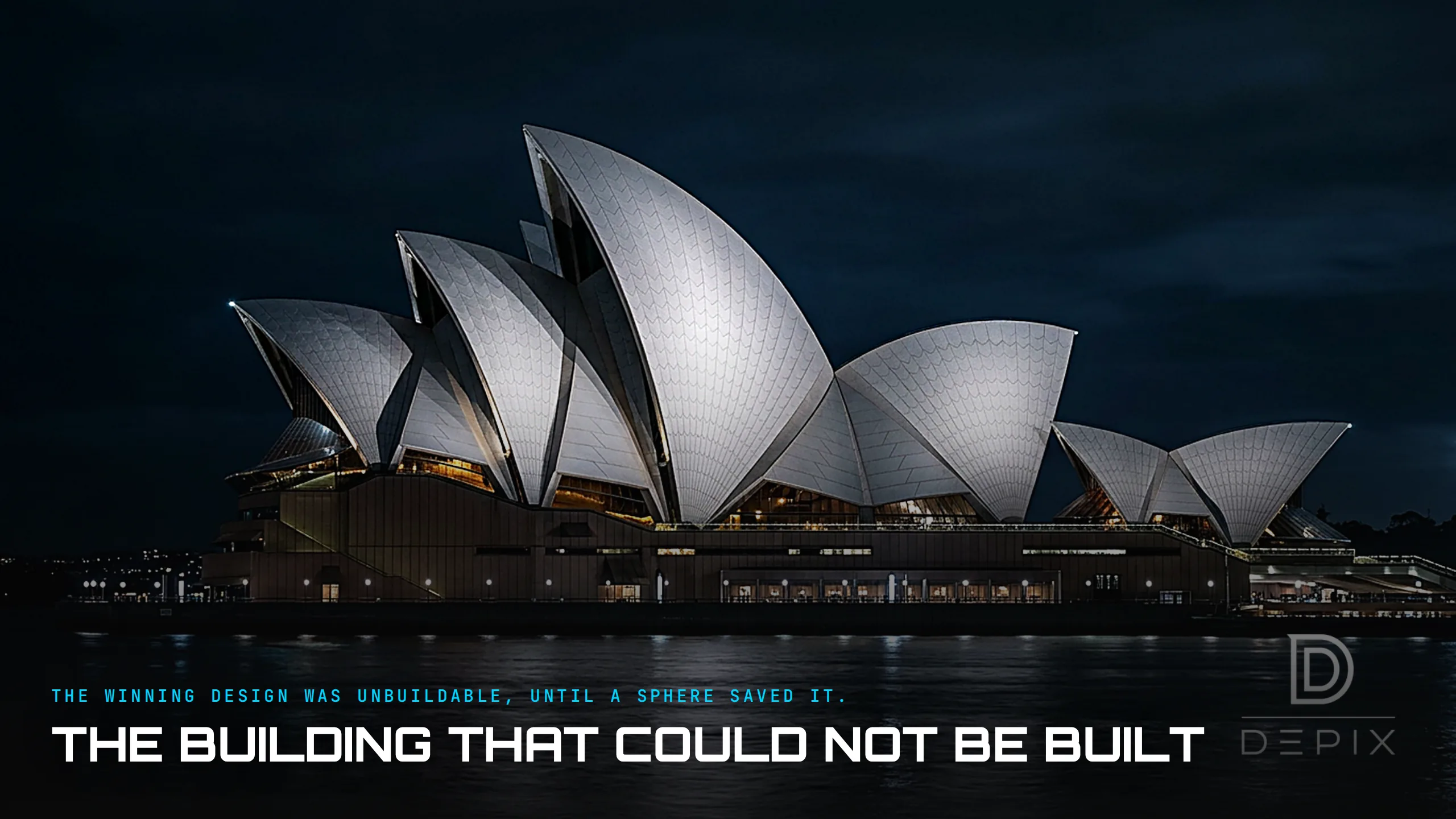
It is one of the most recognised buildings on earth - those white billowing sails against Sydney Harbour. But the Sydney Opera House began as a set of poetic sketches that, by the strict standards of engineering, could not actually be built. The story of how it travelled from an unbuildable drawing to a global icon is the finest lesson in design intelligence that architecture has to offer.
In 1957 an unknown 38-year-old Dane, Jørn Utzon, won the competition with "Design 218" - dramatic free-form concrete shells, chosen from more than 200 entries largely on the strength of a handful of expressive sketches (legend has it a late-arriving juror, Eero Saarinen, rescued it from the rejected pile). The drawing was ravishing. It was also, as an engineering proposition, a nightmare.
Because the sketches were beautiful but geometrically undefined. When Ove Arup's engineers tried to pin the shells down, they found they could not mathematically describe them - the curves were variously called elliptical, then parabolic, but really they were free-form. In the pre-computer late 1950s you simply could not calculate the structural stresses of unique, non-repeating curves, and even if you could, every shell would demand its own bespoke, ruinously expensive formwork. For years the project stalled while scheme after scheme was tried and abandoned; the shells were widely judged unbuildable. By then the podium was already rising while the roof meant to crown it existed only as an unsolved problem - construction had, in effect, begun on a building whose single defining feature was still theoretically impossible.
The breakthrough, around 1961, is one of the most elegant moves in design history. Instead of treating the shells as free-form, Utzon and Arup derived every single shell from the surface of one sphere - a single imaginary sphere roughly 75 metres in radius. Because every shell now shared exactly the same curvature, they could be cast from identical, repeating, prefabricated concrete rib segments made in the same moulds. An impossible one-off free-form became a rational, repeatable, manufacturable system of standardised parts. Utzon reportedly demonstrated it by peeling segments off an orange. The form was finally buildable - not by compromising the vision, but by finding the hidden order inside it.
Here is the lesson, and it is not about architecture. A winning concept is not a finished design. The competition rewarded a vision; but that vision only became real when someone invented the method to realise it. The decisive design act was not the poetic sketch - it was the sphere: the discovery of a rational, repeatable geometry that let the dream be manufactured. The concept phase is not over when the drawing is beautiful. It is over when you have proven the beautiful thing can actually be made. A form that races ahead of its method is a promissory note that somebody, later, has to pay.
And they paid dearly. The Opera House came in ten years late and roughly fourteen times over its original budget - about 102 million dollars against an estimate of seven. Worse was the human cost. Ground down by a new state government's cost-cutting minister, by withheld payments and political interference, Utzon resigned in 1966, left Australia within weeks, and never returned. He was not invited to the 1973 opening. He never saw the finished building with his own eyes. Ambition at this scale carries a price, and it is not only measured in money.
Yet the building stands as a UNESCO World Heritage masterpiece and the symbol of a nation. Was it worth it? The uncomfortable answer design intelligence offers is that the decisions behind the most beloved objects often look, at the time, like catastrophic overreach - and the only thing separating a visionary from a fool is whether the method to realise the vision was ever found.
At Depix, this is precisely why we treat the concept phase not as the moment of the beautiful sketch but as the moment you prove the beautiful thing can exist. A vision without a method is a liability; the method is the design. The Sydney Opera House is on the harbour today because someone refused to accept that "unbuildable" was the final word - and went looking for the order hiding inside the dream until they found a sphere.
Sources:
- ●https://en.wikipedia.org/wiki/Sydney_Opera_House
- ●https://www.sydneyoperahouse.com/our-story/jorn-utzon
- ●https://en.wikipedia.org/wiki/J%C3%B8rn_Utzon
- ●https://en.wikipedia.org/wiki/Ove_Arup
- ●https://createdigital.org.au/engineering-turned-sydney-opera-house-from-idea-into-icon/
- ●https://archup.net/sydney-opera-house-engineering-spherical-solution-tragedy/
- ●https://www.sydneyoperahouse.com/our-story/the-spherical-solution
- ●https://en.wikipedia.org/wiki/Thin-shell_structure
- ●https://www.sydneyoperahouse.com/our-story/utzon-departs-the-house
- ●https://www.smithsonianmag.com/smart-news/architect-sydney-opera-house-wasnt-invited-opening-180956175/
- ●https://www.arup.com/en-us/projects/designing-the-sydney-opera-house/