The Window in the Sole
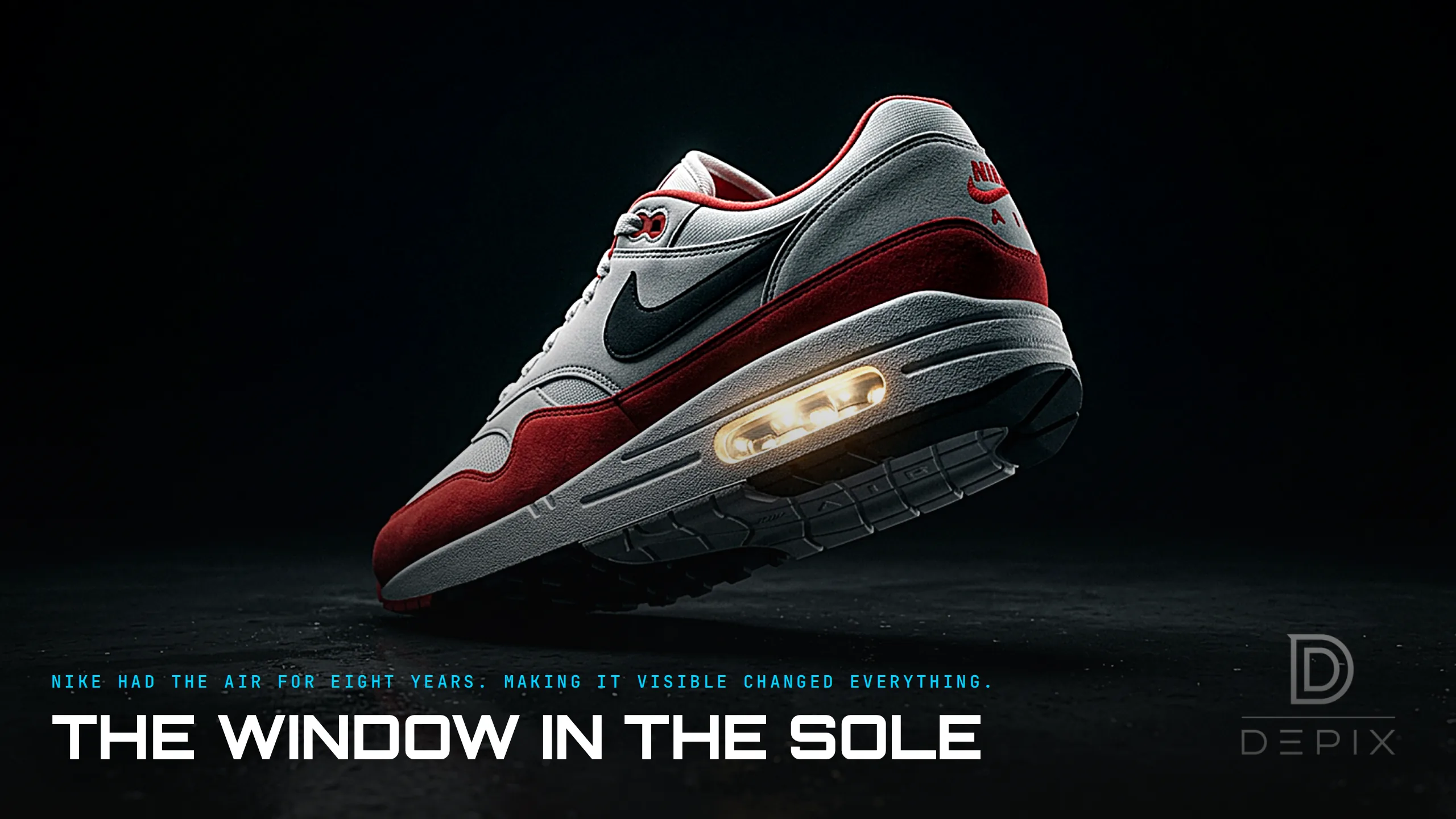
In 1987, Nike cut a hole in a shoe - and changed footwear forever. The Air Max 1 was the first sneaker with a window in its sole, letting you actually see the air cushioning sealed inside. It looks obvious now, when visible Air is everywhere. But at the time it was a radical, nearly career-ending idea, and its real lesson has nothing to do with shoes. It is about the difference between a feature and a feeling.
Start with what was already there. Nike had been putting pressurised-gas "Air" cushioning in its shoes since 1979. The technology came from Marion Franklin "Frank" Rudy, a former aerospace engineer who pitched the idea to Phil Knight in the late 1970s; it first shipped in the 1979 Tailwind. But for eight years the air was invisible - sealed deep inside the foam midsole. You could not see it, could not obviously feel that it was different, could not be sure it was even there. A genuine technical advantage that was, in every commercial sense, mute.
Then came an outsider's eye. Tinker Hatfield was an architect by training, not a footwear designer. On a trip to Paris he stood in front of the Centre Pompidou - the building that famously wears its guts on the outside, its pipes, ducts and escalators fully exposed as the architecture itself. The insight landed: what if a shoe did the same thing, and turned its inner technology into its outer identity? He went back to Oregon and cut away part of the midsole to reveal Rudy's air bag through a clear window.
Inside Nike, it was heresy. Cutting a hole in a running shoe's sole sounded structurally reckless and aesthetically wrong. Hatfield has been blunt about the reaction: "it was widely discussed that I had pushed it too far. People were trying to get us fired." It took real conviction, and the backing of Nike's cushioning chief, to get it out the door. The Air Max 1 launched on 26 March 1987, and the window turned an invisible engineering fact into a visible, emotional, ownable design signature. You could finally see the technology you were paying for. It became one of the most iconic and enduring lines in sneaker history, and "visible Air" hardened into a whole design language. For Nike, the window achieved in one stroke what eight years of the technology sitting hidden never had: it made the air real to the person wearing the shoe.
Here is the part that matters, and it reaches far past footwear. Hatfield did not invent the air; Rudy had done that eight years earlier. He did not add a feature. He made an existing one visible - and that single decision, not the technology, created the icon. His own design philosophy became exactly this: show the technology. The uncomfortable truth underneath is that a feature the user cannot perceive barely exists. Value that is invisible is value you usually cannot sell and often cannot even feel. So the concept-phase question is never only "what does it do?" It is also "how does the person know it is doing it?" Perception is not marketing's problem to solve later; it is part of the design.
There are really only two answers to "how do you sell something no one can see." You can prove it - stage a demonstration dramatic enough that people believe. Or you can expose it - build a window and let them look. Hatfield chose the window, and in doing so turned a buried spec into the soul of the shoe. It is no accident that the move came from an architect, someone cross-pollinating from a building into a sneaker, looking at footwear with a builder's eye for structure worn on the outside.
At Depix, this is why we treat the concept phase as the place you decide not just whether a thing works, but whether its working is legible. A brilliant feature nobody can perceive is a tree falling in an empty forest. The best designers treat visibility as a decision as deliberate as function - because in the end, what people can see is a large part of what they believe, and what they will pay for. Sometimes the most important thing you design is the window.
Sources:
- ●https://www.nike.com/a/air-max-1-history
- ●https://blog.size.co.uk/2023/03/24/a-brief-history-air-technology/
- ●https://en.wikipedia.org/wiki/Nike_Air_Max
- ●https://en.wikipedia.org/wiki/Tinker_Hatfield
- ●https://en.wikipedia.org/wiki/Centre_Pompidou
- ●https://www.centrepompidou.fr/en/pompidou-plus/magazine/article/the-secret-history-of-the-nike-air-max-the-sneaker-inspired-by-the-centre-pompidous-architecture
- ●https://www.sneakerjagers.com/en/n/the-untold-story-tinker-hatfield/57108
- ●https://www.highsnobiety.com/p/nike-air-max-1-history/
- ●https://blakecrosley.com/blog/design-philosophy-tinker-hatfield
- ●https://en.wikipedia.org/wiki/Nike,_Inc.