The Dimmable Sky
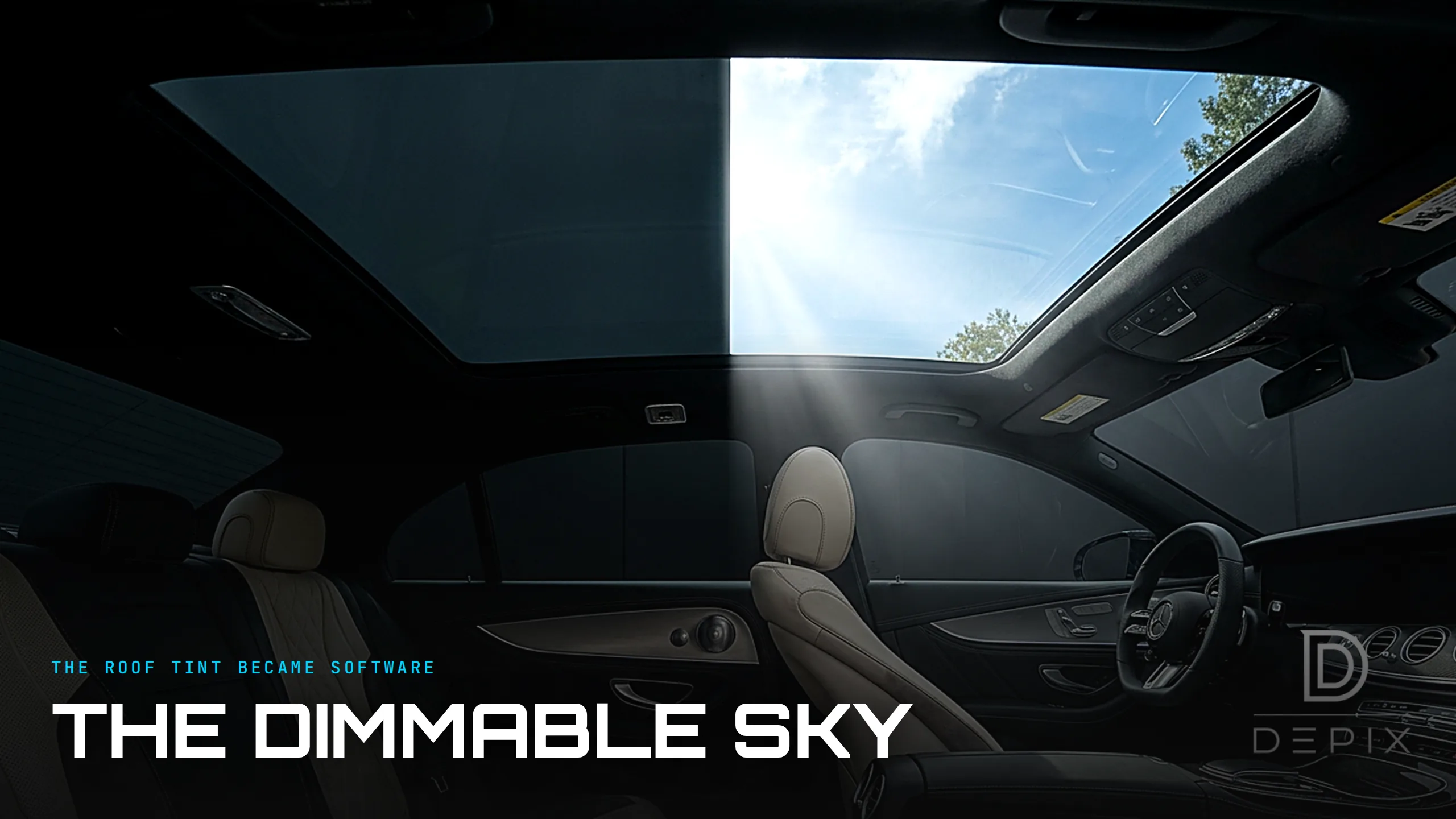
The panoramic glass roof was always a compromise. To get a ceiling full of sky you accepted a permanently dark tint and, beneath it, a bulky powered fabric sunshade rattling in its cassette. Now the glass itself has learned to dim. Cadillac's Celestiq carries the largest piece of dimmable smart glass ever fitted to a production car, divided into four independently controlled zones, and Cadillac notes there is no mechanical sunshade at all — the tint is the shade. That fabric blind was always the weak link: a motorised shade that sagged, rattled and jammed, stealing headroom and adding weight and cost for a job the glass simply could not yet do for itself.
The technology is SPD: a suspended particle device. Millions of microscopic particles float in a thin film laminated inside the glass; apply a voltage and they line up to let light stream through, switch it off and they scatter at random to block it. Mercedes pioneered it on the road as MAGIC SKY CONTROL, working on the physics of a plate condenser, using Research Frontiers' patented SPD-SmartGlass, and the tint switches at the push of a button from clear to blocking over 99% of the light.
This is the part that matters for CMF. A tint used to be a fixed property baked into the glass at the factory — you chose your darkness once and lived with it. Smart glass turns tint into an active, switchable finish: the Celestiq dims from clear to dark in 25% increments across its zones, a finish you dial like a lamp. Because the roof is split into zones, one passenger can sit under bright open sky while another, a metre away, rides in cool near-shade — the same sheet of glass serving two different preferences at once. It joins the small but growing family of finishes that can change their mind after leaving the factory — ambient cabin light, E-Ink paint, and now the glass overhead. Colour, material and finish have quietly stopped being fixed.
And it is emphatically not a party trick. Darkened, the glass blocks up to 99.5% of visible light, 99% of UV and 95% of infrared heat, which cuts the heat building up inside the cabin by as much as ten degrees Celsius and reduces HVAC energy consumption by up to 40% against fixed-tint glass. In an electric car, that heat-load reduction is measured in range. The finish is doing the thermal work the old steel roof used to do — and doing it better, on demand.
There is a deeper move here, too. The smart-glass roof deletes the sunshade entirely: the motor, the fabric, the cassette, the rattle and the failure point all vanish. SPD suits a large panoramic roof precisely because it tints quickly and uniformly, without the slow, uneven "iris effect" of lesser switchable glass, so nothing mechanical is needed to manage the light any more. It is the same quiet story told across modern CMF — the intelligent roof re-imagined as a single clean sheet rather than a layered assembly of glass, shade and trim — a material absorbing a mechanism, the way a knitted cover absorbs a hundred seams. First customer cars are now being delivered with it, so this is production reality, not a concept.
That is the concept-phase lesson. Whether a roof is a fixed dark pane with a shade underneath, or one sheet of glass whose tint is software, is decided at the architecture stage — the laminate, the wiring, the controller and the zone map are all specified together, years before the car ships, and none of it can be retrofitted afterwards. Choosing dimmable glass is not a late trim option; it is a decision to make the roof an active surface that manages light, heat and mood as a designed behaviour rather than a frozen compromise. Get it wrong early and you are left with a heavy pane and a motor forever; get it right and the whole ceiling becomes a single quiet instrument the occupant plays. The sky over your head used to be a pane you simply lived with. Now it is a finish you command — CMF just quietly grew a dimmer switch.
Sources:
- ●GlobeNewswire — Gauzy & Research Frontiers: SPD Smart Glass in serial production for Cadillac CELESTIQ
- ●Cadillac — Smart Glass Roof Controls (owner support)
- ●Nasdaq — Gauzy & Research Frontiers announce first customer delivery of Cadillac CELESTIQ SPD smart glass
- ●HotCars — Why the Cadillac Celestiq's intelligent glass roof is a game changer
- ●Cadillac Society — Celestiq to feature glass roof with SPD-SmartGlass technology
- ●Gauzy — SPD Smart Glass in the Mercedes S-Class family (Magic Sky Control)
- ●The Globe and Mail — Benz reaches for the Magic Sky Control
- ●New Atlas — Mercedes-Benz Magic Sky Control switchable-transparency roof
- ●TopSpeed — Magic Sky Control: Mercedes explains (2012 SLK)
- ●Research Frontiers — SPD-SmartGlass technology
- ●Gauzy — SPD suspended particle device technology