One of One
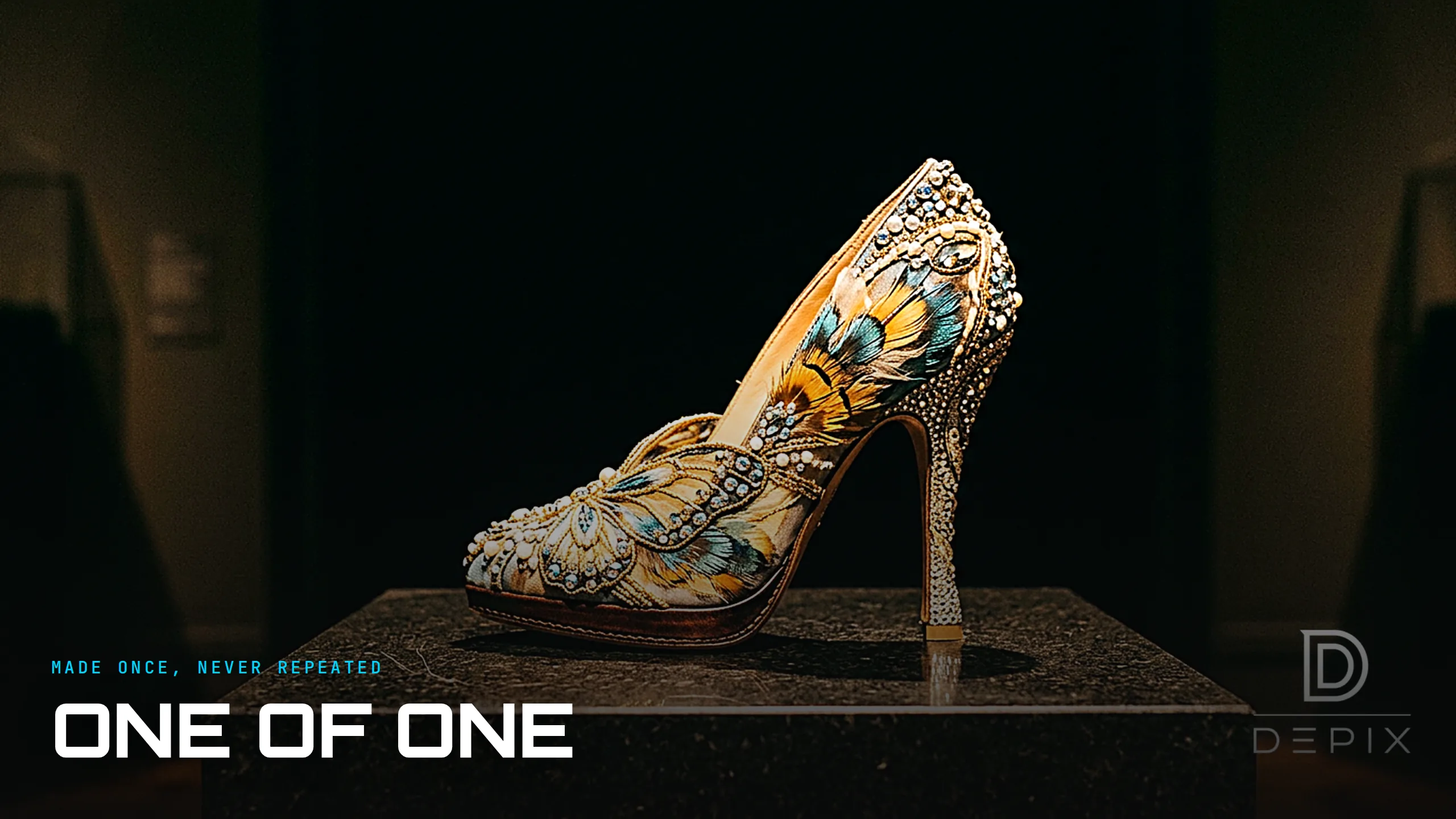
During Paris Haute Couture Week, Roger Vivier did something quietly radical: it extended its ultra-exclusive Pièce Unique line to footwear for the first time, a 31-piece collection called "L'Atelier des Papillons" built by creative director Gherardo Felloni on the house's signature concave Choc heel and the butterfly motif. The pieces carry bead embroidery, hand-painted feathers, organza, macramé, sculpted metal and crystal work, and some took up to 80 hours to complete. Each is one of one. None will ever be made again.
That last fact is the interesting one, because it inverts almost everything industrial design is built on. The entire logic of a product is repeatability: you spend the concept phase perfecting a single design precisely so it can be reproduced thousands of times, and the value of that early work is that it gets amortised across a production run. Pièce Unique deletes the production run. Each object is made once, by hand, as a singular creation, and then, in effect, its pattern is retired. There is no "product." Every piece is simultaneously its own concept phase and its only unit — the prototype is the deliverable.
This is not new; it is the oldest model in fashion, kept alive almost as a living museum. Haute couture is, by its formal definition, exclusive custom garments made largely by hand for a specific client, a single piece sometimes taking a team of specialised artisans hundreds of hours. Couture thrives on scarcity — the final garment may be worn once, photographed a handful of times, produced in tiny numbers, with houses pouring fortunes into an art form that was never designed to scale. Where the rest of the world optimised relentlessly for reproduction, couture kept optimising for the singular.
What does a house actually gain by refusing to scale? The value is the exact inverse of efficiency: the personalised, the human, the un-reproducible. A one-off cannot be value-engineered, because there is no second unit to spread the cost across; every decision is final and expensive, and the hand that made it stays visible in the object. The constraints that make mass production sane — tooling, repeatability, consistency — are exactly the ones couture throws away to keep that hand in the work. The hours and the tiny imperfections are not a cost of the product; on a Pièce Unique, they are the product.
Here is the contrarian turn. We tend to treat couture as a beautiful anachronism, the thing design grew out of on its way to scale. But look at where making is actually heading. As made-to-measure services and digital fabrication spread, and as AI drives the cost of generating infinite unique variations toward zero, the economics quietly flip: producing a thousand identical things becomes the commodity, and producing one thing, perfectly matched to one person, becomes cheap enough to do at scale. Bespoke-at-scale — every unit different, nothing repeated — starts to look less like couture's past and more like everyone's near future. There is a real paradox in it: the same technology that threatens to drown design in infinite indistinguishable copies is also the thing that could make the genuine one-off affordable again, for everyone rather than only the elite few. Roger Vivier is preserving the one-off as heritage; the technology may be about to make its underlying logic universal.
And that reframes the concept phase itself. For a century it mattered because it was leveraged — one great decision multiplied across a million identical units. In a one-off world that leverage disappears, but the decision does not; it becomes more concentrated, not less, because there is no production run to bury a weak choice inside and no "we'll fix it in the next batch." When every object is one of one, the concept phase stops being the cheap front end that everything downstream amplifies and becomes, simply, the whole thing. Roger Vivier's butterflies are a preview of that world: eighty hours, one object, no repeat, every gram of the design decided and defended in the piece itself. In an age about to be flooded with infinite perfect copies, the rarest and most valuable thing a designer can make is the one that was only ever made once.
Sources:
- ●WWD — Roger Vivier debuts exclusive Pièce Unique couture footwear collection
- ●WWD — Gherardo Felloni's first Pièce Unique footwear designs take flight
- ●Daily Front Row — Roger Vivier expands Pièce Unique couture collection to include shoes
- ●Hashtag Legend — Roger Vivier's creative director on legacy, craftsmanship and being unique
- ●L'Officiel — Roger Vivier expands the world of Pièce Unique for Fall/Winter 2026
- ●Wikipedia — Haute couture
- ●The VOU — Haute couture explained
- ●Fashion Theory — The business of haute couture
- ●Kute Tailor — Haute couture vs. fast fashion: craftsmanship, culture, sustainability
- ●Smart Fashion — The art of haute couture: a testament to personalised luxury
- ●WWD — Roger Vivier opens Paris store with exclusive made-to-measure service