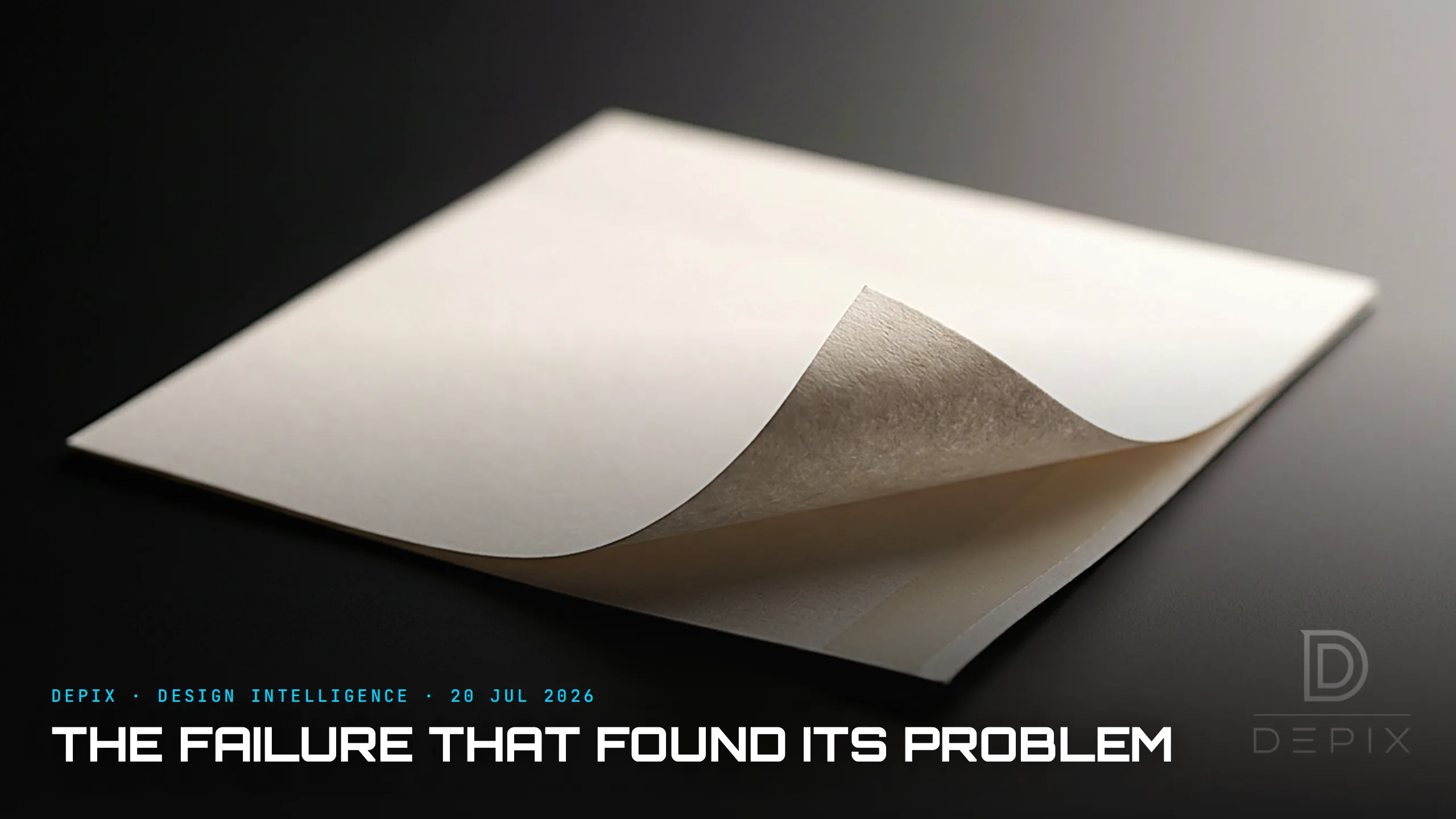
The Post-it Note: The Failure That Found Its Problem
In 1968 a 3M chemist named Spencer Silver was trying to make a stronger adhesive and made a weaker one instead. What he got was a coating of tiny, almost indestructible acrylic spheres that stuck only where they happened to touch a surface — strong enough to hold two sheets of paper together, weak enough to peel them apart again without a tear, and able to do it over and over. By every standard that mattered to the project he had been given, it was a failure. Glue is supposed to hold. This barely did.
Silver, to his enormous credit, refused to file it under failure. He spent the next five years showing it to anyone at 3M who would look — hallway demos, internal seminars, a running campaign that earned him the nickname "Mr. Persistent." He was certain the adhesive was good. What he could not find was the thing it was good for. It became the textbook case of a solution looking for a problem: a genuinely novel technology sitting inert for years, not because it did not work, but because nobody knew which question it was the answer to.
The answer arrived in 1974, in a church. Art Fry, another 3M scientist, sang in a choir and was quietly irritated that the paper bookmarks in his hymnal kept sliding out and losing his place. He had sat through one of Silver's seminars, and it clicked: coat the bookmark with Silver's useless glue and it would stay put, then lift off cleanly without damaging the page. Once he made a few, he saw the bookmark was the small idea — the big one was a note that sticks anywhere and leaves no mark. The property everyone had read as the adhesive's defect — that it does not hold permanently — was the entire point.
Even then it was not done. The first commercial launch, in 1977, went out in four cities under the name Press 'n Peel and landed with a thud. It was only after 3M changed the approach entirely — flooding a test city with free samples so people could feel what the thing did, and renaming it the Post-it Note — that the 1980 national relaunch caught. Twelve years after the "failed" glue, it was an office necessity.
We keep this story close at Depix because it inverts the usual account of where design happens. The exciting part is supposed to be the solution — the breakthrough material, the clever mechanism. But the Post-it's decisive design act was not the chemistry; it was finding the problem the chemistry answered. Silver had the solution fully formed in 1968 and it created nothing for six years, because a solution without the right problem is just an interesting fact. Teams celebrate the moment the technology works and assume the hard part is behind them; the Post-it says the hard part may not have started, because a capability that has not been matched to a real human need has, so far, created nothing at all.
This changes what a "failure" even is. Silver's adhesive was not bad; it was mismatched — measured against a problem (make a permanent bond) that happened to be the wrong one. The most useful move when something underperforms is often not "how do we make it stronger?" but the quieter, harder question: "what is this the right answer to?" A spec is never good or bad on its own — only relative to a problem, and the problem is a design decision as much as the solution is. Concept-phase work is usually taught as generating options; the Post-it is a reminder that half of it is correctly naming the problem, sometimes long after the solution already exists.
And it is not luck, whatever the "happy accident" version suggests. The accident was the glue. Everything that turned it into a product — Silver's six years of refusing to let it die, Fry's specific application, 3M's decision to let people touch it before judging it — was deliberate. The lesson the little square teaches is that a technology is worth exactly as much as the problem you can match it to, and that matching is not something that happens to you. It is the work.
Sources:
- ●Wikipedia — Spencer Silver
- ●National Inventors Hall of Fame — Spencer Silver
- ●Lemelson-MIT — Art Fry & Spencer Silver
- ●NIHF — The Invention of the Post-it Note (a solution looking for a problem)
- ●Wikipedia — Art Fry
- ●Smithsonian Magazine — The heartwarming history of the Post-it Note
- ●NIHF — How Did Art Fry Co-Invent Post-it Notes?
- ●Post-it Brand — History of Post-it Notes (Press 'n Peel, 1977)
- ●ImprintNow — Who Invented Post-it Notes (origin story, sampling)
- ●Wikipedia — Post-it Note
- ●Inky Memo — The team that invented Post-it Notes

Concorde: The Plane Was Never the Problem

The Ballpoint Pen: The Idea Was Easy. The Tolerance Wasn't.