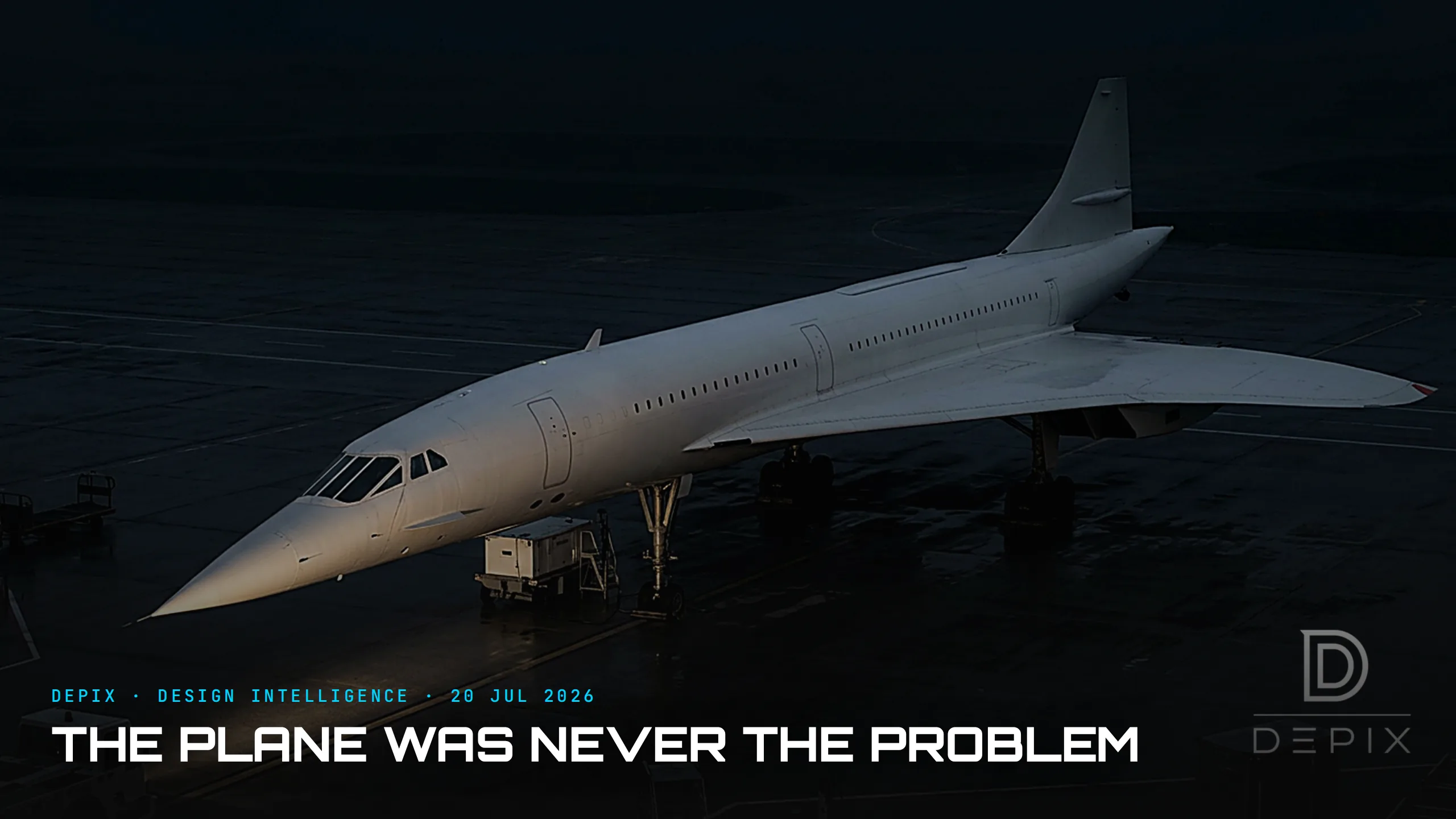
Concorde: The Plane Was Never the Problem
Concorde is still, more than twenty years after its last flight, one of the most beautiful machines ever built — a needle-nosed Mach-2 airliner with a drooping nose and an ogival delta wing, cruising at twice the speed of sound near the edge of space. As an engineering and design object it was a triumph, and it is remembered as one. It was also a commercial catastrophe, and the reason is the most important thing about it: almost nothing that killed Concorde was an engineering problem.
Start with the sonic boom. A plane going supersonic drags a continuous shockwave along the ground — a startling crack, not a one-off. After a 1964 test programme deliberately boomed Oklahoma City several times a day for months and shattered windows and public patience, the reaction was political, not technical. In 1973 the United States banned civil overland supersonic flight outright. In a single regulatory stroke, the dream route — Los Angeles to New York in two hours — was dead, and Concorde was confined to oceanic crossings. The plane could still do Mach 2. It just was not allowed to, over anyone's house.
Then the economics, which were brutal and, again, not a flaw in the aircraft. Concorde carried around a hundred passengers and drank fuel at a supersonic rate; a seat had to sell at roughly thirty times an economy fare, and the plane still needed to fly half-full merely to break even. The market answered clearly. Of the initial rush of options from sixteen airlines, almost every order was cancelled; in the end just fourteen entered service, split between British Airways and Air France, and no other carrier ever bought one. A 2000 crash and the post-9/11 travel slump finished a business that had never really had a market, and Concorde was retired in 2003.
Here is the concept-phase point, and it is uncomfortable for anyone who loves the engineering. The team that built Concorde solved, brilliantly, the constraints they were experts in — aerodynamics, propulsion, materials, heat. The constraints that actually decided its fate were ones they had far less command of: regulation (the boom ban), economics (fuel and fares), and market appetite (who will really pay). A design defined only by its technical constraints is a flawless answer to a question the wider world may simply refuse to ask. The binding constraint is very often not the one your discipline is best at. You do not get to choose which constraint decides the outcome; you only get to choose whether you went looking for it while there was still time to design around it.
You can watch the industry finally internalise this by looking at what its successors are doing. Boom Supersonic's Overture, the most advanced new attempt, is a slightly slower Mach-1.7 jet — and its plan is explicitly to fly only the roughly six hundred overwater routes where the boom never reaches land. Fifty years on, engineers are still routing around the same regulation, which tells you the regulation, not the speed, was always the real constraint. And the most telling project is not a passenger plane at all: NASA's X-59 is a demonstrator whose entire job is to reshape the shockwave so the boom arrives as a soft thump instead of a crack — an attempt to dissolve the regulatory constraint at its physical root. In 2025 the FAA moved to lift the 52-year ban, conditioned precisely on aircraft not producing an audible boom. The design problem, correctly named at last, was never "go faster." It was "make supersonic flight something regulators and the public will permit."
We keep this at Depix as the cautionary twin to every "wouldn't it be incredible if" concept. Concorde is proof that you can win every argument inside your own domain and still lose, because the concept phase is where you are meant to map the whole constraint landscape — including the unglamorous, non-engineering constraints that do not yield to cleverness in your specialty. The most dangerous constraints are the ones outside your expertise, precisely because they are the easiest to wave away as somebody else's problem. Concorde did not fail as an aircraft. It succeeded completely as an aircraft — and that was never the question it needed to answer.
Sources:
- ●Wikipedia — Concorde
- ●Wikipedia — Sonic boom
- ●Air Data News — FAA proposes ending the 50-year overland supersonic ban
- ●History Tools — Why did the supersonic Concorde fail
- ●Etonomics — The Economics of Concorde
- ●Gigazine — Why did Concorde end in commercial failure (30x fares)
- ●Altitude Post — Why the Concorde was retired and what's replacing it
- ●Wikipedia — Air France Flight 4590 (the 2000 crash)
- ●Wikipedia — Boom Overture
- ●David Veksler — Boom Supersonic Overture specs (overwater routes)
- ●NASA — X-59 (Quesst quiet supersonic demonstrator)
- ●Boom Supersonic — Breaking the Sound Barrier Again

The Light Bulb: He Designed the System, Not the Bulb
The Post-it Note: The Failure That Found Its Problem