Validated Isn't Right
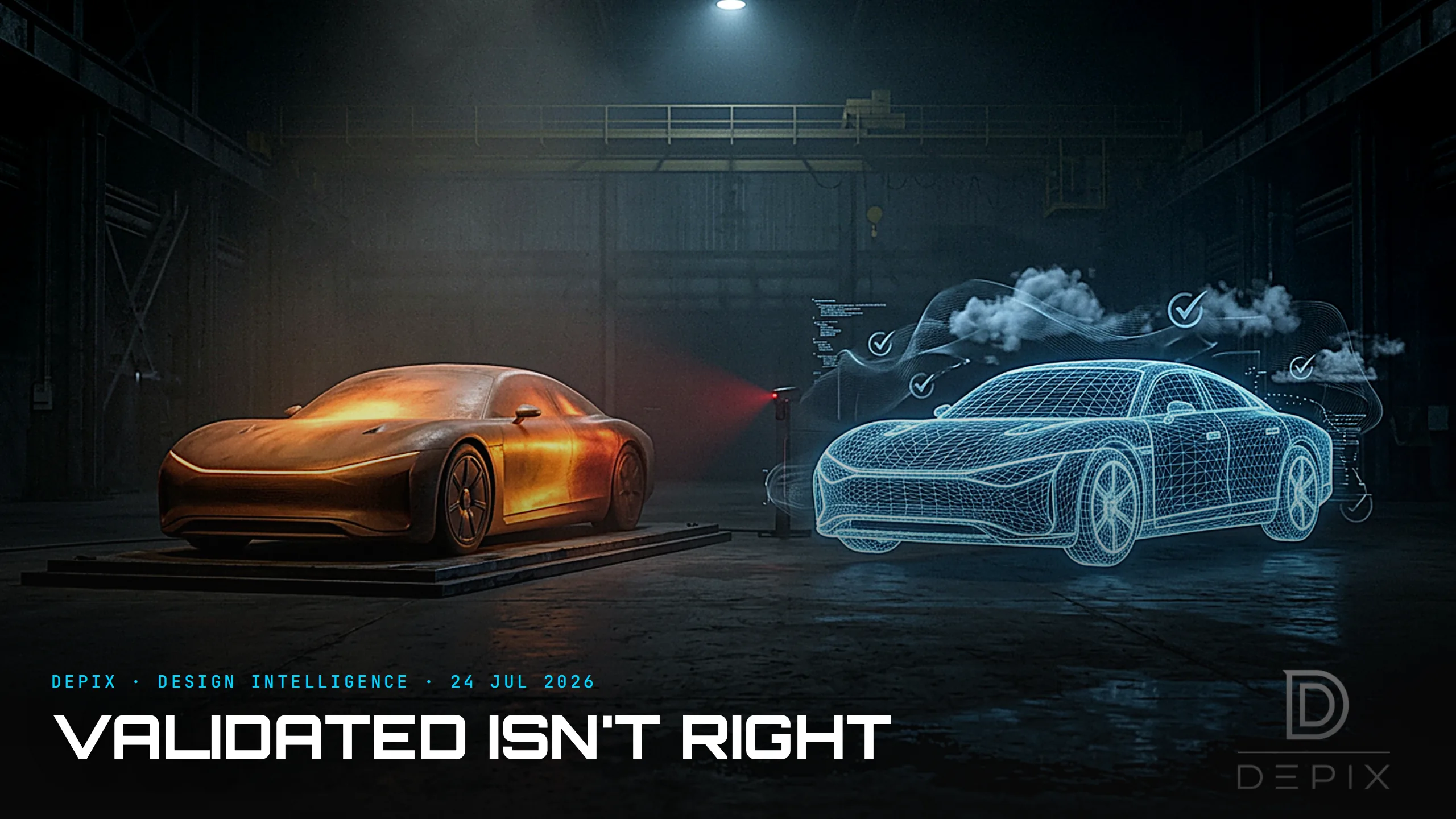
The pitch for the digital twin is one of the most seductive in modern engineering, and it is largely true. Build a living virtual replica of a product and you can test and refine it before committing to a single physical prototype - simulating its crashworthiness, its aerodynamics, its thermal behaviour, its manufacturability. In March 2026 Synopsys announced a platform that validates up to 90% of a vehicle's software before any hardware exists. BMW twins entire assemblies and optimises battery thermal flows with no physical test bench. The promise, in one consultancy's phrase, is to build with certainty.
That phrase is worth stopping on, because it hides the whole problem. Certainty about what, exactly?
A digital twin gives you certainty that a design works. It will tell you, before you cut any metal, that the crash structure passes, that the airflow is clean, that the part can be made, that the battery will not cook. This is genuinely valuable, and it removes an enormous amount of risk from execution. But "works" and "right" are different words, and the twin only speaks the first one. It has no opinion whatsoever on whether the thing is desirable, beautiful, or worth building at all.
Those are not soft edge cases; they are the actual decision. And they sit almost entirely outside what a twin can model. Research into human digital twins is candid about the limit: subjective experience, emotional response and design intent remain extremely hard to capture, because humans cannot be measured in full detail and their responses are dynamic, contextual and resistant to instrumentation. You can simulate a person's ergonomics; you cannot simulate whether they will fall in love with the object. The twin can confirm the door closes with a precise, satisfying sound-pressure curve. It cannot tell you if the car has any soul.
Here is where it gets dangerous, and it is a concept-phase danger. The "validated" stamp a twin produces is enormously authoritative - it arrives with graphs, tolerances and green checkmarks. In a review meeting, "the digital twin validates it" sounds like the end of the argument. So teams quietly conflate two very different claims: "the simulation says this works" and "this is the design we should build." The first is a fact about physics. The second is a judgment about desirability that no simulation ever made. The organisation feels it has decided, when all it has actually done is confirm that a decision nobody made is at least manufacturable.
The failure mode is a product that passes every test and moves no one - technically flawless, emotionally dead, validated into existence. It is the engineering equivalent of a beautifully rendered frame of a mediocre design: the tool did its job perfectly and answered the wrong question with total confidence.
None of this is an argument against digital twins, any more than a spell-checker is an argument against writing. The twin is the best execution-de-risking tool ever built, and going back to guessing at crash performance would help no one. It is an argument about which job the tool is for. A twin should validate a decision after a human has made it - "we believe this is the right car; now prove it can be built and made safe" - not stand in for the decision itself. The moment "is it validated?" starts to answer "is it good?", the most important question in the whole programme has gone unasked.
Build with certainty, by all means - certainty that your idea can survive contact with physics. Just remember that the idea still has to be worth having, and that no twin, however high its fidelity, will ever generate one for you or tell you that you have found it. That part is still yours, and it always was.
Sources:
- ●Toobler - The role of digital twin in the automotive industry in 2026
- ●Neural Concept - Digital twin in the automotive industry
- ●Synopsys - Electronics Digital Twin platform (90% software validation pre-hardware, Mar 2026)
- ●Engineering.com - Synopsys launches Electronics Digital Twins for software-defined vehicles
- ●Slalom - Using digital twins to build with certainty
- ●Simio - Automotive what-if simulation with intelligent digital twins
- ●Nielsen Norman Group - Digital twins: simulating humans with generative AI (limits)
- ●Springer - Human factors in digital twins: challenges and future prospects
- ●ScienceDirect - Towards human digital twin: reviewing human modelling and simulation
- ●DEPIX - Seeing Isn't Deciding (the tool confirms; it does not decide)