Seeing Isn't Deciding
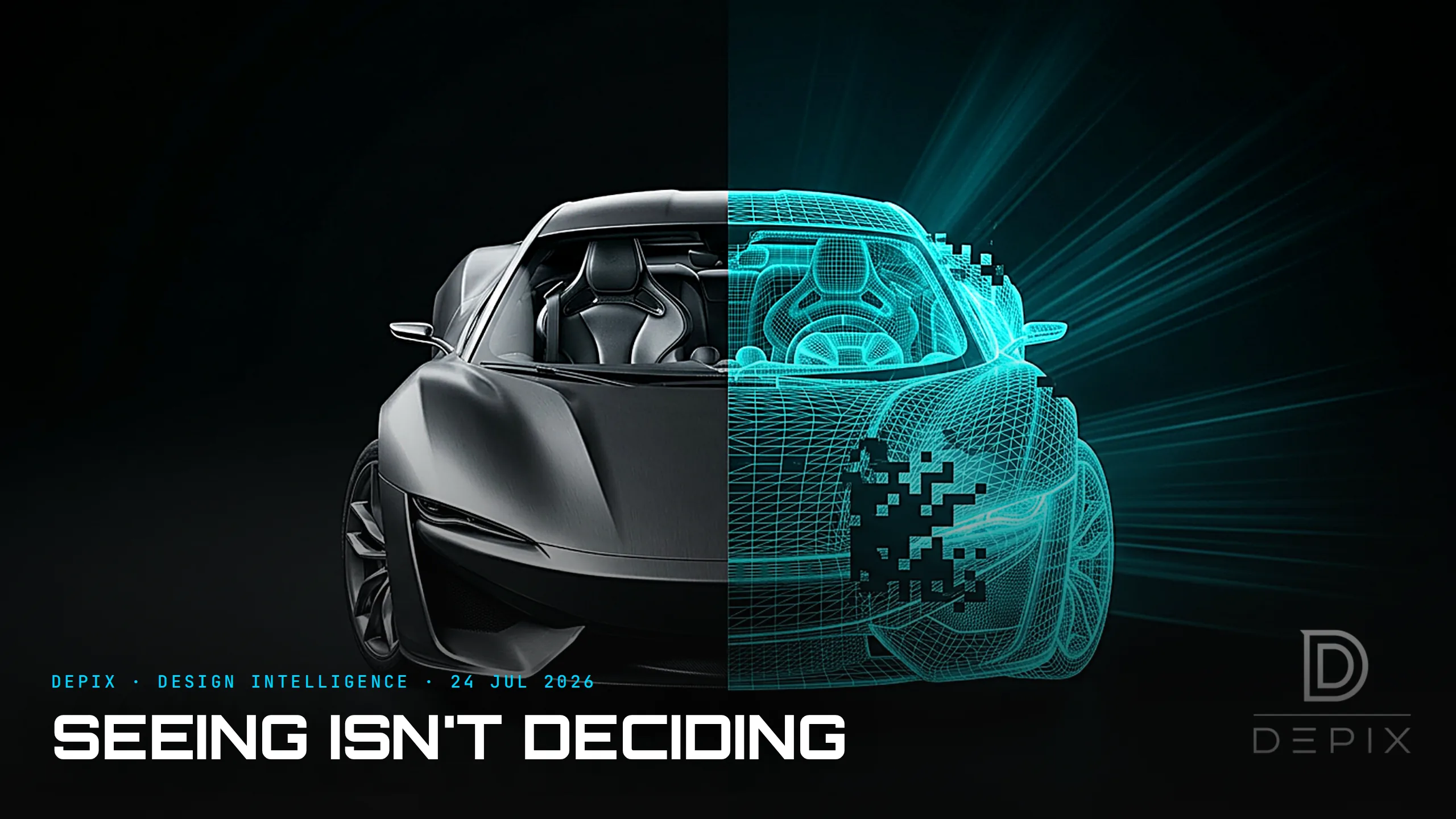
There is a number that gets quoted in every real-time rendering pitch, and it is genuinely staggering: the loop between changing a design and seeing the finished, lit, ray-traced result has gone from days to milliseconds. A designer can now walk around a concept car in VR, change its paint on the fly, and watch the reflections resolve under studio light in real time. Studios report production timelines cut by 60%; whole pipelines have switched to real-time engines; platforms like Omniverse make iteration instantaneous, with no data prep between a change and its full-quality result. This is real, it is here, and it is mostly wonderful.
But collapse a loop to zero and you should ask what used to live inside it. Between "what if we lowered the roofline" and "here is what that looks like," there used to be a wait - hours, sometimes days for an offline render. That wait was annoying, and it was also where a specific kind of work happened: you formed a hypothesis, argued it, imagined the result, and committed to a prediction before the machine confirmed or denied it. The gap forced you to think in advance. Real-time rendering did not just speed that gap up. It deleted it.
What replaces prediction is reaction. When every change is visible the instant you make it, the natural behaviour is not to decide - it is to fiddle. Nudge the character line, glance at the render, nudge it back, try another wheel, rotate the light, chase whatever happens to catch the eye in this exact frame. The tools are explicitly built to reward this: the whole promise is instant feedback so you can iterate at any cadence and immediately see the effect on local shape features you just created. That is a superpower for exploration. It is a trap for decision-making, because it quietly swaps a hard question - is this right? - for an easy one: does this look good right now, on this screen?
Those are not the same question, and the difference is the whole job. "Looks good in this frame" is a property of the render: the hero angle, the flattering HDRI, the ultra-real studio lighting that real-time ray tracing does so well. "Is right" is a property of the design: the proportion that still works at a distance, in bad light, from the three-quarter-rear nobody screenshotted. A real-time engine optimises ferociously for the first and is completely silent on the second. It will happily render a thousand beautiful frames of a mediocre decision.
None of this is an argument against the tool - the speed is a genuine gift, and going back to overnight renders would help no one. It is an argument about the discipline the tool now demands. When seeing is instant, the scarce skill is no longer producing the image; it is knowing what you are looking for before you look. The designers who use real-time rendering well treat it as a way to test a hypothesis they already hold - "I believe this lower roofline reads as faster; let me confirm" - not as a slot machine they pull until something sparkles. They decide, then look. The tool tempts you to do the reverse.
This is a concept-phase problem wearing a technology costume. The concept phase was always the place where you commit to what the thing is before the evidence is in - that is what makes it high-leverage and uncomfortable. Real-time rendering offers to remove the discomfort by giving you evidence for everything, instantly, forever. The failure mode it enables is a team that never has to hold a conviction because it can always just look again, and so drifts frame by beautiful frame toward whatever renders best, with no one ever having decided anything. As the technology keeps collapsing the design-to-visualisation gap toward zero, the deliberate pause - the self-imposed gap where a designer states what they expect and why, before the render answers - stops being a delay the tool removed and becomes a discipline the designer has to add back.
Seeing went instant. Deciding never will, because deciding is not a rendering problem. The loop that collapsed was design-to-seeing. The loop that still runs at human speed, and always will, is design-to-conviction - and that is the only one that was ever actually the point.
Sources:
- ●Unreal Engine - How real-time tech is changing the auto design landscape
- ●Unreal Engine - Real-time ray tracing part 3: automotive design & visualization
- ●Unreal Engine - Rotor Studios switches its automotive pipeline to UE5
- ●Unreal Engine - Automotive & car design uses
- ●The Digital Bunch - Real-time visualization for luxury automotive launches
- ●NVIDIA - Director of photography revs up Omniverse for a car demo
- ●NVIDIA - Omniverse RTX racing demo: rendering & realistic simulation
- ●Leadtek - NVIDIA Omniverse platform (instant iteration, no data prep)
- ●3DCGI Studio - From concept to reality: how 3D visualization transforms auto design
- ●Varjo - Omniverse support enables real-time ray tracing at human-eye resolution