Freedom Came With a Default Shape
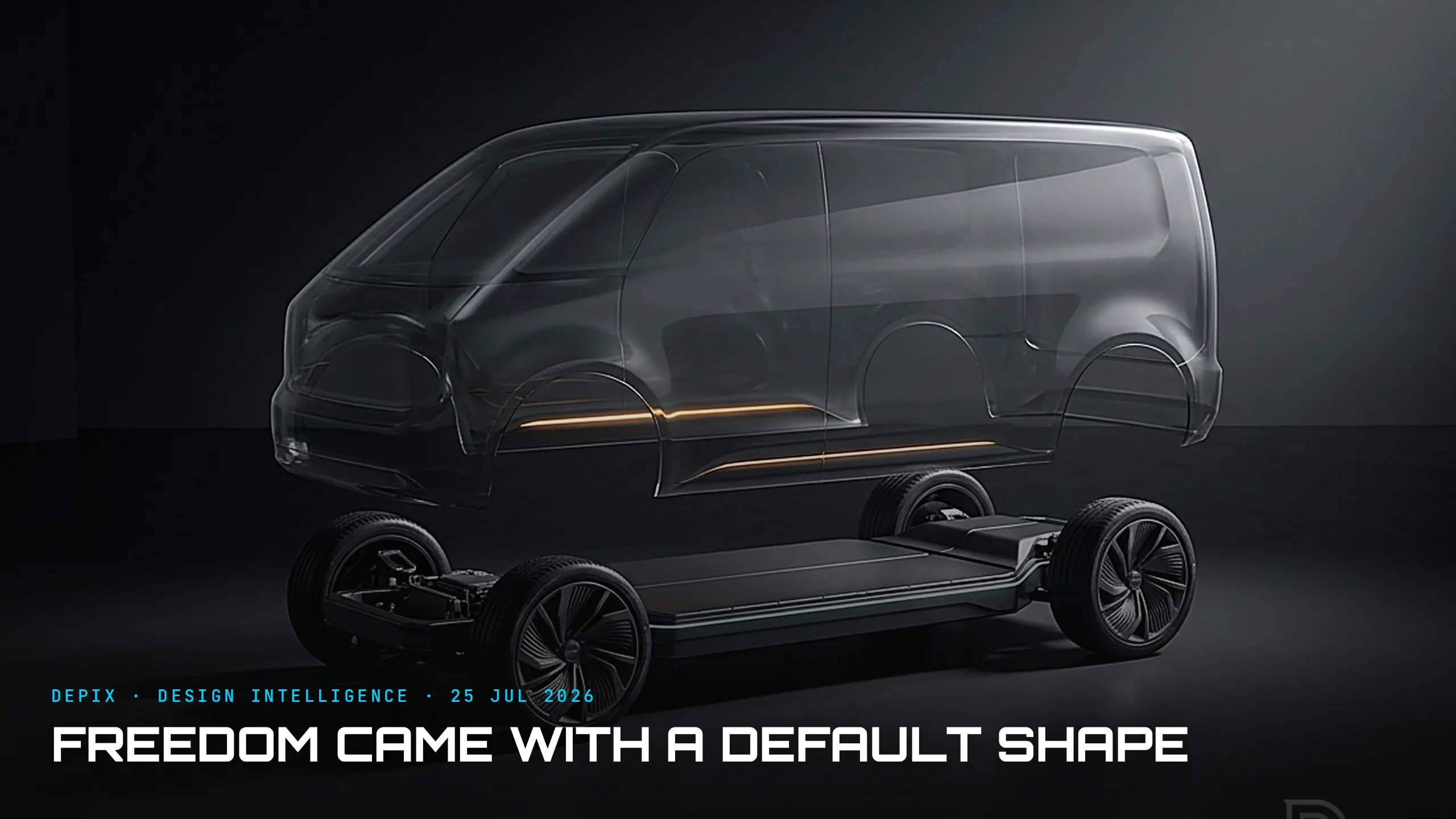
For a century, the hardest constraints in car design lived under the bonnet. The engine, the gearbox and the transmission tunnel dictated where the wheels sat, how long the nose had to be, how high the floor rode and where a passenger could put their feet. The skateboard platform deleted all of it in a single move: batteries and motors flatten into a slab between the axles, and the body above becomes, in the industry's favourite phrase, a blank canvas.
The freedom is real. With no engine bay to package around, designers inherit longer wheelbases, shorter overhangs and a flat floor - more usable cabin inside a smaller footprint. Purpose-built architectures such as Hyundai's E-GMP and Volkswagen's incoming SSP - one base intended to underpin more than 40 million cars across the group - are sold on exactly this promise: one flexible floor, endless bodies on top.
So why do the bodies keep arriving looking the same?
Walk any EV launch and the silhouettes rhyme: a tall, cab-forward one-box, short overhangs, a high beltline, a fastback tail, flush handles and a full-width lightbar. Critics have taken to calling it the death of the silhouette, and the standard defence is physics: range rewards aerodynamics, and when every team optimises toward the same drag target they converge on the same shape. That is true - but it lets the platform off the hook. The deeper cause is the slab itself. A pack under the floor raises the hip-point and lifts the cabin; to keep headroom without a limousine roofline, the whole body grows tall and boxy. The flat floor that promised freedom quietly fixes the stance before a designer draws a line.
That is the trap hiding inside the blank canvas. A canvas has no opinion; a skateboard does. Left unchallenged it pushes every car toward the same tall monovolume, because that is the path of least resistance for a thick pack and a low drag number. The freedom is genuine - and so is the default. Under deadline and cost pressure, most programmes take the default.
The instructive exceptions are the cars that refused it, and every one of them paid for the refusal at the concept phase, not in the styling studio. Porsche wanted a low sports-car seating position on top of a battery slab - a physical contradiction. Its answer was to cut "foot garages", recesses in the pack beneath the rear footwells, so passengers could sit low despite the floor. That is not a drawing decision; it changes the battery's geometry, and it is only possible if you demand it before the pack is engineered. Hyundai did the equivalent with the Ioniq 6, committing to a streamliner saloon while the market stampeded toward crossovers and then engineering a 0.21 drag coefficient - active flaps, wheel-gap reducers, a single defining curve - to make the low body actually pay for itself. In both cases the distinctive shape exists because someone decided early that the platform would serve the design, not dictate it.
That is the real lesson of the skateboard, and it reaches well past cars. Every powerful new platform - an EV architecture, a design system, a foundation model - is advertised as freedom and arrives carrying a default. The default is never neutral: it is the cheapest path the platform makes available, and it is invisible precisely because it feels like "just how the thing wants to be built." Differentiation is not something you bolt on later with a grille graphic or a signature colour. By the time the pack is tooled and the hardpoints are frozen, the silhouette is already chosen; you are only picking trim.
So the concept-phase question is never "what does this platform let us do?" - the brochure answers that. It is "what will this platform do by default if we don't fight it, and is that the car we actually want?" Ask it early and you get a Taycan or an Ioniq 6. Ask it at the clay model and you get another tall one-box, plus a marketing budget to explain why it is different. The skateboard did not take design freedom away. It moved the moment you have to use it - all the way upstream, to the decision most programmes are still making far too late.
Sources:
- ●E-Mobility Engineering - EV skateboard platforms explained
- ●Capital One - What is a skateboard platform?
- ●Hyundai - E-GMP dedicated EV platform
- ●Charged EVs - VW to replace MEB and PPE with the Scalable Systems Platform (SSP)
- ●Autocar - Volkswagen SSP platform, 2026, more than 40 million cars
- ●Autoblog - Why all EVs look the same now
- ●Capital One - Why are EVs shaped the way they are?
- ●Dezeen - How electric vehicle technology is changing car design
- ●Porsche Newsroom - Technical feature: the Taycan (foot garages)
- ●InsideEVs - Secrets behind the Ioniq 6's top aerodynamic efficiency
- ●CarBuzz - The ingenious aerodynamics of the Hyundai Ioniq 6 (0.21 Cd)
- ●The Truth About Cars - Design differentiation is a real EV challenge