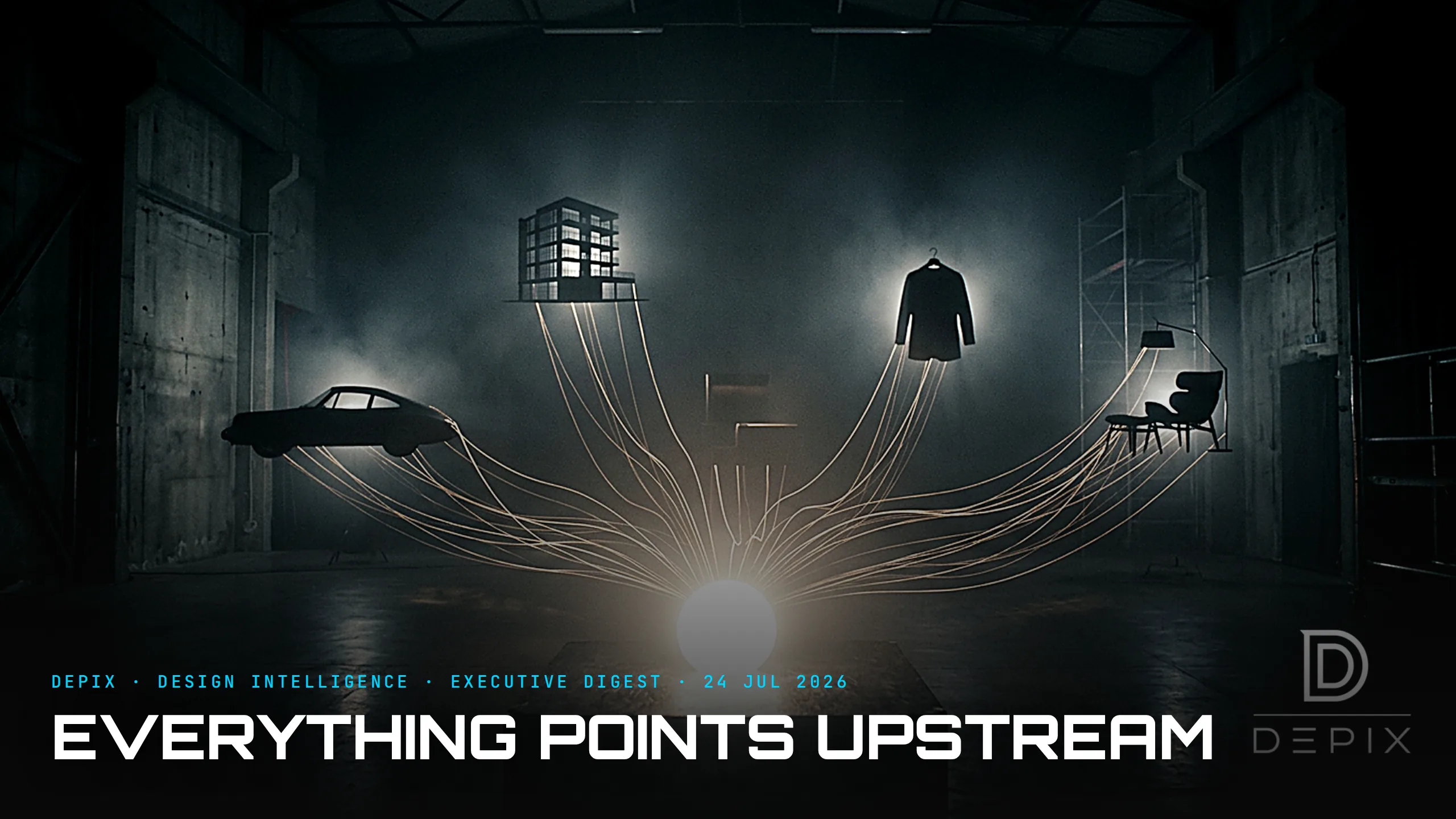
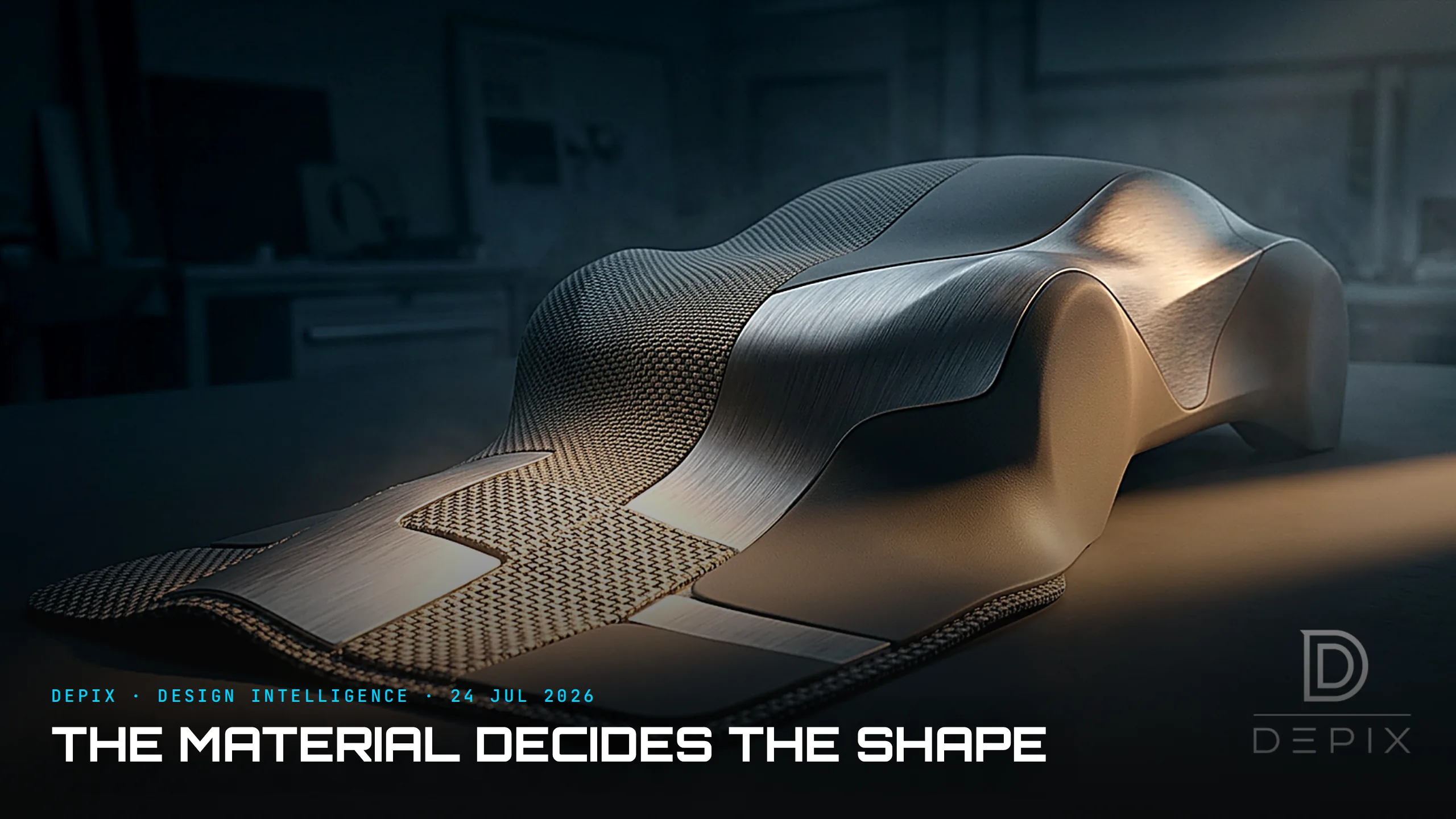
The Twin Can't Tell You What to Build: What Digital Twins Fix in Design — and What They Can't
Years before a single car rolls off a new production line, the factory that will build it already exists — as a physics-accurate virtual replica running in software. Inside BMW's iFACTORY, planners rearrange robots and logistics lines and run virtual collision checks, testing every change before a single bolt is turned — a projected 30% cut in planning costs, with teams making around three validated changes a week across more than 30 plants. This is the digital twin, and it is having an enormous moment: the automotive digital-twin market alone is forecast to grow from $2.7 billion in 2025 to $28.7 billion by 2034, part of a broader market heading past $34 billion in 2026.
The pitch is irresistible, and largely true: validate before you build. Catch the flaw in a simulation that costs nothing instead of in a prototype that costs millions. NVIDIA's Omniverse has become a kind of operating system for these industrial twins, and manufacturers are scaling them across whole plant networks.
Here is the design-intelligence catch, and it is a subtle one. A digital twin is an extraordinary answer to one question — did we build the thing right? — and it has almost nothing to say about a different, more important one: are we building the right thing?
The twin validates execution, not intent. It will faithfully, beautifully confirm that your factory runs at peak throughput, that your part survives the load case, that your airflow is optimal — for the design you handed it. It holds no opinion on whether that was the design worth building. Feed it a mediocre concept and it will help you execute a mediocre concept to perfection. Worse, its authority is only as good as its inputs: every serious account of the technology warns of garbage in, garbage out — a twin fed incomplete, noisy or wrongly-assumed data produces confident, precise, rigorously-validated nonsense.
The concept phase — the moment you decide what the thing should be, who it is for, what it should make a person feel — still has no simulator. There is no twin that tells you the market wants a smaller car, that the cabin should feel like a room and not a cockpit, that the brand should stand for calm instead of aggression. Those are judgments, and judgments do not run in Omniverse.
The real risk isn't that digital twins are overhyped; the engineering value is real and compounding. It's that their precision manufactures false confidence. "The simulation passed" quietly starts to feel like "the decision was right." A team that can validate everything begins to believe validation is deciding. It isn't. Validation tells you your answer is internally correct; it never tells you that you asked the right question. That is the one thing every account of the technology's limits keeps circling: the twin optimises the given problem, and stays silent on whether it was the problem worth solving.
Used well, the twin is the most powerful servant the concept phase has ever had. It lets you carry an early decision into reality with real confidence instead of a hopeful guess, and it lets you explore more concepts — faster, cheaper, earlier. BMW's planners making three changes a week are effectively running the concept phase somewhere that being wrong is free. That is a genuine gift to the front of the pipeline.
But servant is the operative word. The moment the twin stops serving the concept and starts standing in for it — the moment "we simulated it" replaces "we decided it" — you have automated the easy half of design and quietly abandoned the hard half. The twin can perfect the how. Only a human can choose the what. And the what, as always, is settled at the very start, in the one part of the pipeline that no simulation has yet learned to run.
Sources:
- ●BMW Group develops custom application on NVIDIA Omniverse — NVIDIA
- ●BMW Group scales its Virtual Factory (iFACTORY, collision checks, 30%) — BMW Press
- ●Digital Twin in Automotive Market ($2.7B 2025 -> $28.7B 2034) — GM Insights
- ●Automotive factory planning at BMW with AI-enabled digital twins (GTC 2025) — NVIDIA
- ●NVIDIA Omniverse: OS for physical AI & industrial digitalization — Introl
- ●Digital twins in manufacturing at enterprise scale (BMW iFACTORY) — ClarityPoints
- ●Digital Twin Market size & growth — Fortune Business Insights
- ●Digital Twin statistics 2026 (market past $34B) — MindInventory
- ●Challenges and limitations of digital twin systems — CloudSimulation
- ●Advantages and disadvantages of digital twin technology (garbage in, garbage out) — TechTarget
- ●Challenges and limitations of digital twin technology — FasterCapital
- ●TEVV of Digital Twins: a comprehensive framework — arXiv
The Default Is the Design: Why the Option Nobody Chooses Is the One That Matters Most
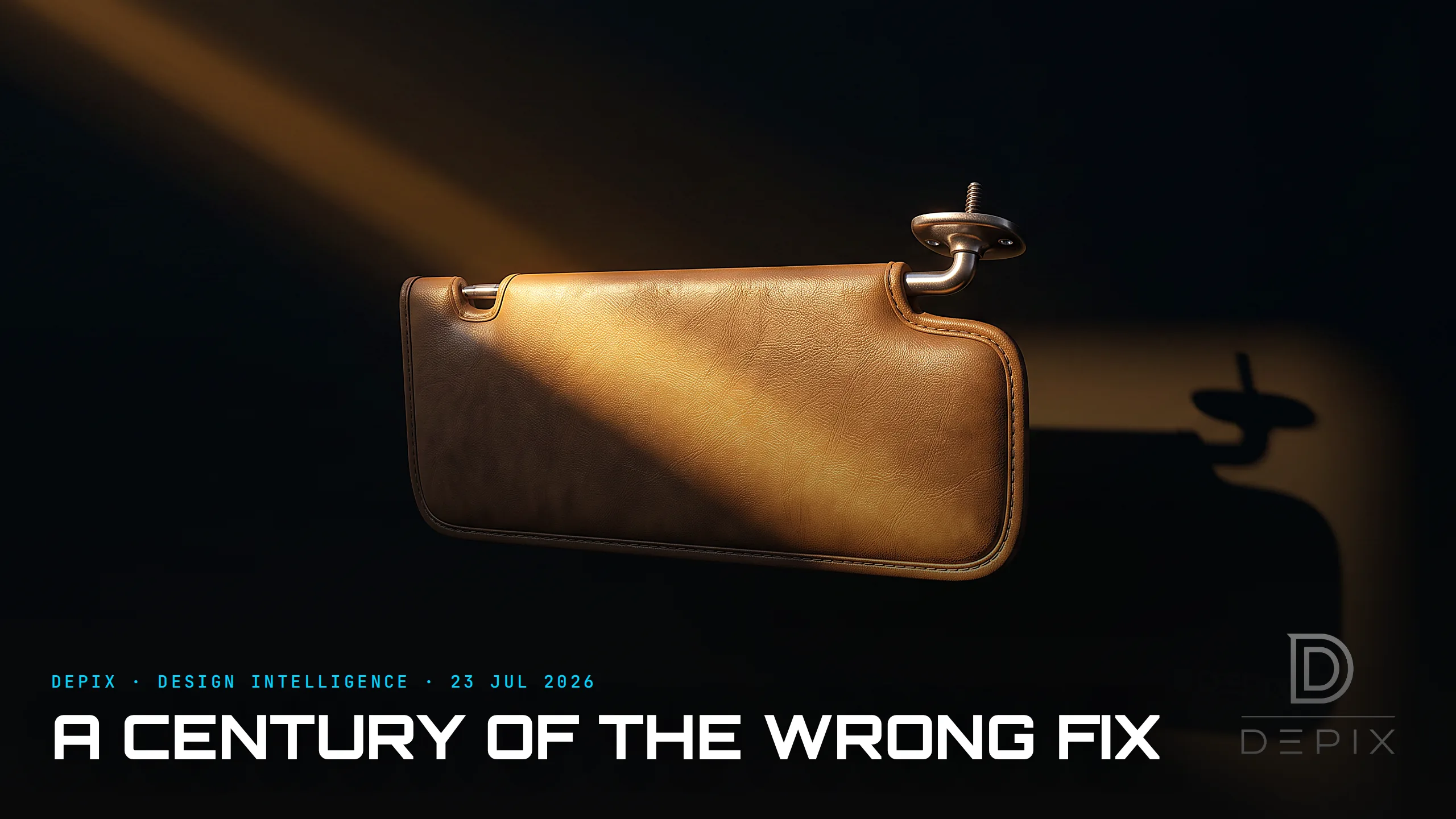
The Sun Visor Never Solved the Problem: What a Century-Old Flap Teaches About Re-Asking the Question