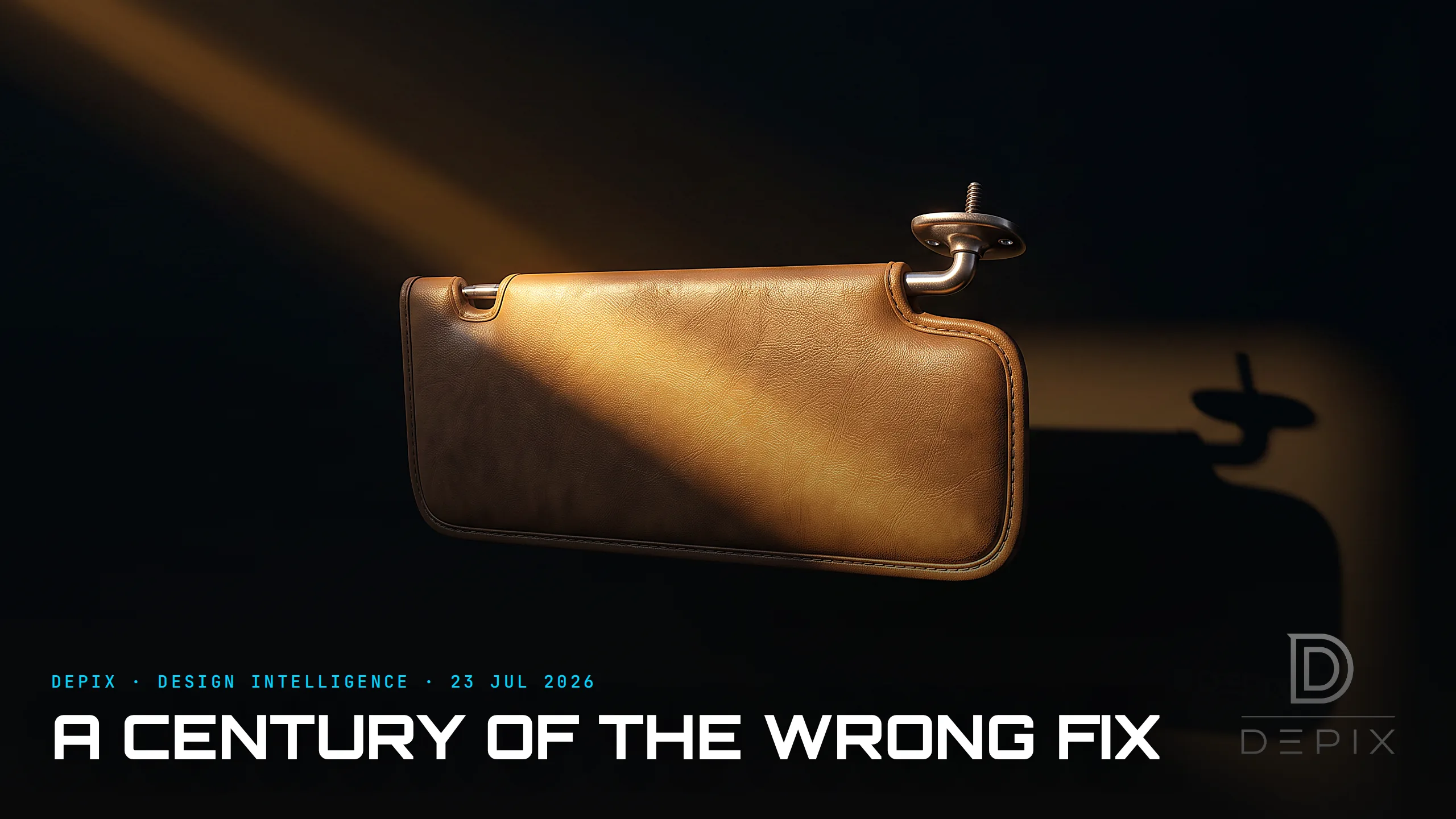
The Sun Visor Never Solved the Problem: What a Century-Old Flap Teaches About Re-Asking the Question
Reach up, flip it down. The sun visor is one of the few things in your car your great-grandparents would recognise instantly. Ford fitted a "glare shield" to Model T cabins from 1924; it moved inside the cabin in the early 1930s and settled into the flip-down flap we still use, essentially unchanged a century later. In a car that now parks itself, that unbothered little flap is a fossil.
We tend to read that longevity as a compliment — a design so right it never needed changing. It's closer to the opposite. The visor survived unquestioned for a hundred years not because it solved the problem, but because it was good enough to stop anyone asking whether it did.
Look at what it actually does. Glare is a small, moving beam of light hitting a small target: your eyes. The visor's answer is to drop an opaque slab across a large part of your forward view — trading one hazard (a dazzling patch) for another (a blind spot where a traffic light or a pedestrian might be). You have almost certainly ducked and craned around one. It doesn't aim; it blocks, and hopes the thing you need to see isn't behind it. A century of patents — see-through visors, retractable glare shields — kept iterating on that same slab, never questioning the premise.
Then, at CES 2020, Bosch showed the Virtual Visor and, almost accidentally, exposed the premise. It is a transparent LCD strip paired with a driver-facing camera. The camera tracks the shadow the sun casts on your face, locates your eyes and darkens only the handful of pixels standing between the sun and your pupils — the rest of the panel stays clear. It won a CES Best of Innovation award, and uses machine learning to keep the dark spot on your eyes as you move.
Here is the design-intelligence point, and it is not about LCDs. The breakthrough wasn't a better visor. It was a better question. For a century the industry solved "how do we make a better flap?" Bosch solved "how do we stop glare reaching the eyes?" — and the flap simply disappeared. The object we had all accepted turned out to be an answer to a question nobody had re-read.
This is the trap hiding inside every "it works." A good-enough solution that goes unchallenged doesn't advertise itself as a problem; it advertises itself as solved. It sits in the corner of the product, reliable and invisible, quietly absorbing the assumption that the question behind it was settled long ago. The most fertile ground for reinvention in any product is rarely the part everyone complains about — that part gets attention. It is the part everyone has stopped seeing, precisely because it never fails loudly enough to demand it.
And the leverage is entirely at the concept phase. Once you commit to "a flap," every downstream decision is about the flap: its hinge, its material, its mirror, its detents. You can refine that flap for a hundred years and never arrive at a transparent display, because the display is not a better flap — it is what you get when you delete the flap and return to the original need. Re-stating the actual problem is a five-minute act of intent at the very start; it becomes almost impossible to recover later, buried under a mature solution.
The visor is a small, almost comic example, but the pattern is everywhere. The rear-view mirror, the horn button, the parking brake, the indicator stalk — every car is full of century-old answers wearing the disguise of settled fact. So are most products, and most companies. The dangerous phrase is never "this is broken." It is "this works — leave it." Because "works" only ever meant "good enough that we stopped asking," and good enough is where the next idea is hiding.
So the next time something in your design is so reliable it has gone invisible, treat that as a flag, not a comfort. Pull it back into the light and ask the question it was built to answer — not "how do we improve this thing?" but "what were we actually trying to do, before this thing became the answer?" A hundred years of the sun visor is proof that the gap between works and right can stay open a very long time before anyone thinks to close it.
Sources:
- ●Automotive features, the unsung heroes (sun visor from 1924) — Kelley Blue Book
- ●Bosch's smart virtual visor tracks the sun while you drive — IEEE Spectrum
- ●How Bosch engineers transformed the regular ol' sun visor — TechCrunch
- ●Bosch's LCD visor only blocks the view where the sun is — Designboom
- ●CES 2020: Bosch Virtual Visor for driver safety — AutoTechInsight (S&P)
- ●Bosch uses AI to block the sun's glare as you drive — TechRadar
- ●Glare be gone: Bosch demos Virtual Visor (CES Best of Innovation) — Collision Repair
- ●Bosch unveils smart virtual sun visor at tech show — Malay Mail
- ●See-through automobile sun visor (US patent 4,362,330)
- ●Visor with retractable glare shields (US patent 4,728,142)
- ●The history of windshield auto glass — Crystal Glass

The Twin Can't Tell You What to Build: What Digital Twins Fix in Design — and What They Can't

The Death of the Car Key: What We Lose When a Ritual Becomes a Feature
Related posts
The Default Is the Design: Why the Option Nobody Chooses Is the One That Matters Most
The Twin Can't Tell You What to Build: What Digital Twins Fix in Design — and What They Can't
The Death of the Car Key: What We Lose When a Ritual Becomes a Feature