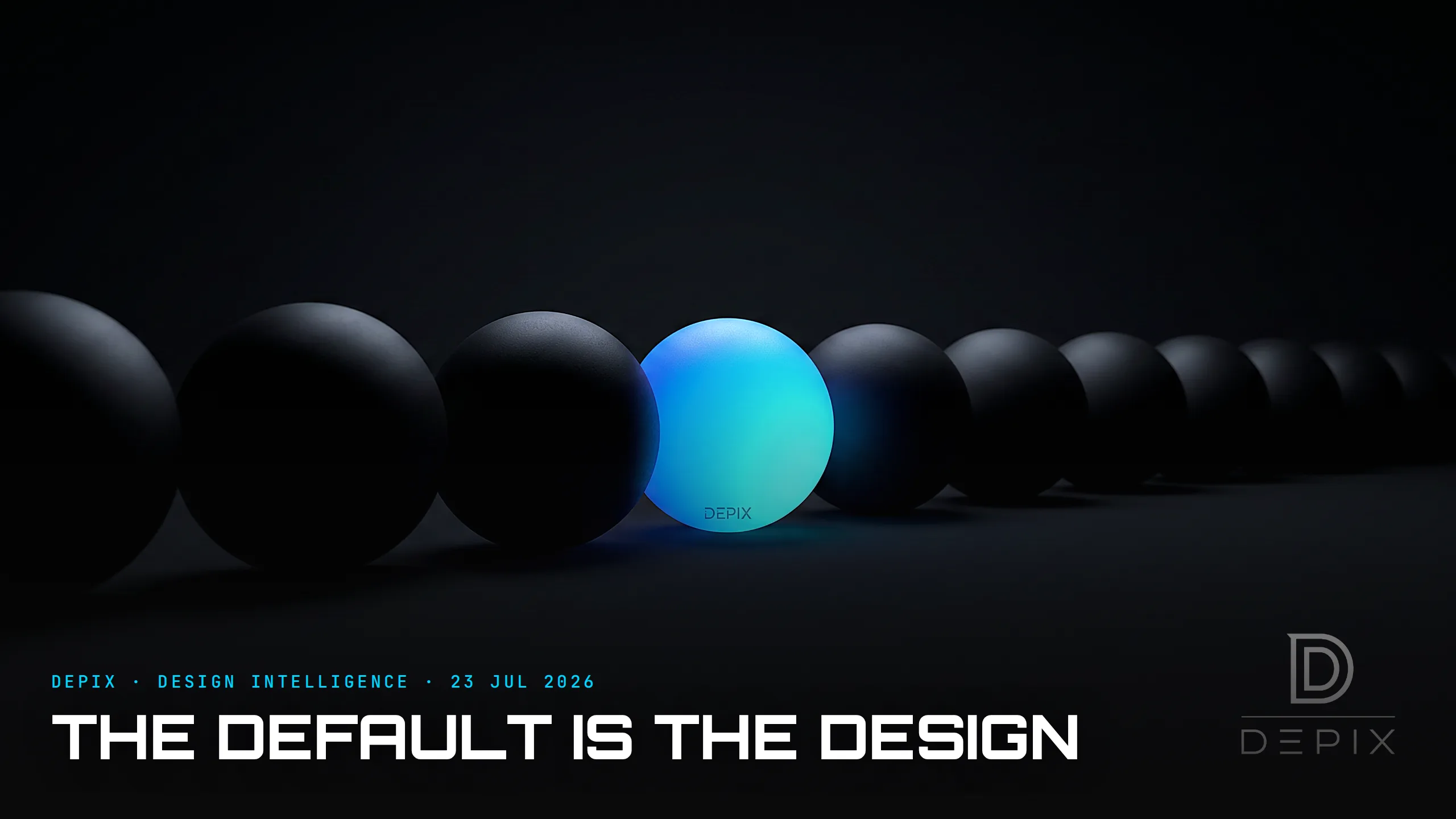
The Default Is the Design: Why the Option Nobody Chooses Is the One That Matters Most
Somewhere in every product there is a decision almost no one argues about and almost everyone lives with: the default. The pre-ticked box, the factory setting, the option already selected when you arrive. It feels like a triviality — a sensible starting point you're free to change. You almost never do. And that is precisely why the default is the most powerful design decision in the entire product.
The starkest proof is life and death. In 2003, Eric Johnson and Daniel Goldstein asked a simple question — do defaults save lives? — and looked at organ-donation rates across countries. Where citizens had to opt IN to donate, participation sat low. Where they were enrolled by default and had to opt OUT, it ran extraordinarily high. The difference wasn't the people or their values — it was a single word on a form. Opt-out countries see roughly six times the registration of opt-in ones. Same question, opposite default, wildly different world.
Why? Because changing a default takes effort, and we are magnificent procrastinators. The pull toward the pre-set option even has a name — status quo bias — and it means whatever you set as the starting point becomes, for most people, the ending point too.
If that sounds abstract, consider its price tag. Google reportedly paid Apple around $20 billion in a single year for one thing: to be the default search engine in Safari. Not the only option — you can change it in three taps — just the default. Google's own analysis reportedly estimated it would lose tens of billions in revenue if it lost that default slot, and the arrangement became the centre of a landmark antitrust case. Twenty billion dollars a year for a setting almost everyone could change and almost no one does. That is the market putting a number on the default effect.
Here is the design-intelligence point. Designers pour their attention into the options — the features, the flows, the choices they lay out for the user. But the one option the majority will actually live inside is the default, and it is routinely the most carelessly made decision in the whole product. It gets chosen late, often by an engineer picking "whatever's reasonable," treated as a technical placeholder rather than what it truly is: the experience the product will have for most of the humans who ever touch it.
A default is never neutral. Choosing it is choosing the outcome for the silent majority who will never open the settings. That makes it, unavoidably, a design decision — and often an ethical one — which is why the opt-in versus opt-out choice is now studied as a policy lever, not a form-design detail. "We'll just pick a sensible default" is the sentence where enormous influence quietly leaks out of the concept phase and into an afterthought.
The fix isn't complicated, but it is a discipline: treat the default as a first-class concept-phase decision. Decide it early, deliberately, and with full knowledge that it is the design for most people — because for most people it is the only design they will ever experience. Ask the uncomfortable question every default hides: if nobody ever changes this, is this the world we meant to build? The sums companies pay to own a default prove they already know the answer to how much it matters.
Because people mostly won't change it. The genius of the default is also its danger: it delivers your intention to millions without asking them to lift a finger — a gift if you chose it with care, and a quiet catastrophe if you didn't really choose it at all. The option nobody notices is the one that decides almost everything. Design it like it matters, because it is the one part of your product you can be certain most people will use exactly as you left it.
Sources:
- ●Defaults and Donation Decisions (Do Defaults Save Lives?) — Johnson & Goldstein
- ●The Default Effect: why the default almost always wins — Yu-kai Chou
- ●Does how we ask for organs determine whether people donate? — AMA Journal of Ethics
- ●Nudging to donate organs: procrastination & the status quo — NIH/PMC
- ●Comparing the effects of defaults in organ donation (status quo bias) — ScienceDirect
- ●Google paid Apple $20 billion in 2022 to be Safari's default search — PhoneArena
- ●Google's default search payments to Apple at risk in antitrust suit — AppleInsider
- ●Google search monopoly antitrust appeal — MacRumors
- ●Crowding-out effects of opt-out defaults (organ donation policy) — NIH/PMC
- ●Google's $20B annual payment to Apple for default status — Rocket Clicks
- ●Apple dodged a $20 billion hit thanks to the Google antitrust ruling — Yahoo Finance
Design Intelligence Daily — The Decision Is Always Upstream (23 July 2026)

The Twin Can't Tell You What to Build: What Digital Twins Fix in Design — and What They Can't