Form Follows Cooling
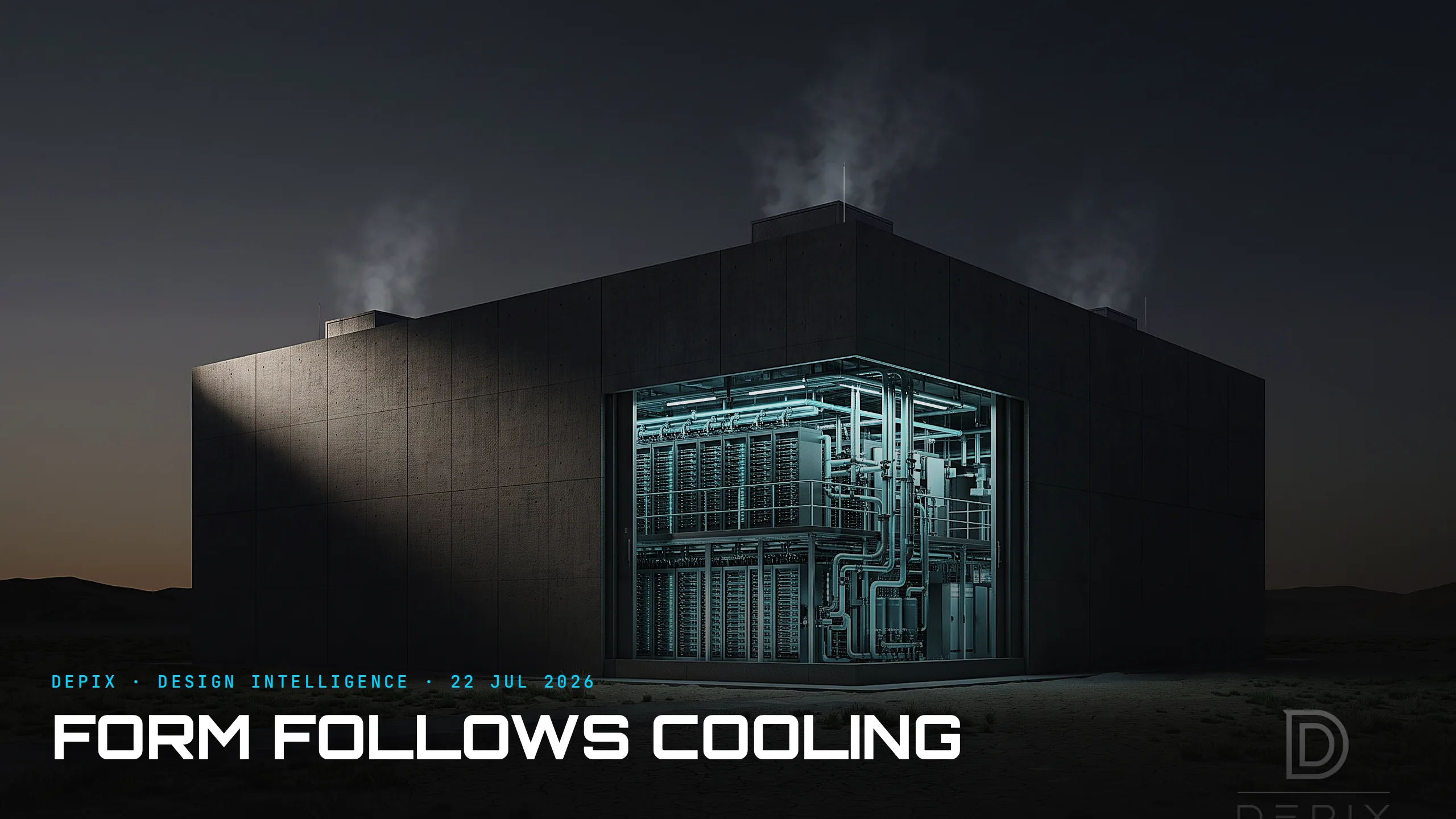
The most important buildings of the AI era are the ones nobody is designing to be looked at. In 2026, the hyperscalers are pouring on the order of $400 billion into data centres, and these buildings — the physical substrate of the cloud and of AI — have quietly become one of the dominant new building types of the decade. Yet a data centre has almost no "design" in the conventional sense: no facade worth photographing, no conversation with the street, just a vast windowless box off a motorway. The interesting thing isn't that they're ugly. It's why. Their entire design lives in the section, not the elevation. Form follows cooling.
For a century, "form follows function" was an architectural slogan mostly honoured in the breach — a nice idea buildings gestured at while doing something prettier. The hyperscale data centre is where it finally becomes ruthlessly literal. As AI racks cross 50–100 kW and GPU clusters heat up, direct-to-chip liquid cooling, rear-door heat exchangers and immersion tanks stop being experimental and become the spec — and the cooling architecture dictates everything: ceiling heights, floor loads, pipe runs, the whole massing. The AI workload is re-designing the building from the inside out. The GPU cluster designs the shed.
The exterior box is just the residue — the smallest, cheapest enclosure that keeps weather off a machine whose real design is airflow, power distribution and heat rejection. It is why so many are prefabricated and modular: if the building is only a wrapper around a thermal system, you may as well stamp it out. Many are deliberately anonymous, too — unmarked, unlit, sited to be forgotten — because a building full of other people's data has real security reasons to disappear. For once, invisibility isn't only a by-product of cost; it is an actual design goal. This is the concept-phase decision taken to its purest form — the building entirely determined by its performance architecture and its need to vanish, decided before anyone draws a wall.
And it inverts what most people mean by "design." We treat design as the visible: the facade, the silhouette, the thing you see. But the most consequential design in a data centre is invisible — the cooling topology, the power train, the redundancy — all engineered around the AI workload rather than any picture. A designer who obsessed over the elevation here would be polishing the least important one percent.
Here is the contrarian turn. This is either the honest endpoint of functionalism, or a quiet abdication — and it is worth being clear about which. When function this completely dominates, the parts that aren't dictated by cooling — how the building sits in its landscape, what it does to the local grid, the water table, the neighbours — become the undesigned part. That is the real design debt of the boom. These sheds draw staggering power and water and reshape whole regions, yet the discipline that should ask "what does this owe its context?" has largely left the room, because the brief says only "cheapest box that cools the chips." The absence of a facade is honest. The absence of a relationship to place is a decision too — just one nobody is owning.
There is a lesson here well beyond server farms. Almost every product has this same split: a visible surface everyone argues about, and an invisible architecture that actually decides whether the thing works. The standing temptation is to design the part you can see. The data centre is the extreme case that clarifies the rule — sometimes ninety-nine percent of the real design decision is invisible, settled at the concept phase, and the visible form is whatever is left over. That is entirely fine when the invisible architecture genuinely is the point. It becomes a problem the moment "the box is just the residue" quietly extends to everything the box does to the world around it.
So the next time you pass a windowless grey shed the size of a stadium, see it for what it is: not a failure of design, but design relocated wholesale into the section — the purest built expression of form-follows-function we have ever managed, and a live question about what a building still owes the place it lands in when its only brief is to keep the machines cool.
Sources:
- ●Accenture — Data centre trends 2026: shifting up a gear
- ●Built In — Where AI data centers are headed after 2025's boom
- ●Data Center Knowledge — Data Center World 2026: AI pushes infrastructure to new limits
- ●TechRadar — Why AI is re-designing data center architecture
- ●Arctiq — The 8 data center trends that will define 2026
- ●Wikipedia — Data center
- ●Wikipedia — Hyperscale data center
- ●Wikipedia — Modular data center
- ●Wikipedia — Computer cooling
- ●Wikipedia — Liquid cooling
- ●Wikipedia — Form follows function
- ●Wikipedia — Functionalism (architecture))
- ●Wikipedia — Cloud computing
- ●Wikipedia — Environmental impact of artificial intelligence