The Cheapest Decisions Cost the Most
Every design leader will tell you the concept phase matters. Then watch where the money and the people actually go, and you find the opposite belief in action. The concept phase - the sketches, the proportion calls, the package and platform decisions made before anything is tooled - is staffed thinnest, scheduled tightest, and treated as the pleasant creative prelude to the "real" work of engineering and production. This is backwards, and the numbers say so with unusual bluntness.
The finding is one of the most replicated in design research: somewhere between 70 and 80 percent of a product's whole-life cost is locked in during the early, conceptual design stage, long before detailed design begins. In one product-archaeology study, early design-phase decisions accounted for 86 percent of total potential rework cost. By the time the design is frozen, up to 80 percent of the cost is already committed. The decisions that determine the most are made in the phase that spends the least.
Now put that next to the cost-of-change curve, first drawn by Barry Boehm and confirmed everywhere since. Changes are cheap early and get dramatically more expensive later: a late modification can cost 5 to 100 times more than the same change made at concept. A structural rib that costs 500 euros in CAD time during the concept phase can cost 50,000 after tooling and push start-of-production back weeks. Late changes can cost millions and cascade into adjacent systems.
Hold those two facts together and the inversion is obvious. The concept phase has the highest leverage and the lowest cost of change. The production phase has the lowest leverage and the highest cost of change. And yet almost every organisation pours its budget, its headcount, and its senior attention into the second one. We spend the most where we can change the least, and the least where we can change everything.
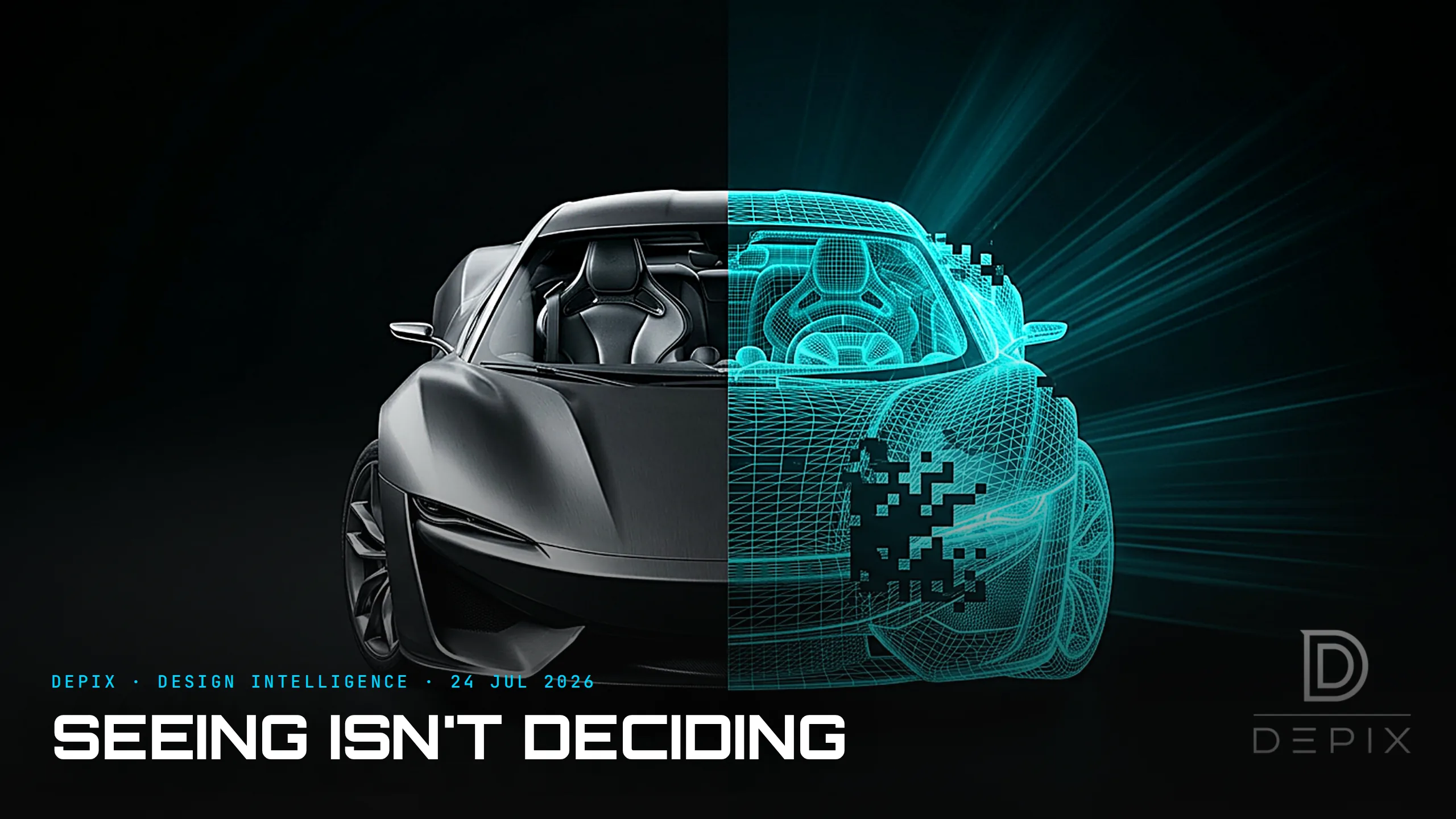
In cars this is starkest, because the geometry is unforgiving. The concept phase is where the car is decided - proportion, package, aero and cost locked while everything is still cheap to change. At concept freeze the main surfaces are defined and frozen; from that milestone the engineering departments build faithfully on top of a stance and a dash-to-axle ratio that no amount of downstream brilliance can undo. Get the platform wrong and you have got the whole car wrong. The most expensive tooling in the plant is a monument to a proportion someone approved in an afternoon.
So why is the highest-leverage phase the one we under-resource? Partly because it is cheap, and we instinctively equate spend with seriousness - a phase that costs little must matter little. Partly because its output is ambiguous: a sketch and a stance are hard to defend in a status meeting, whereas a tooling cost is a number you can point at. And partly because the discomfort of concept - committing to what the thing is before the evidence is in - is exactly what large organisations are built to avoid. It is easier to schedule a hundred downstream reviews than to hold one hard conviction early.
The correction is not more money on concept; it is more seriousness. Put your most senior designers there, not your juniors. Protect the calendar from the constant pressure to "get into the real work". Review proportion and stance with the same rigour you reserve for a launch gate. Treat the afternoon that sets the dash-to-axle ratio as the highest-stakes meeting in the entire programme, because it is.
None of this is an argument against execution - a brilliant concept badly executed still fails. It is an argument about where the leverage lives, and it lives upstream of almost everything you currently measure. The cheapest phase decides the most expensive outcomes. An organisation that understood that in its bones would look strange: thin at the end, deep at the start, spending its best hours on the decisions that are still free to make. Most of us have it exactly the other way round.
Sources:
- ●Tset - Why design-to-cost needs product costing software early (70-80% of cost locked in design)
- ●Design Society - A comparison of design decisions made early and late in development (86% of rework cost)
- ●ResearchGate - Predicting the whole-life cost of a product at the conceptual design stage
- ●Cambridge Design Science - Relative impact of early versus late design decisions
- ●Fictiv - The high cost of late-stage design changes (5 to 100x)
- ●Beyond Design - Why late design changes can cost millions
- ●Mountain Goat Software - The cost of change curve (Boehm)
- ●Magna - Vehicle development process and concept freeze
- ●Neural Concept - Mastering automotive product development
- ●Quality Magazine - Design now, save later: the hidden costs of late-stage changes
- ●DEPIX - Concept cars stopped lying (the concept phase is where the car is decided)